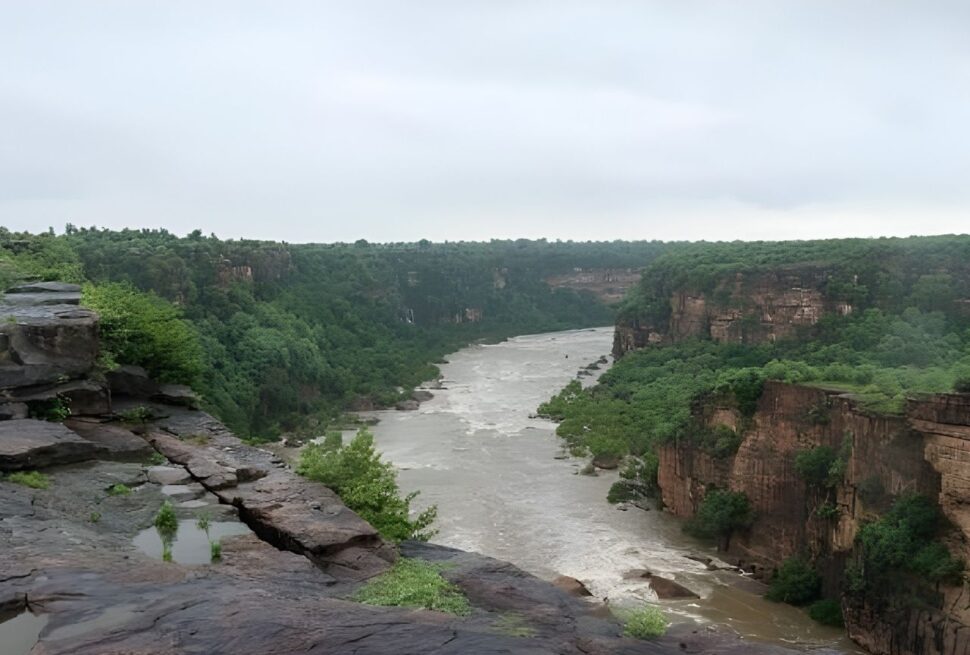

Madhya Pradesh wears its spiritual gravitas effortlessly. Forests that seem older than memory, rivers murmuring ancient hymns, and cities shaped by centuries of devotion together form a landscape where Shiva is not merely worshipped—He is felt. This is a land where faith has sedimented into stone and soil, where temples are not destinations but thresholds.
For pilgrims, culture seekers, or reflective wanderers, these five must visit Shiva temples and Jyotirlingas in Madhya Pradesh offer far more than ritual. They offer resonance—quiet, thunderous, and everything in between.
1. Mahakaleshwar Jyotirlinga — The Sovereign of Time
Ujjain does not wake up; it stirs. At its core stands Mahakaleshwar, one of the twelve Jyotirlingas and the most formidable Shaiva seat in the state. This is the only south-facing (Dakshinamurti) Jyotirlinga, a powerful emblem of Shiva as the arbiter of time, dissolution, and transcendence.
The pre-dawn Bhasma Aarti, conducted with sacred ash, is both unsettling and sublime—a reminder of impermanence delivered with ritual precision. Liberation, here, is not poetic abstraction. It is promise.
During Mahashivratri, Ujjain becomes incandescent. Night stretches endlessly, chants coil through alleyways, and devotion pulses like a living organism.
2. Omkareshwar Jyotirlinga — A Geography That Prays
Cradled by the Narmada, Omkareshwar rests on an island believed to mirror the sacred syllable ॐ. It is not just symbolically holy; its very contours seem intentional, as though the cosmos paused to leave a signature.
This Jyotirlinga is contemplative by nature. Pilgrims walk the Narmada Parikrama, step by deliberate step, allowing rhythm to replace urgency. Lamps drift on water at night, flickering like constellations set free.
Where Mahakaleshwar roars, Omkareshwar listens.
3. Pashupatinath Temple — The Multiplicity of the Divine
In Mandsaur, Shiva reveals Himself not as one, but as many. The Ashtamukhi (eight-faced) Shiva linga, carved from deep red stone, is a rare theological and artistic marvel. Each face conveys a different temperament—creation and annihilation, ferocity and grace, guardianship and mercy.
This temple resists casual viewing. It invites contemplation. To stand before it is to confront the uncomfortable truth that divinity, like life, is never singular.
Mahashivratri here is quieter, more introspective—an inward unfolding rather than a spectacle.
4. Bhojeshwar Temple — Where Time Was Interrupted
Bhojpur’s Bhojeshwar Temple feels like a sentence left unfinished by history. Commissioned by Raja Bhoj, it houses one of the largest monolithic Shiva lingas in India, sculpted from a single stone with audacious confidence.
The structure remains incomplete, yet profoundly complete in spirit. Its exposed stone, massive proportions, and unembellished strength create an atmosphere that is stark, honest, and deeply reverential.
Devotion here feels elemental—stripped of ornament, anchored in awe.
5. Chauragarh Temple — The Ascent of Belief
High above Pachmarhi, Chauragarh Temple demands effort before offering grace. The steep climb is lined with thousands of iron trishuls—each a testament to a wish carried, a vow honored, a prayer answered.
Pilgrims ascend with tridents balanced on shoulders, breath heavy, resolve heavier. The journey is the offering. The summit, merely its affirmation.
On Mahashivratri, the hill becomes a moving meditation—faith expressed through endurance.
A Thoughtful Pilgrimage Route
For those seeking coherence rather than haste, this sequence allows both body and spirit to acclimate:
- Ujjain – Mahakaleshwar Jyotirlinga
- Omkareshwar – Jyotirlinga and Narmada Parikrama
- Mandsaur – Pashupatinath Temple
- Bhojpur – Bhojeshwar Temple
- Pachmarhi – Chauragarh Temple
Each stop recalibrates the journey, deepening its cadence.
Why Madhya Pradesh Resonates with Shiva Devotees
Two Jyotirlingas within one state is rare. But what truly distinguishes Madhya Pradesh is texture—the way rivers, hills, forests, and folklore are inseparable from worship. Iconography varies wildly. Rituals feel lived-in, not staged. Traditions endure because they are practiced, not preserved behind glass.
This is devotion without varnish.
FAQs About Mahashivratri in Madhya Pradesh
Is Mahashivratri crowded in Madhya Pradesh?
Yes, especially at Jyotirlingas. Expect long queues—but also deep spiritual energy.
Is prior booking needed for Bhasma Aarti?
Absolutely. Online registration is essential and fills up fast.
Can first-time travelers manage the pilgrimage?
Yes, with planning. Start early, stay hydrated, and pace yourself.
Is Mahashivratri suitable for cultural travelers, not just devotees?
Definitely! The architecture, rituals, and atmosphere offer rich cultural immersion.
Closing Reflections
These five must visit Shiva temples and Jyotirlingas in Madhya Pradesh are not monuments to be checked off. They are encounters. Each one asks something of you—patience, humility, stamina, silence.
You arrive as a visitor.
You leave altered.
And somewhere between ash and riverlight, stone and sky, Shiva lingers—unavoidable, unmistakable, eternal.