The Thar Desert — Where the Real Rajasthan Begins
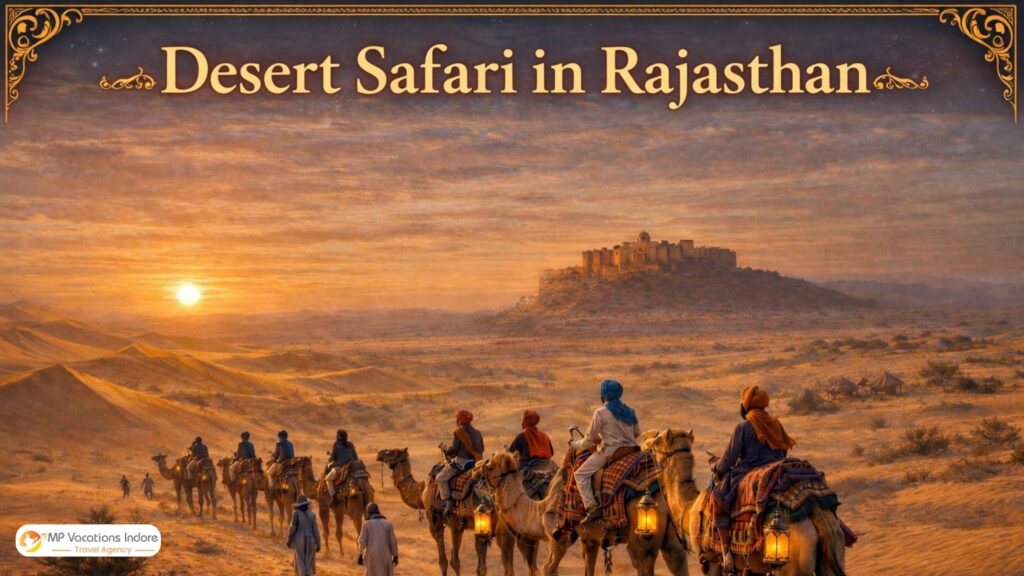
There is a moment on a desert safari in Rajasthan that changes everything. You are perched on the crest of a dune, the last light of the day pulling long shadows across the rippled sand below you, when the silence becomes absolute. No traffic, no crowds, no noise except the wind moving across the Thar. Behind you, the faint shape of Jaisalmer Fort dissolves into the golden haze. Ahead of you, the desert stretches to the horizon with nothing but more desert beyond.
The Thar Desert is one of the most populous deserts on earth — roughly 83 million people live within its boundaries — and yet it carries a profound sense of emptiness and vastness. The great sand dunes of Sam and Khuri, the ancient trading routes that once connected Jaisalmer to Persia and Central Asia, the camel caravans that made the fortunes of the city’s famously wealthy merchants — all of these histories settle into the landscape and give a desert safari here a weight and meaning that goes beyond adventure tourism.
A Jaisalmer desert safari, whether you spend one afternoon on camelback or three days traversing the dunes on a jeep trail, is consistently ranked by travellers as among the most memorable experiences of their time in India. This guide covers everything you need to plan it well: the best locations, the different safari types, what to expect from an overnight camp, when to go, and how to make the most of your time in the Thar.
For the complete Rajasthan trip context, read the Rajasthan Travel Guide 2026, and for everything else to do in Jaisalmer beyond the dunes, see the Jaisalmer Travel Guide.
Best Places for Desert Safari in Rajasthan
Not all of Rajasthan’s desert landscape is dune country — much of the Thar is flat scrubland, thorny acacia, and rocky plains. The great dunefield experiences are concentrated in specific areas around Jaisalmer. Here are the three locations that deliver the definitive Thar desert safari experience:
Jaisalmer — The Desert Capital
Jaisalmer is the undisputed base for any serious desert exploration. The city itself — a 12th-century sandstone fortress rising from the plains — is part of the experience before the dunes even appear. From here, all the major safari departure points are within 45 minutes by road, and the city’s infrastructure of experienced guides, reputable camp operators, and well-worn desert trails is unmatched anywhere else in Rajasthan.
Jaisalmer’s position in the heart of the Thar means that even the drives out of the city offer genuine desert scenery: villages of circular mud-and-thatch homes, herds of camels moving in single file along the roadside, and the skeletal outline of dry desert trees against the sky. The journey is part of the adventure.
Distance from Jaisalmer: Sam Sand Dunes: 42 km (50 mins) | Khuri: 48 km (1 hr) | Kanoi Dunes: 20 km (30 mins — less visited, worth it)
Sam Sand Dunes — The Classic Thar Experience
Sam is the most famous and most visited desert safari destination in Rajasthan, and the statistics make clear why: the dune crests here reach 30 metres, the sand is fine and wind-sculpted into perfect curves, and on a clear winter evening the sunset colours the entire dunefield shades of copper and rose that seem almost impossible to be real.
The trade-off for Sam’s fame is popularity. In peak season (November–February), the dune access road becomes clogged with jeeps, and the main dune ridge can feel like a theme park at sunset. The solution is simple: go with a camp operator who takes you to less-visited dunes two or three kilometres back from the main tourist cluster. A good guide will always know these routes.
Sam is also the location of the largest concentration of luxury desert camps in Rajasthan, ranging from beautifully appointed Swiss-tent operations to the truly extraordinary glamping experiences that have made Jaisalmer famous on the global luxury travel circuit.
Best For: First-time visitors, photography, luxury camping, sunset experiences
Khuri Sand Dunes — The Quiet Alternative
For travellers who find Sam too crowded, Khuri is the revelation. Located 48 km from Jaisalmer in a different direction, Khuri’s dunes are lower and wider than Sam’s but the atmosphere is incomparably more serene. The tiny village of Khuri, with its intricately decorated mud-walled homes and its tradition of hosting desert visitors in family-run guest camps, has maintained a genuinely local character that the commercialised Sam area has largely lost.
A Thar desert safari from Khuri feels more like genuine exploration: there are fewer visitors, the camel routes extend farther into undisturbed desert, and evenings in the village camps often include impromptu performances by local musicians who have been playing traditional Rajasthani instruments since childhood. Khuri is also one of the best spots in the region for birdwatching, with great Indian bustards, Tawny eagles, and sandgrouse regularly spotted on the desert fringe.
Best For: Peaceful atmosphere, authentic local experience, birdwatching, budget-conscious travellers
Types of Desert Safari in Rajasthan
| Safari Type | Duration | Best For | Approx. Cost (per person) |
| Camel Safari | 1–3 hours | Sunset experience, photography, first-timers | INR 300–800 (short) / INR 1,500–3,000 (half-day) |
| Jeep Safari | 2–5 hours | Covering distance, dune-bashing, groups | INR 1,500–3,500 (shared) / INR 4,000–7,000 (private) |
| Overnight Camp | Afternoon to morning | Full desert experience, stargazing, folk culture | INR 2,500–6,000 (standard) / INR 8,000–25,000+ (luxury) |
| Multi-Day Camel Trek | 2–5 days | Deep desert immersion, off-the-beaten-track | INR 3,500–7,000 per day all-inclusive |
Camel Safari — The Timeless Classic
A camel safari is the way travellers have crossed the Thar Desert for more than a thousand years, and riding into the dunes on camelback remains the most iconic desert safari in Rajasthan experience available. The pace is slow, the vantage point is high, and the sensation of the dune sand shifting silently under the animal’s padded feet is unlike anything else in travel.
Short camel rides of one to two hours — departing from the dune base at around 4 PM to catch the sunset from a high crest — are perfect for most first-time visitors. The camel handlers are invariably expert at finding the best dune ridgelines and the ideal sunset positioning. For a deeper experience, half-day and full-day camel safaris travel considerably farther into the desert, often visiting semi-nomadic herder communities, ancient desert shrines, and fossilised seabed landscapes — reminders that the Thar was once the floor of an ocean.
For a detailed booking guide and what to expect, see our Camel Safari Experience Guide.
Camel Comfort Tip: Request a padded saddle cover and bring a small cushion if you plan a ride longer than 90 minutes. Take breaks every 30–45 minutes to stretch — camel riding uses muscles most people have never used before.
Jeep Safari — Cover the Desert at Speed
A jeep safari trades the romance of camelback for range and speed — and for some desert landscapes, it is the better option. The flat, stony expanses between the major dune systems that make poor camel territory are perfect for a jeep: you cover 60–80 km of desert terrain in a half-day, reaching remote fossilised forest sites, abandoned medieval villages, and distant dune ridges that camel safaris never reach.
Jeep safaris are also the best option for travellers with limited mobility, families with young children, or anyone who wants to maximise desert coverage in a short time window. Dune bashing — driving up steep dune faces at speed and sliding down in a controlled skid — is an optional addition that most groups find thrillingly, terrifyingly good fun.
Many operators combine the two: a jeep transfer deep into the desert, then a camel ride for the final approach to the sunset dunes. This hybrid option is growing in popularity and highly recommended.
Overnight Desert Camping — The Full Experience
The overnight camp is where the desert safari in Rajasthan becomes a genuinely transformative experience rather than a tourism activity. Arriving at the dunes in the late afternoon, watching the light show of the sunset, eating dinner under the open sky, lying in a camp bed listening to total silence while the stars wheel overhead — these are the moments travellers describe when they talk about their Rajasthan trips years later.
Camps range from the basic (a tent, a camp bed, a shared bathroom block, and a communal fire) to the extraordinary (private luxury tents with ensuite marble bathrooms, butler service, gourmet dining, and infinity plunge pools overlooking the dunes). There is a genuine market at every level, and the experience at a well-run budget camp can be just as memorable as a night in a five-star glamping resort — it depends entirely on the operator.
For vetted recommendations across budget tiers, read our Best Desert Camps in Jaisalmer guide, which covers the top operators at every price point.
What to Expect at a Desert Camp
An overnight desert camp in the Thar follows a rhythm that has been refined over decades of Rajasthani hospitality. Here is how a typical evening unfolds:
Arrival & Sunset Camel Ride
Most guests arrive at camp between 3:30 and 4:30 PM — early enough to check in, change, and head out on camels for the sunset. The camp’s guides lead guests to the best nearby dune crest, positioning everyone facing west as the sun descends. The golden hour in the desert is extraordinary: the low light rakes across the sand at a near-horizontal angle, casting every ripple and dune into sharp relief, and the sky transitions through gold, orange, deep rose, and finally a luminous purple as darkness arrives.
Photography Tip: The 20 minutes after sunset — the ‘blue hour’ — produce some of the most beautiful desert photographs. Stay on the dunes rather than heading straight back to camp after the sun disappears.
Folk Music & Traditional Dance
The evening entertainment at a desert camp is one of the cultural highlights of any Rajasthan trip. The musicians who perform at the best camps come from hereditary musical families — the Manganiyar and Langas communities, whose musical traditions have been passed down through generations and who perform at weddings, festivals, and courts across the region.
The instruments are unlike anything in Western music: the ravanahatha, a two-stringed bowed instrument said to be one of the ancestors of the violin; the khartal, wooden clappers that produce an intricate rhythm; the morchang, a jaw harp; and the khamaicha, a round-bodied, skin-topped lute. Performances typically last 60–90 minutes, interspersed with ghoomar (the swirling women’s folk dance of Rajasthan) and kalbelia (the sinuous, hypnotic dance of the snake-charmer communities, now a UNESCO Intangible Cultural Heritage).
Tip: Ask your camp host in advance to arrange a Manganiyar or Langa musician specifically — the quality of musical performance varies significantly between camps, and these hereditary musicians are in a different class to generic folk performers.
Desert Dinner Under the Stars
Dinner at a desert camp is eaten in the open, seated on low cushions and carpets around a crackling fire. At better-run operations, the food is genuinely good: dal baati churma (the slow-cooked Rajasthani lentil and wheat dumpling combination), ker sangri (the desert berry and dried bean dish unique to the Thar region), rotis cooked on an open fire, and bajra khichdi (pearl millet porridge) — all the dishes that sustained desert communities through centuries of sparse living. Cold desert nights call for warming food, and the Rajasthani kitchen delivers.
After dinner, the fire dies to embers, the musicians play a final set, and the desert slowly claims the evening. Most guests discover, to their surprise, that they are asleep by 9:30 PM.
Stargazing — The Thar at Midnight
The Thar Desert is one of India’s — and indeed the world’s — finest stargazing locations. With minimal light pollution across hundreds of kilometres in every direction, the night sky on a clear desert night is a revelation: the Milky Way visible as a dense cloud of stars, planets bright enough to cast faint shadows, and shooting stars regular enough to seem almost casual. Many camp operators now offer basic astronomy programmes with telescopes and knowledgeable guides who can identify constellations, planets, and deep-sky objects.
The pre-dawn hours, typically around 4:30–5:30 AM, are the best for stargazing as the Milky Way core rises in the south. They are also perfect for catching the sunrise from the dunes — a slower, softer, and often equally beautiful experience to the sunset the evening before.
Best Time for Desert Safari in Rajasthan
| Season | Months | Desert Temp (Day) | Desert Temp (Night) | Verdict |
| Peak Season | Oct – Feb | 18–28°C | 5–12°C | Ideal. Perfect conditions for camel rides and camping. Pack warm layers for nights. |
| Festival Season | Nov & Feb | 18–25°C | 7–12°C | Pushkar Camel Fair (Nov) and Jaisalmer Desert Festival (Feb) — the very best time. |
| Shoulder | Mar – Apr | 28–38°C | 15–20°C | Good. Warm days but still manageable. Fewer crowds. March light is beautiful. |
| Summer | May – Jun | 42–50°C | 28–35°C | Avoid. Extreme heat makes outdoor activities dangerous. Safari camps often close. |
| Monsoon | Jul – Sep | 30–38°C | 22–28°C | Possible. Dunes look spectacular in green fringe. Some roads may be affected. |
The absolute prime window for a Thar desert safari is November to February. The Jaisalmer Desert Festival in February (held on the full moon closest to Shivratri) is the single best reason to time your trip precisely: camel racing, turban-tying competitions, folk performances, and the surreal beauty of the full moon rising over the dunes.
Desert Safari Travel Tips
Booking & Planning
- Book camps directly or through verified operators: Avoid booking through random touts at Jaisalmer Fort. Use established camp operators with verifiable reviews on booking platforms. The price difference between a tout’s recommendation and a directly booked camp is often INR 500–1,000 — not worth the risk.
- Book in advance in peak season: December and January fill up weeks in advance for quality camps. February (Desert Festival) sells out months ahead. Always pre-book rather than arriving hoping for walk-in availability.
- Specify your preference: When booking, clearly state whether you want a camel ride, jeep safari, or both. Specify whether you want heritage/folk music entertainment. Ask about the type of bathroom facilities — this varies enormously between camps.
What to Pack for a Desert Safari
- Warm layers for the evening and night — desert temperatures drop sharply after sunset, even in October
- A shawl or light blanket for camel riding in the evening
- Sunscreen (SPF 50+) and a wide-brimmed hat or turban — the desert sun is unforgiving
- Closed shoes or ankle boots — sand gets into sandals quickly
- A headlamp or torch for navigating the camp at night
- A power bank — camp charging facilities are limited
- Cash — most desert camps do not accept cards
- A scarf for face protection during dusty jeep rides
Health & Safety
- Hydration: Drink at least 3 litres of water daily in the desert, even in winter when you may not feel thirsty. Dehydration sets in quickly in low-humidity environments.
- Sun protection: Apply sunscreen 30 minutes before going outdoors and reapply every two hours. Wear full-sleeved clothing for long camel rides to avoid sunburn.
- Camel safety: Always mount and dismount camels with the handler’s assistance. Hold the saddle horn firmly when the camel stands or sits — the rocking motion is dramatic and unexpected the first time.
- Stomach: Desert camp food is prepared carefully by experienced cooks, but carry basic stomach medication as a precaution when travelling in Rajasthan generally.
Responsible Desert Tourism
The Thar Desert ecosystem is fragile, and responsible tourism choices protect it for future visitors and for the communities that live within it.
- Choose camp operators who use solar power rather than diesel generators
- Carry all rubbish back from the dunes — leave nothing behind
- Do not disturb desert wildlife, particularly the nocturnal animals active near camps at night
- Tip local musicians and camel handlers directly and generously — they are often the least financially rewarded in the safari chain
- Avoid single-use plastic water bottles — bring a reusable bottle and ask your camp to fill it
Why Desert Safari Is Rajasthan’s Most Iconic Experience
Of all the extraordinary things to do in Rajasthan — and there are many — the desert safari endures as the single experience that most travellers name when asked what defined their trip. It is not the most historically significant experience the state offers (Chittorgarh Fort carries centuries more history than a sand dune). It is not the most architecturally breathtaking (the Sheesh Mahal at Amber Fort is objectively more impressive than a tent camp). But it is the experience that removes you most completely from your ordinary life.
There is no traffic. There is no phone signal. There is no schedule. There is the sand, the silence, the stars, the music, and the fire. The Thar Desert has been doing this to travellers for centuries — drawing them in with its apparent emptiness and then filling them, quietly and completely, with something that is hard to articulate but impossible to forget.
Whether you have an afternoon or three days, whether you travel by camel or jeep or both, whether you sleep in a basic tent or a luxury palace on sand — a desert safari in Rajasthan belongs on your itinerary. It belongs at the end, as a send-off. It belongs in the middle, as a reset. It belongs at the beginning, so that everything that follows is coloured by the Thar.
Plan your complete desert adventure with the Rajasthan Travel Guide 2026. For everything to do in Jaisalmer beyond the dunes, read the Jaisalmer Travel Guide. Ready to book? Explore our Best Desert Camps in Jaisalmer guide for vetted recommendations across every budget, and the Camel Safari Experience Guide for first-timer advice.