Have you ever felt the urge to do something that feeds your soul and challenges your body at the same time? Something that leaves you changed — not just tired?
If yes, the Panch Kedar Trek is calling your name.
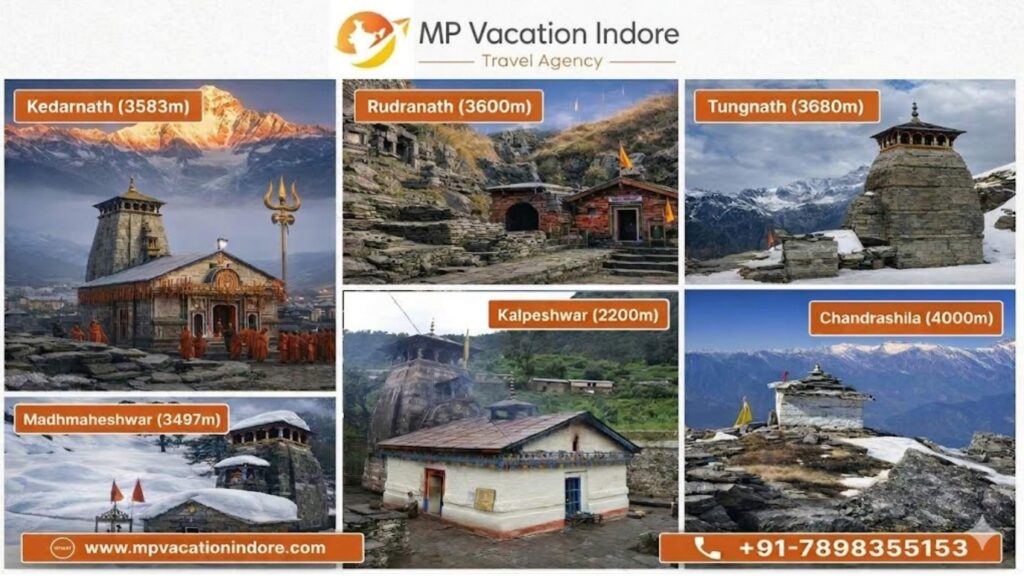
Hidden deep inside the Garhwal Himalayas of Uttarakhand, the Panch Kedar Yatra is a pilgrimage to five ancient temples dedicated to Lord Shiva — Kedarnath, Tungnath, Rudranath, Madhmaheshwar, and Kalpeshwar — each nestled at breathtaking elevations, each wrapped in mythology older than memory. And for those who want to go the extra mile (literally), there’s the Chandrashila Top, a summit that will leave you speechless.
This isn’t just a trek. It’s a journey through rhododendron forests, alpine meadows, moraine ridges, and Himalayan skylines that no photograph can do justice to. Whether you’re a devout pilgrim or an adventure traveller, this guide will tell you everything — the route, the best time to go, how to get there, what it costs, and the insider tips no generic blog will give you.
Let’s begin.
Why the Panch Kedar Yatra is Unlike Any Other Pilgrimage in India
Most Indian pilgrimages get you to a temple. The Panch Kedar Yatra gets you to five — across some of the most spectacular terrain on earth.
According to Hindu mythology, after the battle of Kurukshetra, the Pandavas sought Lord Shiva’s forgiveness for the sin of killing their own kin. Lord Shiva, unwilling to forgive them easily, disguised himself as a bull in the Garhwal hills. As the Pandavas pursued him, the bull sank into the earth — and different body parts appeared at five different locations. The hump at Kedarnath, the arms at Tungnath, the face at Rudranath, the navel at Madhmaheshwar, and the matted hair (jata) at Kalpeshwar. The Pandavas built temples at each of these sites, and together they came to be known as Panch Kedar.
What makes this circuit special is that it demands something of you. You don’t just arrive by car and receive blessings — you earn them. Every step up to Kedarnath, every dew-soaked morning at Tungnath, every misty ridge on the way to Rudranath is a reminder of why this yatra has drawn seekers for centuries.
Best Time to Visit Panch Kedar
The temples open in May (usually after Akshaya Tritiya) and close in November (around Diwali), following the rhythm of the Himalayan seasons. Kalpeshwar is the only exception — it stays open throughout the year.
| Season | Months | Weather | Crowd Level | Recommended? |
|---|---|---|---|---|
| Pre-Monsoon | May – June | 10°C to 20°C days, cold nights | Moderate | ✅ Best |
| Monsoon | July – August | Heavy rain, slippery trails | Low | ❌ Avoid |
| Post-Monsoon | Sept – Oct | Clear skies, 5°C to 15°C | Moderate | ✅ Best |
| Winter | Nov – April | Heavy snow, temples closed | Very low | ❌ Avoid |
My honest recommendation? Go in September or October. The monsoon has cleared, the skies are crystal, and you’ll get views of Nanda Devi, Trishul, and Chaukhamba that look almost unreal. May–June is also excellent if you want to catch the rhododendrons in bloom and the temples freshly reopened for the season.
Avoid July–August — landslides and waterlogged trails make the yatra genuinely risky.
How to Reach the Panch Kedar Region
✈ By Air
The nearest airport is Jolly Grant Airport, Dehradun — about 15 km from Rishikesh. Airlines including Air India and IndiGo operate flights from Delhi. From Rishikesh, jeeps and buses take you to the trek base camps. If flying from Bhopal or Central India, a connection via Delhi is your best bet.
🚂 By Train
Haridwar and Rishikesh are the main rail gateways. Haridwar Junction is very well connected — trains from Delhi, Mumbai, Indore, Bhopal, and other major cities stop here regularly. From Haridwar, shared taxis to Guptkashi, Ukhimath, or Joshimath cost approximately ₹600–₹900 per seat.
🚌 By Road
From Delhi: ~8 hours by road to Rishikesh via NH-58. From Rishikesh, proceed to Guptkashi (Kedarnath base) or Joshimath (Kalpeshwar/Rudranath area) depending on your itinerary order. State buses are budget-friendly; private cabs offer more comfort. Expect to pay ₹2,500–₹4,000 for a private one-way cab from Rishikesh to Guptkashi.
The Six Sacred Stops: A Temple-by-Temple Guide
1. Kedarnath (3,583 m) — Where the Hump of Shiva Appeared
Kedarnath is the crown jewel of the Panch Kedar circuit and one of the twelve Jyotirlingas of Lord Shiva. The trek begins at Gaurikund and covers approximately 16–19 km of uphill trail. It’s moderate to challenging, and on a clear day, the backdrop of the snow-draped Kedarnath range will take your breath away in more ways than one.
The temple itself is ancient — believed to have been built by the Pandavas and later revived by Adi Shankaracharya. The enormous Bhim Sheela behind the temple, which shielded the shrine during the tragic 2013 cloudburst, is a sight that stays with you long after you leave.
Trek from: Gaurikund | Distance: ~16 km one way | Difficulty: Moderate–Challenging
2. Tungnath (3,680 m) — The Highest Shiva Temple in the World
Perched above Chopta — often called the Mini Switzerland of India — Tungnath is the highest Shiva temple in the world, where Lord Shiva’s arms are said to have appeared. The 3.5 km trek from Chopta passes through lush meadows and dense forests, opening up to panoramic Himalayan views that stop trekkers in their tracks every few hundred metres.
From Tungnath, the additional 1.5 km trek to Chandrashila Top (4,090 m) offers a 360° view of Nanda Devi, Trishul, Chaukhamba, and Kedar Dome. On a clear morning, the silence and the sky feel infinite. This is one of the most accessible high-altitude summits in India — don’t miss it.
Trek from: Chopta | Distance: ~3.5 km to Tungnath + 1.5 km to Chandrashila | Difficulty: Easy–Moderate
3. Rudranath (2,286 m) — Where the Face of Shiva Emerged
Rudranath is arguably the most remote and mystically atmospheric of the five temples. Shiva is worshipped here as Neelkanth Mahadev, in the form of his face — carved not by human hands but by the mountain itself. The trail from Sagar Village winds through alpine meadows, dense rhododendron and oak forests, and past waterfalls that appear out of nowhere.
It’s a long trek (~19 km), and the isolation is complete. That’s exactly the point. When you arrive, there’s a stillness here that is difficult to describe.
Trek from: Sagar Village | Distance: ~19 km one way | Difficulty: Moderate–Challenging
4. Madhmaheshwar (3,289 m) — The Navel of the Universe
Set in a deep green valley cradled by Chaukhamba, Kedarnath, and Neelkantha peaks, Madhmaheshwar is where Lord Shiva’s navel (the madhya or middle) appeared. The temple sits in one of the most serene natural amphitheatres in the entire Himalayan range. Even the trek from Ransi is a feast — butterflies, mountain goats, wildflowers, and a solitude that feels earned.
The small side trek to Budha Madhmaheshwar for a sunrise view is absolutely worth the extra effort.
Trek from: Ransi (via Ukhimath) | Distance: ~19 km one way | Difficulty: Moderate
5. Kalpeshwar (2,200 m) — Lord Shiva’s Matted Hair in Urgam Valley
The final and most accessible of the Panch Kedar temples, Kalpeshwar is nestled in the lush Urgam Valley — known for its apple orchards, terraced fields, and a gentler pace of mountain life. The temple sits inside a natural rock cave where Lord Shiva’s jata (matted hair) is worshipped. It’s the only Panch Kedar shrine open year-round.
The 2 km walk from Urgam Village is easy and peaceful — a soulful full stop to one of the greatest journeys you’ll ever undertake.
Trek from: Urgam Village (accessible from Helang, near Joshimath) | Distance: ~2 km one way | Difficulty: Easy
6. Chandrashila Top (4,090 m) — The Summit Above Tungnath
Strictly speaking, Chandrashila is not a Kedar temple — it’s a peak. But no Panch Kedar yatra guide is complete without it. Perched just 1.5 km above Tungnath, the Chandrashila summit is where Lord Rama is believed to have meditated after defeating Ravana. On clear days, you can see a panoramic arc of the Himalayas from Nanda Devi in the east to Bandarpunch in the west.
For first-timers to high altitude, this is a dream summit — accessible, stunning, and deeply rewarding.
Read Also – Madhya Pradesh Jyotirlinga Tour – 4 Days Spiritual Pilgrimage to Ujjain, Omkareshwar & Maheshwar
Things to Do on the Panch Kedar Yatra
- Attend the early morning abhishek puja at Kedarnath — arrive before 5 AM to skip the crowds
- Summit Chandrashila at dawn for a golden hour over the Himalayas
- Walk through the magical rhododendron forests of Rudranath in May–June
- Explore the terraced apple orchards and Garhwali homes of Urgam Valley
- Spot Himalayan monal (Uttarakhand’s state bird), musk deer, and snow leopard tracks along forest trails
- Stop at the Devprayag sangam (confluence of Bhagirathi and Alaknanda) on your drive in
- Savour simple but wholesome pahadi dal, rice, and aloo sabzi at dhabas along the trail — surprisingly nourishing at altitude
- Visit the Omkareshwar Temple at Ukhimath, where the idols of Kedarnath and Madhmaheshwar rest during winter
- Catch Ganga Aarti at Rishikesh or Haridwar at the start or end of your journey
Tour Package & Budget Breakdown
| Package Type | Duration | Cost per person (₹) | Includes |
|---|---|---|---|
| Budget (backpacker) | 12–14 days | ₹18,000–₹25,000 | Shared accommodation, basic meals, local guide |
| Mid-Range | 12–14 days | ₹30,000–₹45,000 | Guesthouse/home stays, all meals, guide, transport |
| Comfort / Group Tour | 14–16 days | ₹50,000–₹75,000 | Hotels at base camps, full meals, guide, transfer, porter |
Note: Helicopter service to Kedarnath costs approximately ₹4,500–₹7,500 one-way from Guptkashi/Phata and is worth booking in advance during peak season for those with limited mobility.
Travel Tips for Panch Kedar Yatra
✓ Acclimatise before you ascend — spend a day in Rishikesh or Guptkashi before your first trek
✓ Book Kedarnath darshan online via the official Uttarakhand government portal — walk-in queues can be brutal in May–June
✓ Carry cash — ATMs are scarce beyond Guptkashi and Joshimath; stock up before you enter the hills
✓ Pack layers, not bulk — temperatures swing 15°C between day and night; a thermal, fleece, and windproof jacket cover all bases
✓ Start every trek early — aim to be on trail before 6 AM; afternoon weather in the Himalayas can change fast
✓ Hire a local guide for Rudranath — the trail is remote and poorly marked in places; a guide from Sagar Village costs ₹800–₹1,200/day and is worth every rupee
✓ Phone connectivity — BSNL works best in the high-altitude sections; Airtel/Jio coverage is patchy above base camps ✓ Respect temple customs — remove footwear, dress modestly, and avoid photography inside the sanctum
Sample 14-Day Panch Kedar Itinerary
| Day | Route | Highlights |
|---|---|---|
| 1 | Rishikesh/Haridwar – Guptkashi | Devprayag, Rudraprayag confluence |
| 2 | Guptkashi – Gaurikund – Kedarnath | Kedarnath darshan, Bhim Sheela |
| 3 | Kedarnath darshan + return to Guptkashi | Early morning puja |
| 4 | Guptkashi – Chopta | Scenic mountain drive |
| 5 | Chopta – Tungnath – Chandrashila | Summit sunrise, highest Shiva temple |
| 6 | Chopta – Mandal – Sagar Village | Drive + acclimatisation |
| 7 | Sagar – Rudranath | Remote forest trail, alpine meadows |
| 8 | Rudranath darshan + return to Sagar | Neelkanth Mahadev |
| 9 | Sagar – Ukhimath – Ransi | Omkareshwar Temple visit |
| 10 | Ransi – Gaundhar | Himalayan flora & fauna |
| 11 | Gaundhar – Madhmaheshwar | Valley of peaks, serene summit |
| 12 | Madhmaheshwar – Ransi – Ukhimath | Return trek |
| 13 | Ukhimath – Helang – Urgam – Kalpeshwar | Final Kedar, cave temple |
| 14 | Urgam – Joshimath – Rishikesh | Completion of Yatra, Ganga Aarti |
Frequently Asked Questions (FAQs)
What is the best time to do the Panch Kedar Trek? May–June and September–October are ideal. The weather is clear, trails are accessible, and temperatures are manageable. Avoid July–August due to monsoon landslides. Post-monsoon September offers the clearest Himalayan views of the year.
How many days are required for the complete Panch Kedar Yatra? A minimum of 12–14 days is needed to cover all five temples comfortably. Rushing the circuit risks altitude sickness and missed darshans. If time is short, Tungnath + Chandrashila can be done as a 2–3 day standalone trek from Chopta.
Is the Panch Kedar Trek suitable for beginners? Some temples like Kalpeshwar and Tungnath are accessible for fit beginners. Kedarnath, Rudranath, and Madhmaheshwar require moderate fitness. You should be able to walk 10 km continuously before attempting the circuit. No technical climbing skills are needed.
What is the budget for a Panch Kedar trip from Indore or Bhopal? Total budget including transport, accommodation, meals, and local guide typically ranges from ₹25,000–₹50,000 per person for 14 days, depending on package type. Budget travellers using shared transport and basic guesthouses can do it for less.
Is Panch Kedar safe for solo female travellers? Yes, with standard precautions. The trails are well-travelled during season, and Garhwali communities are known for their hospitality and respect. Joining a group tour or hiring a local guide is recommended for Rudranath, which is remote and less-frequented.
When do the Panch Kedar temples open and close? Kedarnath, Tungnath, Rudranath, and Madhmaheshwar open in May (Akshaya Tritiya) and close in October–November before Diwali. Kalpeshwar is the only temple open throughout the year, making it accessible even in winter.
Which is the hardest temple to reach in the Panch Kedar circuit? Rudranath is considered the most challenging due to its long trail (19 km one way), remote location, and less-developed facilities. Madhmaheshwar is close behind. Both require good fitness and ideally a local guide.
Ready to begin your Panch Kedar Yatra? Explore our curated Uttarakhand pilgrimage packages with MP Vacation Indore — specially designed for Indian travellers. Enjoy comfortable stays, experienced guides, and thoughtfully planned itineraries that honour both the spiritual and adventurous spirit of this extraordinary journey.