Why 7 Days Is the Perfect Length for Rajasthan
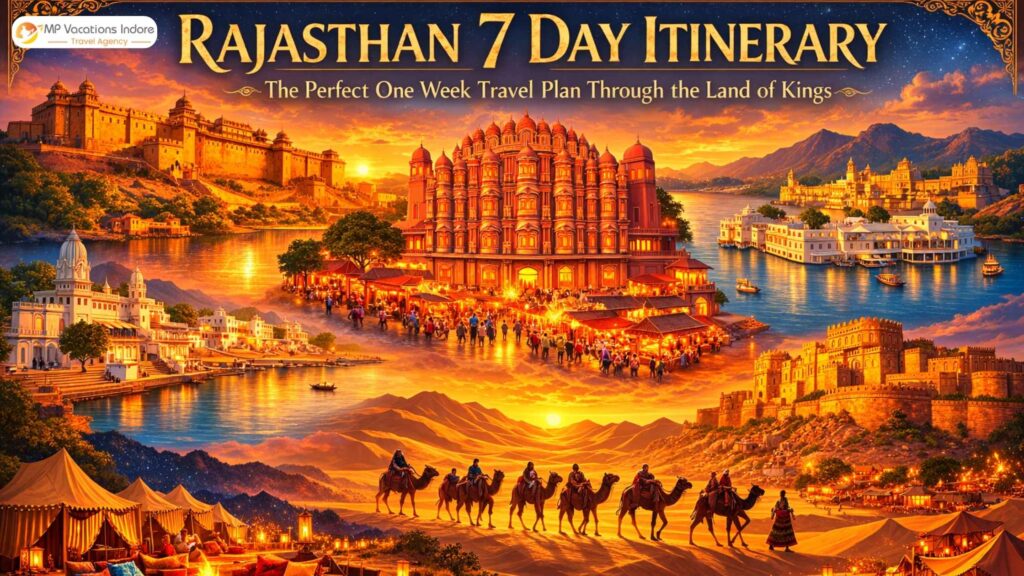
Seven days in Rajasthan is the Goldilocks option — not so short that you are sprinting between forts, not so long that you exhaust the highlights before you have had time to fall in love with them. One week gives you enough time to experience four very different destinations, each with its own personality, its own colour palette, its own flavour of Rajasthani life.
In seven days you can stand on the ramparts of Amber Fort as the sun rises over the Aravalli Hills, wander the sacred ghats of Pushkar at dawn, watch the sun melt into Lake Pichola from a rooftop in Udaipur, and fall asleep beneath a sky full of stars in a tent camp on the Sam Sand Dunes outside Jaisalmer. That is a week well spent by any measure.
This Rajasthan 7 Day Itinerary follows the classic west-arc route — Jaipur to Pushkar to Udaipur to Jaisalmer — combining Rajasthan’s most iconic Jaipur tourist attractions with the romance of Udaipur and the raw desert magic of Jaisalmer. It works equally well as a self-drive road trip, a private car hire journey, or a combination of trains and local taxis.
For broader trip planning across the state, read our complete Rajasthan Travel Guide 2026 — the definitive resource for first-time and returning visitors alike.
Your 7 Day Rajasthan Trip at a Glance
| Day | Location | Highlights |
| Day 1–2 | Jaipur | Amber Fort, Hawa Mahal, City Palace, Jantar Mantar, bazaars |
| Day 3 | Pushkar | Pushkar Lake, Brahma Temple, ghats, bazaar stroll |
| Day 4–5 | Udaipur | Lake Pichola boat ride, City Palace, Jag Mandir, Jag Mandir |
| Day 6–7 | Jaisalmer | Jaisalmer Fort, Patwon Ki Haveli, Sam Sand Dunes, camel safari |
Total Distance: Jaipur → Pushkar: 145 km (2.5 hrs) | Pushkar → Udaipur: 280 km (5 hrs) | Udaipur → Jaisalmer: 460 km (7 hrs) or fly (1 hr 10 mins)
DAYS 1 & 2 Jaipur — The Pink City
Your Rajasthan adventure begins in Jaipur — the state capital, a UNESCO World Heritage City, and one of India’s most spectacular urban destinations. Give yourself two full days here and you will barely scratch the surface. For a complete guide to the city, read our dedicated Jaipur Travel Guide.
Day 1 — Forts, Palaces & the Old City
◆ Morning
Begin early — ideally arriving at Amber Fort by 7:30 AM before the heat and the crowds build. The approach to Amber along the narrow hillside road, with the fort’s ochre walls reflected in Maota Lake below, is one of the great arrival moments in Indian travel. Inside, the Sheesh Mahal (Hall of Mirrors) is the unmissable centrepiece: a room encrusted with thousands of tiny convex mirrors that scatter light like a private constellation. Spend at least 90 minutes exploring the fort, then take a jeep back down and stop briefly at Jal Mahal — the Water Palace appearing to float in Man Sagar Lake — for photographs on the drive back to the city.
⏱ Time: Amber Fort: 90–120 mins | Jal Mahal stop: 15 mins
◆ Afternoon
After lunch in the old city — try the legendary pyaaz kachori (spiced onion pastry) at Rawat Mishthan Bhandar — head to the adjacent City Palace and Jantar Mantar. Buy the combined ticket, which covers both sites. The City Palace museum houses royal costumes, weaponry, and the enormous silver urns used by the Maharaja for carrying Ganges water on overseas travels. The Jantar Mantar, Jai Singh II’s remarkable stone observatory, looks abstract until a guide explains the instruments — book one at the entrance, it transforms the visit entirely.
Tip: The combined City Palace & Jantar Mantar ticket (approx. INR 700 for foreigners) is excellent value. Budget 2.5 hours for both.
◆ Evening
Stroll from Jantar Mantar to Hawa Mahal — just five minutes’ walk. The five-storey latticed facade is best photographed in the early evening when it glows terracotta in the descending sun. Then lose yourself in Johari Bazaar, the old city’s glittering jewellery quarter, browsing gem dealers and gold workshops before dinner on a rooftop overlooking the illuminated Palace of Winds.
Day 2 — Hilltops, Markets & Local Life
◆ Morning
Rise early and drive up the Aravalli ridge to Nahargarh Fort for the finest panoramic views over the Pink City. The fort’s interior — particularly the Madhavendra Bhawan, with its series of identical suites built for the Maharaja and his nine queens — is fascinating. From Nahargarh, a short drive brings you to Jaigarh Fort, connected by a walled pathway along the ridge. Jaigarh houses the Jaivana, claimed to be the world’s largest wheeled cannon, and offers commanding views of Amber Fort spread across the hillside below.
⏱ Time: Nahargarh Fort: 75 mins | Jaigarh Fort: 60 mins
◆ Afternoon
Spend the afternoon exploring the old city on foot. Visit the Albert Hall Museum (worth 60–90 minutes for its Rajput miniature paintings and curious collection of Egyptian mummies), then work your way through the colour-coded bazaars: Bapu Bazaar for block-print fabrics and embroidered leather shoes, Nehru Bazaar for blue pottery and marble souvenirs.
◆ Evening
Book the Amber Fort sound and light show for a dramatic close to your Jaipur chapter, or head to Chokhi Dhani — a purpose-built Rajasthani village experience with folk dance performances, camel rides, and a traditional thali dinner.
Where to Stay in Jaipur
| Budget | Hotel | Why We Love It |
| Budget | Zostel Jaipur | Sociable hostel in the old city, rooftop hangout, perfectly located for bazaar exploration |
| Mid-Range | Dera Rawatsar Heritage Hotel | Beautifully restored haveli in the old city with carved courtyards and hand-painted walls |
| Luxury | Rambagh Palace (Taj) | The former royal residence of the Maharaja — polo grounds, spa, formal gardens, and impeccable service |
Travel: Jaipur → Pushkar: 145 km | approx. 2.5 hours by road via NH-58. Hire a private car or take a shared taxi from Sindhi Camp bus stand.
DAY 3 Pushkar — Sacred Lake Town
Pushkar arrives as a surprise. After the scale and noise of Jaipur, this small town of whitewashed temples, sacred ghats, and incense-threaded lanes feels like stepping into another world entirely — quieter, more contemplative, and genuinely unlike anywhere else in Rajasthan. Your Rajasthan travel itinerary benefits enormously from including it: the contrast to Jaipur is precisely the point.
◆ Morning
Arrive in Pushkar by 9–10 AM and check into your guesthouse. Then head immediately to Pushkar Lake and its 52 ghats. The atmosphere is most vivid in the morning, when pilgrims perform puja (prayer ceremonies), priests chant from the water’s edge, and flower petals float across the still surface. Simply walking slowly around the lake perimeter, pausing at each ghat, takes 45–60 minutes and is one of the most atmospheric experiences of any Rajasthan trip plan.
From the lake, it is a short walk to the Brahma Temple — one of only a handful of temples in the world dedicated to the Hindu creator god Brahma, and a deeply sacred site for Hindu pilgrims. Non-Hindus are welcome but must remove shoes and are asked to move respectfully.
Etiquette: A brahmin priest may approach you at the ghats and offer a ‘Pushkar blessing’ with flowers. Participating is optional — if you accept, a donation is expected. Be aware of the common ‘Pushkar passport’ scam where visitors are pressured into large donations.
◆ Afternoon & Evening
Pushkar’s bazaar is compact but full of character: hand-blocked fabrics, tribal silver jewellery, and an unusually good selection of world music. Many visitors spend a pleasant afternoon browsing, ducking into rooftop cafes for lassi and live music, and watching the light on the Aravalli Hills slowly deepen into gold. For the adventurous, the steep climb to Savitri Temple on the hilltop above the town rewards with sweeping panoramic views — allow 45 minutes for the ascent.
Pushkar has an unexpectedly good restaurant scene for a town its size, with rooftop cafes serving everything from Rajasthani thalis to Israeli breakfasts. The town is predominantly vegetarian (meat and alcohol are banned around the sacred lake), which makes it a genuine contrast to the rest of the itinerary.
Where to Stay in Pushkar
| Budget | Hotel | Why We Love It |
| Budget | Inn Seventh Heaven | Beautiful rooftop haveli guesthouse with organic breakfasts and an excellent library |
| Mid-Range | Hotel Pushkar Palace | Lakeside heritage hotel with ghats directly below the terrace — extraordinary sunset views |
| Luxury | The Westin Pushkar | Resort-style luxury with spa and pool, 10 minutes from the lake |
Travel: Pushkar → Udaipur: 280 km | approx. 5 hours by road. Depart by 8 AM to arrive comfortably for an afternoon City Palace visit. Private car recommended.
DAYS 4 & 5 Udaipur — City of Lakes
Udaipur is where the Rajasthan 7 Day Itinerary reaches its most romantic chapter. The city’s combination of shimmering lakes, towering white marble palaces, and a gentle, artistic energy makes it the most seductive destination in the state. Budget two full days and resist the urge to rush. For the complete picture, read our Udaipur Travel Guide.
Day 4 — Lake Pichola & City Palace
◆ Morning
Begin at the City Palace, the largest palace complex in Rajasthan. The architecture is a layered accumulation of 400 years of royal construction — each successive maharana adding their own courtyard, balcony, and embellishment. The result is a palace that feels endlessly surprising: corridors open unexpectedly onto turquoise-tiled rooms, stained-glass windows scatter rainbow light across marble floors, and a rooftop balcony reveals a suddenly vast panorama of the lake and the city below.
⏱ Time: City Palace museum: allow 2–2.5 hours. Audio guides available in multiple languages — worth hiring.
◆ Afternoon
After lunch at a lakefront restaurant, take the afternoon boat ride on Lake Pichola — one of the truly unmissable experiences of any Rajasthan trip plan. The hour-long circuit takes in the Lake Palace (Jag Niwas), the 18th-century island palace now operated as a Taj luxury hotel that appears to float on the water’s surface, and Jag Mandir, the island garden palace where Shah Jahan once took refuge during a rebellion against his father. The views back towards the City Palace and the Aravalli Hills are extraordinary from the water.
Tip: Book the evening boat ride that ends just before sunset — watching the City Palace turn golden and then rose as the sun drops over the Aravalli Hills is the single most beautiful moment in Udaipur’s day.
◆ Evening
The area around Gangaur Ghat and Lal Ghat comes alive in the evenings with floating diyas (oil lamps), strolling families, and the distant sound of temple bells. The folk dance show at Bagore Ki Haveli — held nightly on the lakeside terrace — is an excellent way to experience Rajasthani classical and folk dance in an authentic heritage setting. Book tickets in advance.
Day 5 — Old City, Art & Hidden Corners
◆ Morning
Udaipur’s old city rewards aimless walking more than almost anywhere in Rajasthan. The lanes between Jagdish Temple and the City Palace are lined with miniature-painting workshops where artists using techniques unchanged for centuries work by natural light. Many welcome visitors to watch and ask questions. The Jagdish Temple itself — a 17th-century Vishnu temple covered in carved figures — is worth visiting at the morning prayer hour when oil lamps are lit inside.
◆ Afternoon
Visit the Saheliyon Ki Bari (Garden of the Maids of Honour) — an 18th-century pleasure garden of fountains, lotus pools, and carved marble kiosks built by Maharana Sangram Singh for the ladies of his court. Then head to the Shilpgram Crafts Village on the city’s western edge, a purpose-built village complex showcasing traditional architecture and craft demonstrations from across Rajasthan, Gujarat, and Goa.
◆ Evening
End your Udaipur stay with dinner at one of the city’s legendary rooftop restaurants. Ambrai Restaurant at the Amet Haveli offers the finest unobstructed view of the Lake Palace across the water; the terrace at Upre by 1559 is equally atmospheric. Book a table rather than arriving hoping for the best — these spots fill early.
Where to Stay in Udaipur
| Budget | Hotel | Why We Love It |
| Budget | Zostel Udaipur | Brilliant lake-view hostel with one of the best rooftop hangout spaces in the city |
| Mid-Range | Kankarwa Haveli | 16th-century merchant haveli on the lake’s edge, run by a charming family, stunning rooftop |
| Luxury | Taj Lake Palace | The iconic floating palace hotel — perhaps the most romantic hotel in Asia |
Travel: Udaipur → Jaisalmer: 460 km by road (7–8 hrs) or fly via Jaipur (1 hr 10 mins direct when available). We recommend flying or an overnight sleeper bus to save precious time. Book at least a week in advance in peak season.
DAYS 6 & 7 Jaisalmer — The Golden City
Jaisalmer is where this Rajasthan 1 week trip reaches its crescendo. Nothing in the rest of the itinerary quite prepares you for the sight of this ancient sandstone city rising from the Thar Desert — part living fort, part medieval town, entirely its own world. For the complete city guide, read our Jaisalmer Travel Guide.
Day 6 — The Living Fort & Golden City
◆ Morning
Spend the morning exploring Jaisalmer Fort — a UNESCO World Heritage Site and one of the world’s last inhabited medieval fortresses. Unlike most Indian forts that stand empty as museums, roughly 3,000 people still live inside Jaisalmer Fort’s 12th-century walls, making it a genuinely living heritage site: there are guesthouses, restaurants, Jain temples, and tiny souvenir shops pressed into carved yellow sandstone alcoves. The Jain Temples inside the fort — built between the 12th and 15th centuries and covered in breathtakingly detailed stone carvings — are the fort’s spiritual and artistic highlight. Remove shoes and be inside before 10 AM to enjoy them without crowds.
⚠ Note: The fort’s drainage system is under severe pressure from tourism. Stay in guesthouses outside the fort walls where possible, and avoid single-use plastics inside the fort complex.
◆ Afternoon
After a lunch of Rajasthani dal and ker sangri (a desert berry and bean dish unique to the Thar region) inside the fort, explore the haveli district outside the walls. Patwon Ki Haveli — five interconnected merchants’ mansions built in the early 19th century — is the grandest collection of carved sandstone facades in the city, its surfaces covered in intricate jali (lattice) screens and sculpted figures. Nathmal Ki Haveli and Salim Singh Ki Haveli each have their own architectural character and are within easy walking distance.
◆ Evening
Climb to the fort’s ramparts at sunset for sweeping views over the golden city — the sandstone buildings shift through extraordinary shades of honey, amber, and copper as the sun descends. Then head to Gadisar Lake, a serene 14th-century reservoir on the city’s edge, where ornate ghats and a carved gateway frame the last light over the water.
Day 7 — Desert Safari & Sand Dunes
◆ Morning
Your final day of this Rajasthan 7 Day Itinerary belongs to the desert. Drive 42 km west to the Sam Sand Dunes — the most dramatic and photogenic dunefield in the Thar Desert, with crests reaching 30 metres. Your camp operator will arrange the transfers as part of your safari package, typically departing at 3–4 PM.
If you have opted for a morning departure instead, take the 3 PM camel safari from your camp (the afternoon timing puts the sun at your back for photography), arriving at a high dune crest for the sunset — arguably the single most spectacular moment of the entire week’s itinerary.
Camel Safari: A one-hour camel ride to the dunes and back is sufficient for most travellers. Avoid very long multi-hour rides if you are not accustomed to camel riding — it is more physically demanding than it looks.
◆ Evening & Night
The overnight desert camp experience is the memory most travellers carry longest from this trip. After the sunset, the camp entertainment begins: folk musicians playing the double-gourd ravanahatha, fire dancers, and a traditional Rajasthani dinner served under a canopy of stars so dense and unpolluted that the Milky Way is clearly visible from horizon to horizon. The camps range from basic tented affairs to extraordinarily lavish luxury glamping setups with private butler service — book according to your comfort requirements.
Rise at 5:30 AM on your last morning for the sunrise over the dunes — the light is extraordinary and the dunes empty of other visitors — before returning to Jaisalmer for your onwards journey.
Where to Stay in Jaisalmer
| Budget | Hotel | Why We Love It |
| Budget | Moustache Jaisalmer | Excellent hostel and private room property with a famous rooftop and good desert tour bookings |
| Mid-Range | Shahi Palace Hotel | Heritage haveli-style hotel inside the fort walls, carved sandstone interiors, rooftop views |
| Luxury | Suryagarh Jaisalmer | Fortress-palace hotel outside the city with stunning desert views, spa, and impeccable Rajasthani hospitality |
Getting Around: Transportation Tips
The most important transport decision for this Rajasthan trip plan is how you connect the cities. Here are the three most popular approaches:
- Private car hire with driver (recommended): Hiring a driver for the full 7 days costs approximately INR 12,000–18,000 total (around $145–$220 USD) — extremely good value for a group of 2–4 people. Your driver navigates, helps with recommendations, and provides door-to-door flexibility.
- Train + local taxis: Jaipur is well-connected by train. Jaipur–Udaipur and Udaipur–Jaisalmer have overnight sleeper options that save a hotel night. Book via the IRCTC website at least 2 weeks in advance for 3AC or 2AC class.
- Fly into Jaipur, fly out of Jaisalmer: Both cities have airports with connections to Delhi and Mumbai. Flying in and out saves time and opens up the Jaipur–Pushkar–Udaipur–Jaisalmer road for a seamless one-direction journey.
Best Time for This 7 Day Rajasthan Itinerary
- October – February: Ideal. Cool days, cold nights (pack layers for the desert), peak festival season. Book accommodation 4–6 weeks in advance.
- March: Holi in Jaipur is spectacular. Temperatures building (28–35°C) but manageable for sightseeing.
- April – June: Very hot. Desert temperatures can exceed 45°C. Not recommended unless you are on a tight budget and can handle the heat.
- July – September: Monsoon. Pushkar Lake is beautiful and full; roads can flood between Udaipur and Jaisalmer. Prices drop 30–40%.
Make This Itinerary Your Own
The Rajasthan 7 Day Itinerary laid out in this guide is a framework, not a fixed route. The beauty of Rajasthan is that it rewards those who pause and wander — who spend an extra morning at Amber Fort because the light was extraordinary, who linger at a Pushkar ghat because the atmosphere was too good to leave, who take a second sunset from the Jaisalmer Fort ramparts because the first one was so good.
Slow travellers might replace the Pushkar overnight with two nights, exploring the town’s quieter corners in the morning when the pilgrims outnumber the tourists. Adventure seekers might swap one Udaipur day for a drive to Chittorgarh (90 km) to see Rajasthan’s most emotionally powerful fort. Foodies might spend an extra half-day in Jaipur on a dedicated street food tour before departing for Pushkar.
Whatever adjustments you make, the bones of this itinerary hold: Jaipur’s grandeur, Pushkar’s serenity, Udaipur’s romance, and Jaisalmer’s desert drama form a sequence that builds perfectly — each destination different enough to feel like a new journey, all of them unmistakably Rajasthan.
For the complete picture — budget planning, packing lists, all the city deep-dives, and alternative itineraries from 6 days to 21 days — read our full Rajasthan Travel Guide 2026, and explore the individual destination guides for Jaipur, Udaipur, and Jaisalmer for granular day-by-day planning.