A Cuisine Born from the Desert
Every great cuisine tells the story of the land it comes from. Rajasthani food tells the story of a place where water was precious, fresh vegetables were scarce, the sun was relentless, and the people were ingenious. The result is one of India’s most distinctive and flavour-dense regional food cultures — a cuisine that solved the problem of feeding royalty and peasants alike in a landscape that offered little but demanded everything.
The famous food in Rajasthan is built on a few brilliant principles: dry-cook wherever possible to preserve food without refrigeration, use fat generously to add richness and calories in a hot climate, lean hard on legumes and dried ingredients that survive desert conditions, and season boldly because flavour is the one resource the Thar Desert cannot take away. These constraints, applied over centuries by cooks in both royal kitchens and village hearths, produced a cuisine of extraordinary depth.
Rajasthani cuisine divides broadly into two traditions: the royal kitchen (mahabaaj), which produced elaborate game-based dishes, rich gravies, and intricate sweets for maharajas and their courts; and the domestic kitchen, which produced the hearty, deeply satisfying everyday food that most people mean when they talk about traditional Rajasthani dishes. This guide covers both — plus the extraordinary street food scene that has evolved in the state’s great cities.
For the full Rajasthan travel context, read our Rajasthan Travel Guide 2026. And for the complete deep-dive into where to eat it all, see the Rajasthan Street Food Guide.
Famous Rajasthani Dishes You Must Try
These are the four dishes that define the Rajasthani table — the ones that appear at weddings, festivals, family celebrations, and on the menus of the best restaurants across the state. If you eat nothing else during your time in Rajasthan, eat these.
Dal Baati Churma — The Soul of Rajasthani Cooking
Dal Baati Churma is not simply a dish. It is the gastronomic identity of Rajasthan — the meal that defines the state’s relationship with its landscape, its history, and its hospitality. Ask any Rajasthani what food represents home and the answer will almost always be the same three words.
The baati is a hard, unleavened wheat dumpling, originally baked by Rajput soldiers who would bury the dough balls in hot desert sand to cook slowly while they fought. Today they are baked in traditional earthen tandoors or charcoal ovens until the exterior is golden and cracked, then cracked open and submerged in clarified butter until they are saturated with it. The dal that accompanies them is typically a five-lentil combination — chana, toor, moong, urad, and moth — slow-cooked with tomatoes, onions, ginger, and the deep smoky notes of dried red Mathania chillies.
The churma completes the trio: crushed baati cooked with sugar, jaggery, ghee, cardamom, and often crushed dried fruits. It is the sweet note that balances the savouriness of the dal and the richness of the butter-soaked baati — a dessert built into the main course, a piece of culinary engineering that never ceases to delight.
Key Flavours — Dal Baati Churma
- Hard wheat flour (atta), ghee, carom seeds — for the baati dough
- Five lentils: chana, toor, moong, urad, moth dals
- Mathania dried red chillies — smoky, fruity heat
- Clarified butter (ghee) — used with extraordinary generosity
- Jaggery, cardamom, crushed nuts — for the churma
Where to Eat It: Laxmi Misthan Bhandar (LMB) in Jaipur is the most celebrated address for dal baati churma. For an atmospheric experience, try it at any traditional dhaba along the Jaipur–Jodhpur highway where the dish is cooked in clay pots over wood fires.
Laal Maas — The Red Meat Curry of Rajput Warriors
Laal Maas is the most famous non-vegetarian dish in Rajasthan, and its reputation extends well beyond the state’s borders. The name means simply ‘red meat’ — an accurate description of a mutton curry whose colour is so intensely, deeply crimson that it looks like it has been painted. That colour comes not from tomatoes (there are none in a traditional Laal Maas) but from Mathania chillies — the dried red chillies grown exclusively near Jodhpur that give the dish its characteristic fruity-smoky heat without the acidic sharpness of other chilli varieties.
Laal Maas was originally a shikar (hunting) dish, cooked by Rajput hunters over open fires in the wilderness after a successful hunt, using wild boar or deer. The recipe called for whatever was available — fat, heat, salt, and as many chillies as could be sourced — and the result was a dish of arresting power and intensity. Today, the version served in restaurants uses mutton (goat meat) slow-cooked in a base of yoghurt, onions, garlic, ginger, and Mathania chillies until the meat falls from the bone and the sauce reduces to a dark, glossy, profoundly complex gravy.
A proper Laal Maas is genuinely, memorably hot — not the performative heat of a restaurant spice challenge but the deep, building warmth of a dish that was designed for people who ate chillies every day of their lives. First-timers should ask for a ‘medium spice’ version; even then, be prepared.
Key Flavours — Laal Maas
- Bone-in mutton (goat) — the fat and marrow are essential to the gravy’s depth
- Mathania dried red chillies — 10 to 20 per portion in a traditional recipe
- Full-fat yoghurt — for tenderising and thickening
- Mustard oil — traditional cooking medium with a distinctive pungent note
- Whole spices: black cardamom, cloves, cinnamon — bloomed in hot oil
Where to Eat It: Kesar Da Dhaba in Jodhpur is the most celebrated address for traditional Laal Maas. In Jaipur, Suvarna Mahal at Rambagh Palace serves a refined royal-kitchen version; for a more rustic experience, numerous Old City restaurants near the City Palace serve it on their terrace dinners.
Ker Sangri — The Dish the Desert Made
Ker Sangri is perhaps the most eloquent expression of Rajasthani culinary ingenuity — a dish made entirely from ingredients that not only survive the desert but thrive in it. Ker is a small, tart berry from the Capparis decidua shrub that grows wild across the Thar Desert. Sangri are the long, dried pods of the khejri tree, the only tree that grows naturally in the sandy soil of the desert and which Rajasthani culture treats with an almost sacred reverence. Together, dried and rehydrated, they form a combination of flavours that is earthy, slightly sour, mildly bitter, and deeply satisfying.
The traditional preparation involves soaking both ingredients overnight, then cooking them in oil with dried red chillies, cumin, fennel seeds, raw mango powder (amchur), and salt. The result has a chewy texture and a complex flavour profile that is unlike almost anything else in Indian cooking — simultaneously familiar and startling. It is a dish that takes patience to appreciate: the first bite is puzzling, the second is interesting, and the third is when you understand why Rajasthani families have been eating it for centuries.
Ker Sangri is both an everyday household dish and a special-occasion preparation — it appears at Rajasthani weddings and festivals as a reminder of desert heritage. It also keeps for days without refrigeration, which is the entire point.
Food Fact: The khejri tree (Prosopis cineraria) is so important to the Rajasthani ecosystem and diet that it is designated the state tree of Rajasthan. In 1730, the Bishnoi community of Khejarli village sacrificed 363 lives to protect khejri trees from being felled — a story considered to be history’s first recorded act of environmental protest.
Gatte Ki Sabzi — The Vegetarian Masterpiece
Gatte Ki Sabzi is the brilliant solution to a vegetarian cook’s most pressing desert problem: what to make for dinner when there are no fresh vegetables. The answer, in Rajasthani cooking, was to make vegetables from scratch. Gatte are firm dumplings made from besan (chickpea flour) mixed with spices — carom seeds, red chilli, asafoetida, and salt — shaped into cylinders, boiled until firm, then sliced into rounds. These rounds are then simmered in a spiced, tangy yoghurt-based gravy that coats them in a sauce of extraordinary complexity.
The dish exemplifies the Rajasthani cook’s mastery of contrasting textures: the dumplings hold their shape against the gravy, remaining slightly chewy at the centre, while their outer surface absorbs the sauce. The gravy itself — thinned with water or buttermilk, seasoned with coriander, fennel, and a finishing pour of hot ghee — is simultaneously light and deeply flavoured.
Gatte Ki Sabzi is typically eaten with bajra rotis (pearl millet flatbreads) or rice, and it is served at virtually every traditional Rajasthani thali. It is also completely vegan when made without ghee — a fact that has made it increasingly popular internationally as plant-based cooking has grown in prominence.
Where to Eat It: Order the traditional Rajasthani thali at Spice Court in Jaipur or Raas Haveli in Jodhpur for the definitive gatte ki sabzi experience alongside a full complement of traditional dishes.
Rajasthan Street Food — Eating on the Move
The street food of Rajasthan is as bold and characterful as the cuisine served in its restaurants. The best of it is found in the early morning and late evening, when market vendors set up their oil-splattered stands and the smell of hot ghee and cumin drifts through the bazaar lanes. For the full guide to where to find it, read our dedicated Rajasthan Street Food Guide.
Pyaaz Kachori — Jaipur’s Breakfast Icon
If Rajasthan has a breakfast anthem, it is the pyaaz kachori. This deep-fried pastry — spherical, golden, and alarmingly hot when it arrives from the karahi — is stuffed with a filling of finely chopped onions cooked with fennel seeds, dried mango powder, red chilli, and cumin until the mixture is fragrant and slightly jammy. The pastry shell shatters at the first bite, releasing a burst of steam and spiced filling that demands immediate attention from the accompanying chutneys: a thick tamarind sauce and a cooling mint-and-coriander green chutney.
Pyaaz kachori at its best — at Rawat Mishthan Bhandar in Jaipur, where the queues begin forming before 8 AM — is a genuinely thrilling eating experience. The ratio of crisp shell to savoury filling is perfectly calibrated, the chilli heat builds slowly, and the tamarind cuts through the richness of the fried pastry in exactly the way a good sauce should. It costs approximately INR 25.
Mirchi Vada — The Jodhpur Special
Jodhpur’s great contribution to the Indian street food canon is the mirchi vada: a large, fat green chilli (the Mathania variety when available, but typically a medium-hot Bhavnagri chilli) stuffed with a spiced potato mixture, dipped in a thick besan (chickpea flour) batter, and deep-fried to a shattering crisp. The result is simultaneously a textural adventure — the crunch of the batter giving way to the slight bite of the chilli skin and then the yielding warmth of the spiced potato — and a heat challenge that varies wildly depending on the chilli’s individual disposition.
The best mirchi vada in Jodhpur is found at the Clock Tower market, where vendors have been perfecting their batters for decades. Eat standing, wrapped in newspaper, with a cup of strong, heavily sweetened chai.
Mawa Kachori — The Sweet Indulgence
The mawa kachori is the dessert cousin of the savoury pyaaz kachori — a deep-fried pastry shell filled with a rich mixture of khoya (reduced milk solids), sugar, and crushed nuts, then drenched in sugar syrup and dusted with saffron and pistachios. It is the kind of sweet that demands you sit down before eating it. The warmth of the freshly fried pastry against the cool syrup, the fragrance of cardamom and saffron, the textural contrast of flaky shell and dense filling — it is an ambitious sweet, and the best versions execute it flawlessly.
Mawa kachori is a Jodhpur speciality, and the most celebrated version is found at Janta Sweet Home near the Clock Tower. In Jaipur, look for it at the old city’s heritage sweet shops, particularly during festival seasons.
Street Food Trail: The most concentrated street food experience in Rajasthan is the evening walk from Jodhpur’s Clock Tower market through the adjacent lanes: mirchi vada, mawa kachori, makhaniya lassi (the famous thick Jodhpur buttermilk drink), and onion-stuffed rotis, all within 200 metres.
Royal Rajasthani Cuisine — Eating Like a Maharaja
The royal kitchens of Rajasthan produced a cuisine that was simultaneously deeply rooted in the desert landscape and spectacularly elaborate in its preparation. The maharajas of Mewar, Marwar, and Jaipur employed hundreds of cooks whose sole occupation was preparing food for the royal household — and the dishes they developed over centuries combined rare spices, game meats, and imported ingredients into preparations of extraordinary complexity.
Several characteristics define royal Rajasthani cuisine. First, the use of ghee is even more extravagant than in domestic cooking — royal thalis were traditionally served with a small bowl of clarified butter on the side for pouring over everything. Second, game meats — wild boar, partridge, venison, and duck — feature prominently, legacy of the Rajput warrior tradition in which hunting was both sport and prestige. Third, a class of dishes called soogi (cooked on open embers rather than a pot) produced smoky, intensely flavoured meats and vegetables.
Today, the best place to experience royal Rajasthani cuisine is at the state’s famous heritage palace hotels. Rambagh Palace in Jaipur serves Rajput recipes from its own royal collection in the Suvarna Mahal dining room. Umaid Bhawan Palace in Jodhpur offers a remarkable royal thali that includes dishes not found on any restaurant menu. The Raas Leela at Raas Jodhpur has brought royal recipes into a contemporary fine-dining format without losing their essential character.
For travellers on a tighter budget, a royal thali at a well-regarded heritage restaurant — typically INR 600–1,200 — offers a curated selection of both royal and domestic Rajasthani dishes in one sitting: the most efficient way to experience the full breadth of the cuisine.
Best Cities for Food in Rajasthan
| City | Must-Try Dishes | Best Spots |
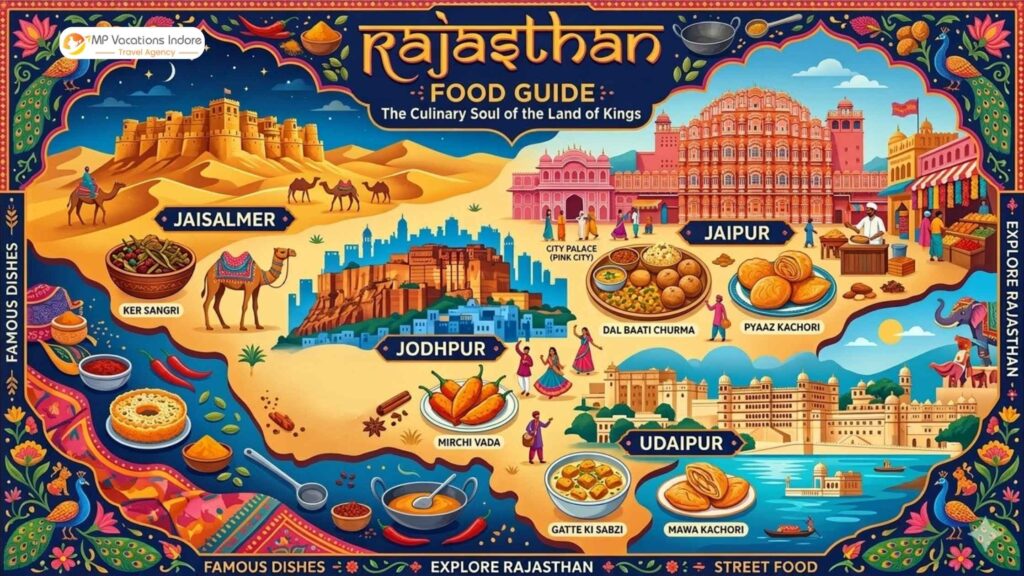
| Jaipur | Pyaaz kachori, dal baati churma, ghewar, laal maas | Rawat Mishthan Bhandar, LMB, Spice Court, Suvarna Mahal (Rambagh Palace) |
| Jodhpur | Mirchi vada, mawa kachori, makhaniya lassi, laal maas, gatte ki sabzi | Clock Tower market, Janta Sweet Home, Kesar Da Dhaba, Raas Jodhpur |
| Udaipur | Dal baati churma, ker sangri, bajra rotis, malpua, udad kachori | Ambrai Restaurant, Natraj Dining Hall, Shree Ganga Dining Hall, Millets of Mewar |
| Jaisalmer | Ker sangri, bajra khichdi, mirchi vada, camel milk products | Trio Restaurant (fort), Desert Boy’s Dhani, Saffron (Nachna Haveli) |
| Pushkar | Malpua, dal baati, rabdi (milk pudding), street lassi | Om Shiva Garden Restaurant, Sunset Cafe, Brahma’s Coffee Corner |
Jaipur — Rajasthan’s Food Capital
Jaipur’s food scene is the most varied and most accessible in the state. The old city’s bazaar lanes — particularly around Tripolia Bazaar and Johari Bazaar — are lined with sweet shops, kachori vendors, and chaiwallas that have been feeding the city for generations. The newer districts offer everything from rooftop fine dining with City Palace views to modern Rajasthani restaurants that are reinterpreting traditional dishes for contemporary palates.
For a curated guide to where to eat in the capital, see our Best Restaurants in Jaipur guide, which covers everything from legendary heritage dhabas to rooftop heritage hotel dining.
Jodhpur — The Street Food Capital
Jodhpur punches above its weight as a food city. The concentration of extraordinary street food in and around the Clock Tower market is unmatched anywhere in Rajasthan — and possibly in India. The city’s mirror-like makhaniya lassi (a thick, tangy buttermilk drink with a distinctive churned texture) and its mirchi vada are both considered the definitive versions of their respective dishes. The city also benefits from proximity to the Mathania chilli farms that provide the raw ingredient for Laal Maas and mirchi vada across the state.
Udaipur — Lake Views and Honest Cooking
Udaipur’s food scene benefits from the city’s slower pace and its significant population of both Indian and international visitors, which has produced a restaurant culture of unusual quality. The local Mewari cuisine — a sub-tradition of Rajasthani cooking that is somewhat lighter and less aggressively spiced than the Marwar dishes of Jodhpur and Jaisalmer — is at its best in the city’s old-town restaurants and family-run dhabas. The rooftop dining experiences overlooking Lake Pichola and the City Palace are among the most atmospherically unbeatable eating settings in all of India.
Rajasthan Through a Thali: The Best Conclusion to Any Journey
To travel through Rajasthan eating only what is available at tourist restaurants would be to miss half the story of the state. The food of Rajasthan — from the simplest dal baati on a dhaba terrace to the most elaborate royal thali in a palace dining room — is inseparable from the history, the landscape, and the culture that produced it. Every dish is an argument for ingenuity. Every flavour combination is a product of necessity. Every meal is an act of hospitality that this part of India performs with a generosity and pride that is entirely its own.
The best way to understand the famous food in Rajasthan is to eat it where it was made: at the source. Follow the smell of ghee through the morning bazaar in Jaipur. Pull over at the roadside dhaba between Jodhpur and Jaisalmer where the dal baati has been cooking since dawn. Sit on the ghats of Pushkar and eat malpua with your fingers while the temple bells ring across the water. Order the traditional Rajasthani cuisine thali in Udaipur and eat until you physically cannot continue.
This is the Rajasthan Food Guide’s central argument: that eating here is not an interruption to sightseeing but the best sightseeing of all. The cuisine is the culture. The kitchen is the history. The thali is the whole magnificent story served in one sitting.
Plan your culinary journey through Rajasthan with our Rajasthan Travel Guide 2026, and make sure to read the Rajasthan Street Food Guide before your first morning in Jaipur’s bazaars. Your appetite will thank you.