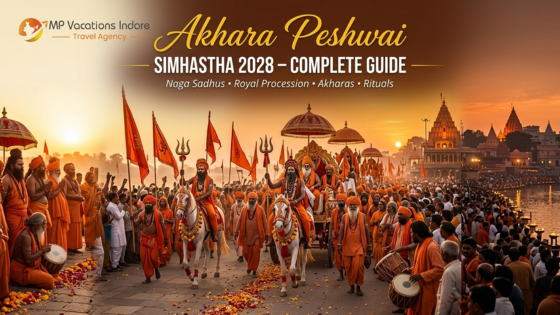
| Direct Answer: Peshwai is the grand ceremonial procession in which each Akhara (Hindu monastic order) officially enters Ujjain before their Shahi Snan. It is one of the most visually spectacular events of Simhastha — saffron flags, elephants, silver palanquins, horses, Mahamandaleshwars on decorated vehicles, and Naga Sadhus leading the march. The 13 Akharas each have separate Peshwai processions in the days before each Shahi Snan date. |
What Is Peshwai — The Grand Entry
Before any Akhara can bathe in the Shipra during Shahi Snan, it must formally enter Ujjain through the Peshwai — the ceremonial procession that announces the Akhara’s arrival to the city and to the Mela. The word ‘Peshwai’ itself means ‘leading forth’ or ‘royal welcome.’ It is the moment when an ancient institution of Sanatana Dharma, with its saints, its traditions, and its accumulated centuries of practice, announces its presence in the sacred city.
For pilgrims and visitors, the Peshwai is often more visually accessible and more emotionally stirring than the Shahi Snan bathing itself. The procession moves through Ujjain’s streets — not at the river’s edge, where the crowds on Shahi Snan day are extreme, but along the roads leading to the ghat, where a good viewing position can be found without the crush of millions. A major Akhara Peshwai can take 2–3 hours to fully pass a single point.
What You Will See During Peshwai
The Procession Structure
Each Peshwai follows a broadly similar format, though each Akhara has its own traditions and visual identity. The general sequence:
- Opening: Saffron and orange flags — dozens of them, carried by sadhus, stretching far ahead of the main procession
- Drums and conches — the sound reaches you long before the procession is visible
- Horses — decorated with ceremonial cloth and silver ornaments
- Elephants — the most senior Akharas have decorated elephants carrying the Akhara’s deity idols
- Silver palanquins — deity idols and the most senior saints carried in ornate silver and gold carriers
- Mahamandaleshwar’s vehicle — the Akhara’s senior spiritual leader on a decorated rath (chariot) or vehicle
- The Naga Sadhus — ash-covered, matted hair, tridents and maces, with no clothing — the most visually extraordinary section
- Regular sadhus — in ochre robes, chanting, some carrying sacred items
- Tail: Akhara supporters, devotees, administrative staff
The Naga Sadhus — The Most Discussed Participants
No element of Kumbh Mela generates more questions than the Naga Sadhus. They are ascetics who have renounced all material attachment — including clothing — and live permanently in the forest or in Akhara settlements. Their bodies are covered in ash (vibhuti), their hair is matted into long locks called jatas, and they carry the weapons of Shiva’s tradition: the trishul (trident), the danda (staff), and sometimes swords or spears.
Naga Sadhus belong primarily to the Shaiva Akharas — specifically the Juna Akhara, which is the largest and most prominent. Their training, initiation, and practice are strictly regulated within their Akhara’s lineage. The Peshwai of the Juna Akhara — with its thousands of Naga Sadhus in procession — is the single most photographed event of every Kumbh Mela.
| Who They Are | Initiated ascetics who have renounced all material life including clothing |
| Their Akhara | Primarily Juna Akhara — largest Shaiva Akhara — plus Niranjani, Mahanirvani |
| Their Ash | Vibhuti — sacred ash. Applied to the entire body as symbol of Shiva and impermanence. |
| Their Hair | Jata — matted locks, sometimes decorated with rudraksha beads, flowers, or ash |
| Photography | Respectful photography is generally accepted during Peshwai from a distance. Do not intrude. |
| Approaching Them | Do not touch or physically approach uninvited. Prostrating (touching feet) requires their acceptance. |
All 13 Akharas — Who They Are
Shaiva Akharas (7) — Shiva tradition
| Juna Akhara | Largest and most prominent. Headquarters at Haridwar. Naga Sadhus lead its Peshwai. |
| Niranjani Akhara | One of the oldest established Akharas. Strong presence at all four Kumbh Melas. |
| Mahanirvani Akhara | Located in Allahabad (Prayagraj). One of the most senior institutions. |
| Atal Akhara | Smaller but significant. Shiva tradition with distinct ceremonial practice. |
| Agni Akhara | Named for the fire (agni) tradition. Smaller Akhara. |
| Anand Akhara | Focuses on the bliss (ananda) aspect of Shiva worship. |
| Avahan Akhara | Invocation-focused tradition. One of the seven Shaiva Akharas. |
Vaishnava Akharas (3) — Vishnu tradition
| Nirmohi Akhara | One of the three Vaishnava Akharas. Distinct visual identity in saffron robes. |
| Digambar Akhara | Sky-clad tradition within Vaishnavism — similar to Shaiva Nagas but Vishnu-worshipping. |
| Nirvani Akhara | Liberated tradition. Vaishnava focus on moksha through devotion to Vishnu. |
Udasi Akharas (3) — Sikh Guru Nanak lineage
| Panchayati Udasin Bari | Followers of Sri Chand, son of Guru Nanak. Traditional ascetic order. |
| Panchayati Naya Udasin | The newer Udasi Akhara with distinct organisational structure. |
| Nirmal Akhara | Founded in the tradition of Guru Gobind Singh. Vedic learning emphasis. |
How to Watch the Peshwai — Practical Tips
| Best Position | Along the main Peshwai route — confirmed closer to 2028 by Mela Authority. Avoid the ghat itself on Peshwai day. |
| Arrive Early | 2–3 hours before the listed Peshwai start time to secure a viewing spot with good sightlines. |
| Height Advantage | A raised position — shop steps, a rooftop with permission, a raised road divider — significantly improves visibility. |
| Photography | Long lens recommended. Procession can be 50–100 metres wide. Naga Sadhu section moves continuously — shoot quickly. |
| Crowd Management | Peshwai crowds are large but structured — the procession has a direction. Stay on one side. Do not attempt to cross. |
| Duration | Major Akhara Peshwai: 1.5–3 hours to fully pass. Smaller Akharas: 45–60 minutes. |
| Multiple Peshwais | Each of the 13 Akharas has a separate Peshwai — spread across the days before the Shahi Snan dates. Check the official 2028 Mela schedule. |
Frequently Asked Questions — Akhara Peshwai Simhastha 2028
Q: What is Akhara Peshwai in Simhastha?
A: Peshwai is the formal ceremonial entry procession of each Akhara (Hindu monastic order) into Ujjain before their Shahi Snan bathing day. It is one of the most visually spectacular events of Simhastha — involving saffron flags, elephants, silver palanquins, Mahamandaleshwars on decorated vehicles, and Naga Sadhus. The 13 Akharas each conduct separate Peshwai processions in the days before each Shahi Snan.
Q: Who are the Naga Sadhus at Simhastha Kumbh Mela?
A: Naga Sadhus are fully initiated ascetics who have renounced all material attachment including clothing. Their bodies are covered in vibhuti (sacred ash), their hair matted into long jatas (locks), and they carry the weapons of Shiva’s tradition — trishul, danda, swords. They primarily belong to the Juna Akhara and lead its Peshwai procession. They are the most visually recognisable participants of any Kumbh Mela.
Q: How many Akharas are there in Simhastha 2028?
A: There are 13 main Akharas recognised by the Akhara Parishad — 7 Shaiva (Shiva-worshipping), 3 Vaishnava (Vishnu-worshipping), and 3 Udasi (Sikh lineage). All 13 participate in Simhastha 2028. Each has its own designated bathing sequence on Shahi Snan dates and its own Peshwai procession.
Q: Can tourists watch the Peshwai at Simhastha?
A: Yes — Peshwai processions are public events that move through Ujjain’s streets before the Shahi Snan. A good viewing position along the route gives you one of the most extraordinary visual spectacles in India without the extreme ghat-area crowd density of Shahi Snan day itself. MP Vacation’s guide knows the best viewing positions for each major Akhara’s Peshwai route.
| 📞 Watch the Peshwai with an Expert Guide: MP Vacation Indore guides know the best Peshwai viewing positions in Ujjain — positions that give you a clear sightline to the Naga Sadhus without the extreme crush of Shahi Snan ghat crowds. Call or WhatsApp +91-7898355153. |