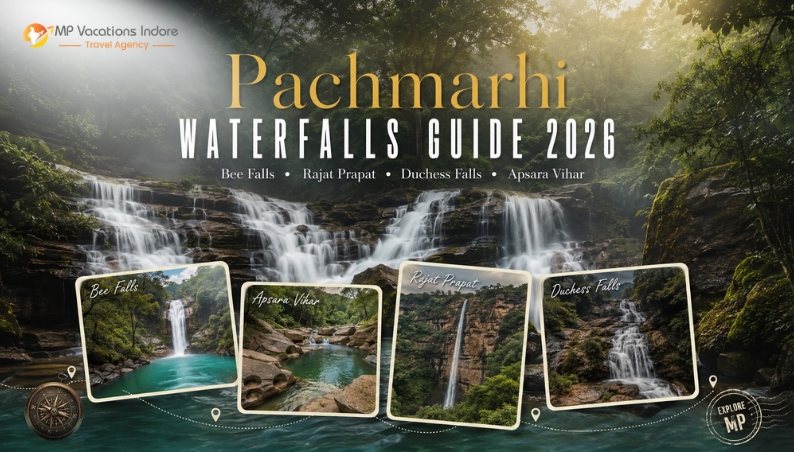
| Quick Answer — Pachmarhi Waterfalls:Pachmarhi has 5 main waterfalls: 1. Rajat Prapat — 107 metres (tallest, viewpoint only). 2. Duchess Falls — approx 100 metres (trek required). 3. Bee Falls / Jamuna Prapat — 35 metres (swimming permitted). 4. Apsara Vihar — natural cascade + swimming pool. 5. Silver Falls (smaller seasonal fall near Bee Falls trail). Best season: Monsoon (July–September) for maximum volume. October–February for comfortable visiting. All falls except Pandav Caves require a Gypsy permit. |
Why Pachmarhi Is Madhya Pradesh’s Waterfall Capital
The Satpura Range’s geology — ancient, weathered, cut through by millennia of monsoon rainfall — has created a waterfall landscape unlike anything else in Central India. The plateau at 1,067 metres collects monsoon rainfall that has nowhere to go except over the plateau edge, where it drops through forested cliff faces into hidden gorges below. The result is a concentration of waterfalls — each with its own character, each requiring a different level of effort to reach — that makes Pachmarhi unique in Madhya Pradesh and competitive with India’s most celebrated waterfall destinations.
Here is the complete guide to every waterfall in Pachmarhi — what each one is, how to reach it, when to go, and whether it is worth the effort.
1. Rajat Prapat — The 107-Metre Silver Falls (Tallest in Pachmarhi)
| Height | 107 metres — tallest waterfall in Pachmarhi, 30th highest in India |
| Type | Viewpoint only — base is in an inaccessible gorge |
| Local Name | Rajat = Silver (Hindi) · Named for the silver shimmer on the falls in sunlight |
| Also Called | Big Fall, Silver Fall |
| Access | Gypsy from town → viewpoint parking → short walk to viewpoint railing |
| Swimming | Not permitted — base inaccessible |
| Best Season | July–August (monsoon) — full roaring volume, spectacular visual · October–November (post-monsoon) — clear view across valley |
| Combined With | Usually paired with Duchess Falls in the same Gypsy tour zone |
| Photography | Morning light from the viewpoint gives clearest view across the valley. Bring a wide lens. |
Rajat Prapat’s defining characteristic is its inaccessibility. You cannot reach its base. You cannot touch it. You stand at a viewpoint and look at 107 metres of white water cutting through sheer, jungle-covered cliff faces into a gorge that no visitor has entered on foot. This distance makes it more visually dramatic than any waterfall you can walk to — it is a painting hung in a natural gallery, viewed from across the room.
In monsoon, the fall becomes a broad curtain of water rather than the thin silver thread of winter. The two versions are so different that returning Pachmarhi visitors often say the monsoon Rajat Prapat and the winter Rajat Prapat feel like separate places.
2. Duchess Falls — The Forest Cascade (Most Rewarding Trek)
| Height | Approximately 100 metres — multi-tiered cascade |
| Type | Trek waterfall — requires 4 km forest descent and climb |
| Difficulty | Moderate to difficult · Slippery in monsoon — guide mandatory |
| Access | Gypsy to trailhead + 4 km trek through dense forest |
| Swimming | Possible at base pool — check current conditions |
| Best Season | July–September (monsoon) for maximum flow · October–November for manageable trek with good water |
| Named By | British colonial officers — one of several Pachmarhi features with colonial-era English names |
| Note | Most physically demanding waterfall in Pachmarhi · Rewarding for fit trekkers · Not suitable for elderly or young children |
Duchess Falls is the waterfall you earn. The 4-km forest trail from the Gypsy drop-off point descends through sal forest and rock formations to a clearing where the multi-tiered cascade comes into view. In monsoon the falls are at full power — a broad, powerful flow that fills the clearing with mist and sound. Because few casual tourists make this effort, the clearing feels private and unhurried in a way that Bee Falls never does.
MP Vacation includes Duchess Falls in 3-day and 4-day Pachmarhi packages for physically active groups. If your group includes elderly members or children under 10, we schedule Bee Falls and Apsara Vihar instead — equal visual reward with zero physical strain.
3. Bee Falls / Jamuna Prapat — The Swimming Waterfall
| Height | Approximately 35 metres |
| Type | Accessible waterfall with natural swimming pool |
| Local Name | Jamuna Prapat · Bee Falls (colonial name, possibly from bees’ nest near original trail) |
| Swimming | Permitted and popular at base pool — clean, cool water year-round |
| Water Source | Jambu Dwip stream — also provides Pachmarhi town’s drinking water |
| Access | Gypsy to trailhead → 15-minute trek (moderate steps) → falls and pool |
| Best Time | Arrive before 10 AM — crowds build significantly through the morning |
| Best Season | October–March for comfortable trek and good water · Monsoon for full force (no swimming allowed in full monsoon) |
| Changing Facility | Basic changing areas available near the pool — carry a change of clothes |
Bee Falls is Pachmarhi’s most visited attraction because it offers something no other waterfall in the region does: you can actually swim in it. The natural pool at the base of the 35-metre cascade is fed year-round by the Jambu Dwip stream — the same stream that supplies Pachmarhi town’s drinking water. The water is clean, cold even in October, and perfectly safe for adults and children over 8.
The 15-minute trek from the Gypsy drop-off is Pachmarhi’s most social trail — families, couples, and solo travellers converge here throughout the day. Arrive early. The difference between Bee Falls at 8 AM (peaceful, the forest sounds audible over the water) and Bee Falls at 11 AM (crowded, the social sounds audible over everything) is significant enough to matter. MP Vacation schedules Bee Falls as the first morning stop in all Pachmarhi itineraries.
Also read – 15 Best Places to Visit in Pachmarhi 2026
4. Apsara Vihar — The Natural Pool Waterfall
| Type | Natural cascade feeding a calm swimming pool |
| Name Meaning | Apsara = celestial nymph · Vihar = abode |
| Access | Short, easy walk from Gypsy drop-off — family-friendly trail |
| Swimming | Permitted — calmer and shallower than Bee Falls pool · Better for young children |
| Crowds | Significantly less crowded than Bee Falls · Good alternative on busy peak-season days |
| Best Season | October–March · Monsoon creates higher water flow but reduces visibility in the pool |
| Combined With | Often visited on the same Gypsy route as Bee Falls — same zone |
Apsara Vihar is the waterfall for families with young children or those wanting a quieter water experience than Bee Falls. The pool is gentler, the trail is easier, and the crowds are thinner. It is often skipped by first-time Pachmarhi visitors who don’t know about it — which is exactly why it remains pleasant. MP Vacation includes Apsara Vihar in all family packages as a complement to Bee Falls, usually visited after the Bee Falls morning.
5. Silver Falls — The Hidden Seasonal Cascade
| Type | Seasonal waterfall — significant only in monsoon and post-monsoon |
| Access | Near the Bee Falls trail — visible from the approach path in good monsoon flow |
| Best Season | July–October · Dries to a trickle or disappears by December |
| Note | Not a separate Gypsy destination — visible en route to Bee Falls · Worth pausing for in monsoon |
Waterfall Season Guide — When to Visit Each
| Waterfall | Best Season | Off Season |
| Rajat Prapat (107m) | July–November · Full volume + clear views | December–June · Thin trickle in dry season |
| Duchess Falls (100m) | July–November · Most powerful · Trek slippery in rain | December–April · Water significantly reduced |
| Bee Falls (35m) | October–March · Swimming, comfortable trek · Monsoon for volume but no swimming | May–June · Water lowest, summer heat on trek |
| Apsara Vihar | October–March · Calm pool, easy walking · Monsoon for higher flow | May–June · Pool may be very low |
| Silver Falls | July–October · Seasonal · Not reliable outside monsoon | November–June · Usually dry |
Practical Guide — Visiting Pachmarhi Waterfalls
Gypsy Permit — Mandatory for All Falls
All of Pachmarhi’s main waterfalls (Rajat Prapat, Duchess Falls, Bee Falls, Apsara Vihar) are inside the forest zone where private vehicles are prohibited. A Gypsy (permitted open-top forest jeep) is the only authorised vehicle on these routes. Day permits are issued at Bison Lodge (the forest checkpoint in Pachmarhi town). MP Vacation pre-arranges the Gypsy and permit for all tour clients — you do not queue separately.
Sequencing Your Waterfall Day
The optimal sequence for a full waterfall day in Pachmarhi: Start at Bison Lodge for permit (7:30–8 AM). Gypsy to Bee Falls by 8:30 AM (before the crowd builds). 15-minute trek down. 45 minutes at the pool. Gypsy to Apsara Vihar (if your group has young children). Then Rajat Prapat viewpoint before noon. Lunch. Afternoon: Duchess Falls (physically fit groups only — allow 3 hours for the 4 km trek). Return by 4:30–5 PM.
What to Carry
• Change of clothes in a waterproof bag — Bee Falls and Apsara Vihar involve swimming, not just viewing
• Waterproof camera bag or dry bag — mist from Rajat Prapat viewpoint reaches camera equipment
• Sturdy closed-toe footwear — the Duchess Falls trek requires proper grip, not sandals or flip-flops
• Water bottle — 1 litre minimum per person. No shops inside forest zones.
• Cash — Gypsy drivers are paid in cash. Carry ₹500–₹800 per vehicle per zone.
Frequently Asked Questions — Pachmarhi Waterfalls
Q: Which is the highest waterfall in Pachmarhi?
A: Rajat Prapat (also called Silver Falls or Big Fall) is the highest waterfall in Pachmarhi at approximately 107 metres. It is also considered the 30th highest waterfall in India. It can only be viewed from a designated viewpoint — the base is in an inaccessible gorge. Access requires a Gypsy (forest jeep permit). Best viewed in monsoon (July–September) when it reaches full volume.
Q: Can you swim in Pachmarhi waterfalls?
A: Yes — swimming is permitted at Bee Falls (Jamuna Prapat, 35m) and Apsara Vihar. Both have natural pools at their base. Swimming is not permitted at Rajat Prapat (viewpoint only, base inaccessible) or Duchess Falls during heavy monsoon. Carry a change of clothes for the swimming stops. MP Vacation schedules both swimming waterfalls as morning stops in all Pachmarhi family packages.
Q: When is the best time to see Pachmarhi waterfalls?
A: For maximum waterfall volume — monsoon (July–September). Rajat Prapat and Duchess Falls are most powerful in July–August. For comfortable visiting with swimming at Bee Falls — October to March. For clear photography of Rajat Prapat — October to November (post-monsoon, full water, clear skies). Summer (May–June) sees significantly reduced flow on all waterfalls.
Q: Do I need a Gypsy to reach waterfalls in Pachmarhi?
A: Yes — a Gypsy (permitted forest jeep) is mandatory for all major waterfalls including Bee Falls, Rajat Prapat, Duchess Falls, and Apsara Vihar. Private vehicles are not allowed on forest routes. A day permit must first be obtained from Bison Lodge in Pachmarhi town. MP Vacation pre-arranges the Bison Lodge permit and Gypsy for all tour clients as standard — no separate queuing required.
Q: Is Bee Falls and Rajat Prapat in the same Gypsy zone?
A: No — Bee Falls and Apsara Vihar are in one sightseeing zone, and Rajat Prapat and Duchess Falls are in a different zone. Most visitors split the waterfall day: morning zone (Bee Falls + Apsara Vihar), then afternoon zone (Rajat Prapat + Duchess Falls for fit trekkers). MP Vacation sequences all waterfall visits efficiently across the two zones to avoid backtracking.
| 📞 Visit All Pachmarhi Waterfalls with MP Vacation:We arrange the Bison Lodge permit, Gypsy for both zones, and sequence your waterfall day to avoid the morning crowd at Bee Falls and the afternoon heat at Duchess Falls. Call or WhatsApp +91-7898355153. |