Introduction: Why Rajasthan Belongs on Every Travel List
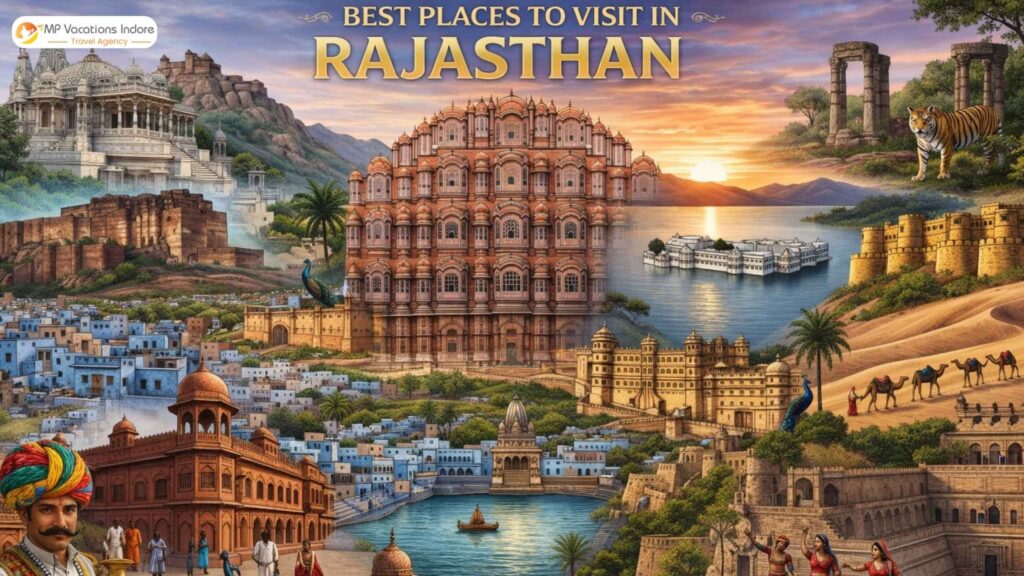
If there is one state in India that captures the full grandeur of the subcontinent’s history, culture, and colour, it is Rajasthan. The places to visit in Rajasthan are extraordinarily diverse — from soaring hilltop forts and shimmering desert lakes to sacred pilgrimage towns and royal palace hotels that once housed maharajas.
Rajasthan is the largest state in India by area, and its landscapes shift dramatically as you travel through it: the golden Thar Desert in the west, the green Aravalli hills in the east, the fertile plains of the south, and the patchwork of walled medieval cities in between. This is a land where history did not simply happen — it was chiselled into sandstone, painted onto havelis, and woven into the saris of its people.
The tourist places in Rajasthan attract travellers from every corner of the world, and the famous places in Rajasthan consistently top India’s most-visited destination lists. Whether you are a first-time visitor to India or a seasoned traveller returning for your fifth trip, the Rajasthan tourist attractions never stop surprising you.
This guide covers 10 of the best Rajasthan travel destinations, from world-famous icons to hidden architectural gems. For full trip planning — including itineraries, budget guides, and travel tips — read our complete Rajasthan Travel Guide 2026: Places, Itinerary & Tips.
Top Places to Visit in Rajasthan
Here are the ten destinations that define Rajasthan travel — each one a world unto itself.
1. Jaipur — The Pink City
Jaipur is where most Rajasthan journeys begin — and for good reason. The state capital is a dizzying blend of Mughal and Rajput grandeur, alive with colour, commerce, and centuries of royal history. Founded in 1727 by Maharaja Jai Singh II, the city was designed on a precise grid system and painted a distinctive terracotta pink for the visit of Prince Albert in 1876 — a tradition that has never faded. Today, Jaipur’s walled old city is a UNESCO World Heritage Site, home to some of India’s finest architecture and most vibrant street markets.
Key Attractions
- Amber Fort — a hillside Mughal-Rajput masterpiece accessible by jeep or elephant
- Hawa Mahal — the iconic five-storey Palace of Winds with 953 latticed windows
- City Palace — the royal residence and museum complex still partly inhabited by royalty
- Jantar Mantar — the world’s largest stone observatory, also UNESCO listed
- Nahargarh & Jaigarh Forts — hilltop sentinels with panoramic city views
- Johari Bazaar — for handcrafted jewellery, gemstones, and block-print textiles
Best Experiences
- Hot-air balloon ride at dawn over the forts and old city
- Guided food walk through the old city’s legendary street food lanes
- Sunrise visit to Amber Fort before the crowds arrive
- Cooking class in a heritage haveli learning Rajasthani recipes
Best Time to Visit: October to March (peak season); Holi (March) for festival atmosphere
Plan your visit: Jaipur Travel Guide
2. Udaipur — City of Lakes
Udaipur is Rajasthan’s most romantic city — a vision of white marble palaces, shimmering lakes, and flower-draped ghats reflected in still water. Founded in 1559 by Maharana Udai Singh II, the city is built around a series of interconnected lakes in the southern Aravalli hills. The famous City Palace — one of the largest palace complexes in India — rises majestically above Lake Pichola, while the Lake Palace (now a luxury hotel) appears to float in the middle of the lake itself. Udaipur moves at a gentler pace than Jaipur, and its rooftop cafes, art galleries, and classical dance performances make it easy to lose track of time here entirely.
Key Attractions
- City Palace — a 400-year-old lakeside palace with stunning rooftop views
- Lake Palace — the most photographed building in Rajasthan
- Jag Mandir — an island palace and garden accessible by boat
- Saheliyon ki Bari — the enchanting Garden of the Maids of Honour
- Bagore Ki Haveli — featuring an excellent folk art museum and evening dance shows
- Eklingji & Nagda Temples — spiritual sanctuaries just outside the city
Best Experiences
- Sunset boat ride on Lake Pichola — arguably Rajasthan’s most romantic experience
- Watching the classical Rajasthani dance show at Bagore Ki Haveli
- Exploring the Shilpgram craft village and mela
- Tasting royal Rajasthani cuisine at a heritage hotel rooftop restaurant
Best Time to Visit: October to March; Mewar Festival (March/April) for cultural festivities
Plan your visit: Udaipur Travel Guide
3. Jaisalmer — The Golden City
Jaisalmer is one of the most extraordinary places to visit in Rajasthan — a living medieval fortress city rising from the Thar Desert like a mirage of yellow sandstone. The Jaisalmer Fort, built in 1156 by Rawal Jaisal, is one of the world’s few living forts: roughly 3,000 people still reside within its ancient walls, alongside temples, havelis, restaurants, and guesthouses. Beyond the fort, the vast Sam and Khuri sand dunes stretch to the Pakistani border, and the desert sky at night — far from any city lights — is among the most spectacular stargazing spots in India.
Key Attractions
- Jaisalmer Fort — a UNESCO-listed living fort with intricate Jain temples within
- Patwon Ki Haveli — five interconnected mansions carved with extraordinary stone lacework
- Sam Sand Dunes — Rajasthan’s most iconic desert landscape
- Gadisar Lake — a serene reservoir with ornate ghats and migratory birds
- Desert Cultural Centre — showcasing the art, music, and history of the Thar
- Kuldhara — the haunting ruins of an abandoned 18th-century village
Best Experiences
- Overnight desert camping under the stars at Sam or Khuri dunes
- Camel safari at sunrise or sunset through the Thar Desert
- Attending the Jaisalmer Desert Festival (February) — folk music, camel races, and turban-tying contests
- Watching the sunset from the ramparts of Jaisalmer Fort
Best Time to Visit: November to February; Desert Festival in February is unmissable
Plan your visit: Jaisalmer Travel Guide
4. Jodhpur — The Blue City
Jodhpur is one of the most visually spectacular Rajasthan travel destinations. The city’s old quarter is famous for its dense concentration of houses painted vivid indigo blue — a tradition believed to repel insects and signify Brahmin households — that spill down the hillside beneath the towering Mehrangarh Fort. The fort itself is one of India’s finest, with walls rising 36 metres and housing a world-class museum of royal artefacts, miniature paintings, and armour. The contrast of the massive ochre fort against the blue city below is one of India’s great visual spectacles.
Key Attractions
- Mehrangarh Fort — arguably India’s finest fort, with extraordinary museum collections
- Jaswant Thada — a delicate white marble cenotaph gleaming above the blue city
- Umaid Bhawan Palace — part royal residence, part heritage hotel, part museum
- Sardar Market at the Clock Tower — a vibrant bazaar of spices, textiles, and antiques
- Mandore Gardens — ruins and monuments set among green gardens north of the city
- Toorji Ka Jhalra — a stunning restored stepwell at the heart of the old city
Best Experiences
- Sunrise view over the blue city from Mehrangarh’s ramparts
- Zip-lining over the blue city — one of India’s most unique adventure experiences
- Tasting Jodhpur’s famous mirchi vada (chilli fritters) and mawa kachori
- Blue City photography walk through the old neighbourhood lanes
Best Time to Visit: October to March; Marwar Festival (October) celebrates Rajasthani folk traditions
Plan your visit: Jodhpur Travel Guide
5. Pushkar — Sacred Lake Town
Pushkar is unlike anywhere else in Rajasthan. One of Hinduism’s most sacred towns, it is built around a holy lake believed to have been formed when Lord Brahma dropped a lotus flower to earth. The town’s 52 ghats, hundreds of temples, and the rare Brahma Temple at its centre draw pilgrims year-round. Yet Pushkar also has a distinctly bohemian character — its bazaars are lined with jewellery stalls, yoga studios, rooftop cafes, and artisan shops, attracting backpackers and spiritual seekers alongside devout Hindu pilgrims. Each November, the famous Pushkar Camel Fair transforms the desert on the town’s edge into one of the world’s most colourful spectacles.
Key Attractions
- Brahma Temple — one of the few temples in the world dedicated to Lord Brahma
- Pushkar Lake and its 52 sacred ghats
- Savitri Temple — reached by a steep hillside climb with panoramic views
- Pushkar Camel Fair grounds — best visited during the November fair
- The bazaar streets lined with block-print shops and silver jewellery stalls
Best Experiences
- Taking part in a puja (prayer ceremony) at the sacred ghats at dawn
- Attending the Pushkar Camel Fair for camel races, folk music, and carnival atmosphere
- Exploring the bazaar for hand-stamped textiles and tribal silver jewellery
- Watching the sunset from Savitri Temple hilltop
Best Time to Visit: October to March; November for the world-famous Pushkar Camel Fair
6. Mount Abu — Rajasthan’s Hill Station
Mount Abu stands apart from every other destination in Rajasthan. Perched at 1,220 metres in the Aravalli Range, it is the state’s only hill station — a cool, forested retreat where the scorching desert plains feel a world away. For most travellers, the extraordinary Dilwara Jain Temples are reason enough to visit. Built between the 11th and 13th centuries, these temples are considered masterpieces of Jain architecture; the intricate marble carvings covering every surface — ceilings, pillars, doorways — are almost incomprehensibly detailed. Mount Abu also offers gentle trekking, wildlife spotting in the Wildflower Hall sanctuary, and peaceful evenings beside the Nakki Lake.
Key Attractions
- Dilwara Jain Temples — some of the finest marble-carved temples in the world
- Nakki Lake — the heart of the hill station with boating and lakeside promenades
- Guru Shikhar — the highest peak in the Aravalli Range at 1,722 metres
- Mount Abu Wildlife Sanctuary — home to leopards, bears, and abundant birdlife
- Achalgarh Fort — a partially ruined hilltop fort with panoramic desert views
- Sunset Point — the most popular gathering spot for evening views
Best Experiences
- Marvelling at the impossibly detailed marble carvings of the Dilwara Temples
- Boating on Nakki Lake at sunset with Aravalli hills as a backdrop
- Trekking to Guru Shikhar for sweeping views over Rajasthan and Gujarat
- Spotting wildlife in the sanctuary’s forested trails
Best Time to Visit: November to February for cool weather; avoid June–August monsoon for road safety
7. Ranthambore — Wildlife Safari Destination
Ranthambore National Park is the crown jewel of Rajasthan’s wildlife heritage. Spread across 1,334 square kilometres of dry deciduous forest, grassland, and ancient ruins, it is one of India’s most famous tiger reserves — and one of the best places on earth to spot the Bengal tiger in the wild. What makes Ranthambore uniquely atmospheric is the 10th-century Ranthambore Fort, a UNESCO World Heritage Site, that rises from the heart of the jungle. Watching a tiger stalk through the ruins of ancient temples and royal cenotaphs is a scene that belongs to another era entirely.
Key Attractions
- Ranthambore Fort — a hilltop UNESCO fort with jungle panoramas
- Tiger sightings in Zones 1–10 of the national park
- Padam Talao — the largest lake in the park, perfect for crocodile and birdlife spotting
- Jogi Mahal — a historic forest rest house beside the lake used as a filming location
- Ranthambore Bazaar — for handcrafted wildlife-themed art and textiles
Best Experiences
- Early morning jeep safari for the best tiger-sighting opportunities
- Canter safari (larger open truck) for a more sociable group experience
- Birdwatching — over 300 species including painted storks, kingfishers, and eagles
- Photography walks around the forest fringes at dawn and dusk
Best Time to Visit: October to April (park closed July to September); November to February for best sightings
8. Bikaner — Desert Heritage City
Bikaner is one of Rajasthan’s most underrated tourist places. Sitting deep in the Thar Desert north of Jaisalmer, this walled city was founded in 1488 by Rao Bika, a son of the founder of Jodhpur. Its spectacular Junagarh Fort — never conquered in its 500-year history — is one of Rajasthan’s finest, housing a series of lavishly decorated palaces within its walls. Bikaner is also renowned for its unique camel breeding farm (the only government-run camel research centre in Asia), its exquisite havelis, and the Karni Mata Temple — the extraordinary rat temple where thousands of sacred rats are revered as holy beings.
Key Attractions
- Junagarh Fort — an unconquered 16th-century fort with extraordinary palace interiors
- Lalgarh Palace — a stunning red sandstone Indo-Saracenic palace converted into a heritage hotel
- Karni Mata Temple at Deshnok — the world-famous rat temple, 30 km from Bikaner
- National Camel Research Centre — home to India’s largest camel herd
- Bikaner Old City Havelis — intricately carved merchant mansions along the old bazaar lanes
Best Experiences
- Exploring the opulent Anup Mahal and Karan Mahal inside Junagarh Fort
- Visiting the Karni Mata rat temple at dawn for a uniquely surreal experience
- Attending the Bikaner Camel Festival in January — camel races, polo, and beauty pageants
- Sampling Bikaner’s famous bhujia (spiced gram noodles) and Bikaner rasgullas
Best Time to Visit: October to February; January for the Bikaner Camel Festival
9. Chittorgarh — Historic Fort City
Chittorgarh is where Rajasthan’s most epic tales of valour, sacrifice, and honour were written. The city is dominated by Chittorgarh Fort — the largest fort in India by area, sprawling across 700 acres on a mesa rising 180 metres above the plains. This UNESCO World Heritage Site was the capital of the Mewar kingdom and the site of three legendary jouhar (mass self-immolations) by Rajput women who chose death over surrender to invading armies. Walking through its gates today — past the soaring Victory Tower, the ancient temples, and the haunting palaces — is to walk through one of the most emotionally charged heritage sites in the country.
Key Attractions
- Chittorgarh Fort — India’s largest fort complex, spanning 700 acres
- Vijay Stambha (Victory Tower) — a 15th-century tower of victories with panoramic views
- Kirti Stambha (Tower of Fame) — a 12th-century Jain tower covered in carvings
- Rani Padmini’s Palace — site of the most famous jouhar legend
- Meera Temple — dedicated to the 16th-century saint-poetess Mirabai
- Fateh Prakash Palace — a museum of Mewar art and artefacts
Best Experiences
- Climbing the Vijay Stambha for sweeping views over the fort complex
- Attending the Chittorgarh Sound and Light Show for an immersive history of Mewar
- Exploring the vast fort plateau at sunrise when it is almost entirely empty
- Visiting the Cow Mouth (Gaumukh) Reservoir inside the fort
Best Time to Visit: October to March; combine with Udaipur (90 km away) for a seamless itinerary
10. Bundi — Hidden Architectural Gem
Bundi is the kind of destination that devoted travellers guard jealously — a small, spectacularly preserved hill town that has somehow stayed off the mainstream tourist trail. Nestled in a narrow valley in the Hadoti region, Bundi is famous for three things: the tiered hilltop Taragarh Fort with its extraordinary baori (stepwells), the magnificent Bundi Palace filled with some of the finest Rajput murals in existence, and the town’s network of intricately carved stepwells that predate anything of their kind elsewhere in India. Rudyard Kipling lived here for a time and described it as a place of “cliffs and forests and ravines.” Nothing has changed.
Key Attractions
- Taragarh Fort — a dramatically situated 14th-century fort with deep reservoir cisterns
- Bundi Palace (Garh Palace) — extraordinary Rajput murals depicting royal processions and Hindu legends
- Raniji Ki Baori — an ornate 46-metre-deep stepwell considered Bundi’s finest
- Nawal Sagar Lake — a picturesque artificial lake with a submerged temple at its centre
- 84-Pillared Cenotaph — a secluded and astonishing canopied memorial
- Sukh Mahal — a small pleasure palace beside the lake where Rudyard Kipling reportedly stayed
Best Experiences
- Exploring Bundi’s extraordinary network of ancient baori stepwells on foot
- Climbing Taragarh Fort at dawn for views over the rooftops and lake
- Photographing the indigo-painted lanes of the old town
- Attending the Bundi Utsav festival (November) — folk dance, music, and boat racing
Best Time to Visit: October to March; November for the Bundi Utsav festival
Start Exploring the Places to Visit in Rajasthan
The ten destinations in this guide represent the full sweep of what Rajasthan has to offer — from the world-famous grandeur of Jaipur, Udaipur, and Jaisalmer to the quiet, unhurried magic of Bundi and Pushkar. Each one rewards curiosity. Each one has a story.
The beauty of travelling through this region is that these places are connected by some of India’s most scenic road journeys. Driving from Jodhpur through the desert to Jaisalmer as the sun drops behind the dunes, or winding through the Aravalli hills from Udaipur to Chittorgarh at golden hour, are experiences that stay with you long after the trip ends.
Whether you have six days or three weeks, whether you are travelling on a shoestring or in style, the famous places in Rajasthan and the Rajasthan tourist attractions in this guide will form the backbone of an extraordinary journey. Use the city guides linked above for destination-specific planning, and for the complete picture — including itineraries, travel tips, budget guides, and the best time to visit each region — read our full guide:
Rajasthan Travel Guide 2026: Places, Itinerary & Tips — your one-stop resource for planning the perfect Rajasthan adventure.
Rajasthan is waiting. The forts are lit at dusk. The desert is cooling. The thali is on the table. Go.