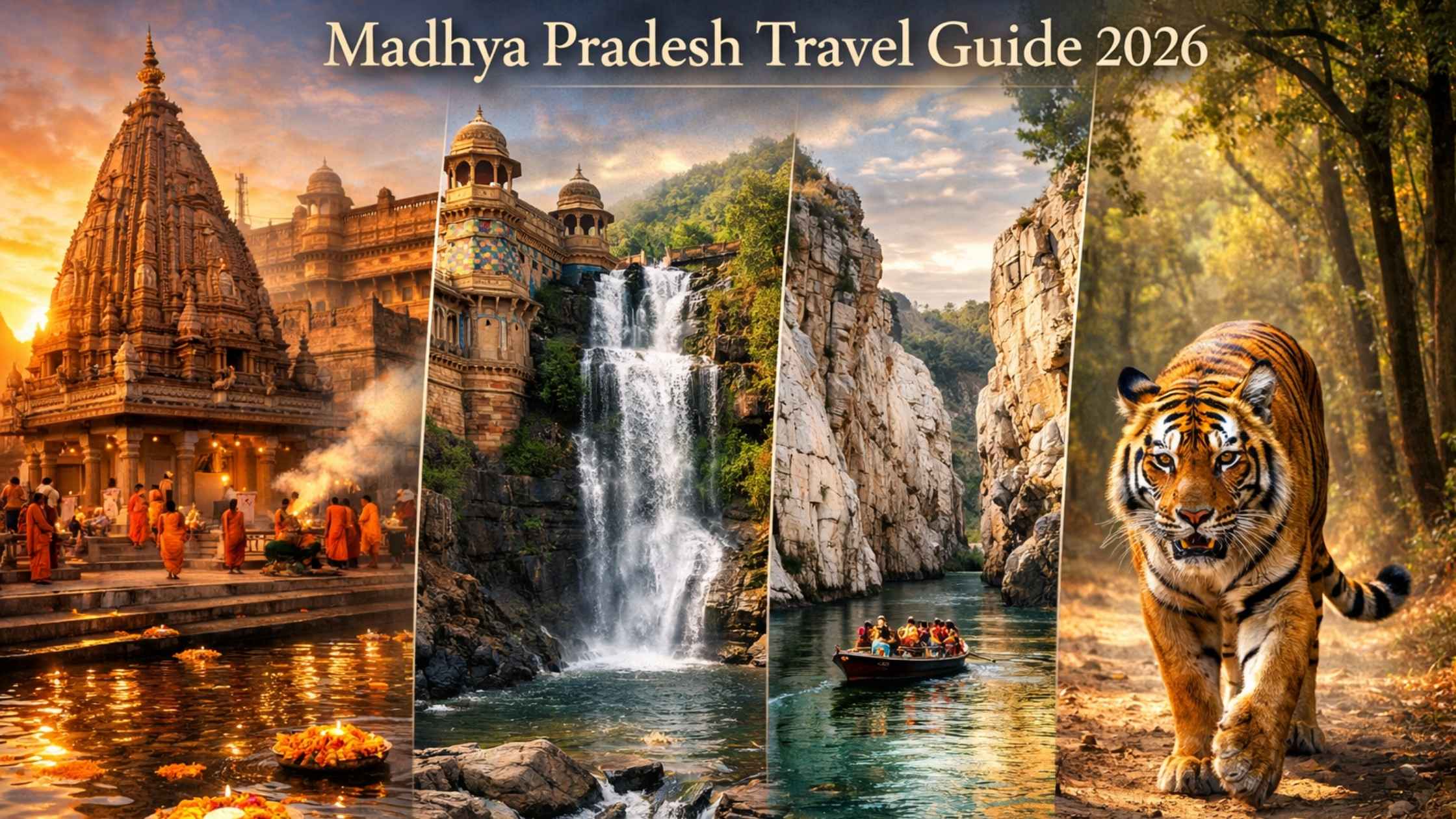
There is a reason seasoned Indian travellers quietly call Madhya Pradesh their favourite secret. While the crowds rush to Rajasthan and Goa, MP sits in the heart of the country — unhurried, deeply layered, and extraordinarily rewarding — waiting for travellers who want the real India.
This Madhya Pradesh travel guide for 2026 covers everything you need to plan the perfect MP trip. From the sacred ghats of Ujjain and the medieval grandeur of Gwalior Fort to the misty waterfalls of Pachmarhi, the roaring marble gorge at Jabalpur, and tiger country in Pench — Madhya Pradesh is a state that genuinely has it all. And thanks to significant investments in road infrastructure and tourism in recent years, 2026 is one of the best times in recent memory to explore MP.
At mpvacationindore.com, we are based right here in Indore and have been helping travellers discover Madhya Pradesh for years. This guide brings together that local knowledge — city by city, season by season, tip by tip — so your MP journey goes exactly the way you want it to.
Let’s begin.
Why Madhya Pradesh in 2026?
Madhya Pradesh earned the title “Heart of India” not just geographically — it sits at the centre of the country — but culturally. It holds more UNESCO World Heritage Sites than most Indian states (Khajuraho, Sanchi, Bhimbetka), more tiger reserves than anywhere else in India (six), and a tourism landscape that spans ancient temples, hill stations, marble canyons, Buddhist monuments, colonial-era hill towns, and some of the wildest wilderness on the subcontinent.
Here is what makes 2026 a particularly good year to visit:
- Improved connectivity — New expressways have cut road travel times between Indore, Bhopal, and major MP destinations significantly
- Upgraded accommodation — Heritage hotels, eco-lodges near national parks, and new boutique properties have expanded across the state
- Year-round appeal — With destinations ranging from cool hill stations (Pachmarhi) to desert-edge towns (Orchha), MP has something worth visiting in every season
- Less crowded than comparable states — Khajuraho gets a fraction of the footfall of Hampi; Pench offers tiger sightings without the Ranthambore rush
MP is not a single-type destination. It is a state of contrasts — and this MP travel guide is designed to help you find the contrast that speaks to you.
Ujjain Tourist Guide
The City That Time Measures Itself By
Ujjain is one of the seven sacred cities of Hinduism — a saptapuri — and is perhaps the most spiritually alive city in all of Madhya Pradesh. It sits on the eastern bank of the Shipra River, 56 km from Indore, and has been a centre of learning, astronomy, and devotion for over 2,500 years. Kalidasa, ancient India’s greatest Sanskrit poet, is believed to have lived and written here. The Indian standard meridian once passed through Ujjain, making it the country’s historical time-keeper.
Top Attractions in Ujjain
Mahakaleshwar Jyotirlinga Temple The crown jewel of Ujjain and one of the 12 Jyotirlingas — the most sacred Shiva shrines in India. The presiding deity here is Mahakala, the Lord of Time. The temple is most famous for the Bhasma Aarti — a pre-dawn ritual performed between 4 AM and 6 AM in which the Shivalinga is anointed with sacred ash. Witnessing this aarti is a profound, deeply moving experience. Advance booking for Bhasma Aarti is essential — tickets are available online through the temple trust.
Kaal Bhairav Temple A unique and atmospheric temple dedicated to Kaal Bhairav, the fierce form of Shiva who is considered the guardian of Ujjain. The temple is notable for the offering of madirav (liquor) to the deity — a ritual that draws curious and devout visitors alike. The lanes leading to this temple are among the most visually rich in the city.
Ram Ghat The most beautiful of Ujjain’s many ghats on the Shipra River. In the evenings, Ram Ghat hosts the Shipra Aarti — a ceremony of oil lamps and devotional chanting that, while smaller than Varanasi’s Ganga Aarti, is equally sincere and considerably less crowded. Come for sunset, stay for the aarti.
Vedha Shala (Jantar Mantar, Ujjain) Lesser known than Jaipur’s Jantar Mantar, Ujjain’s astronomical observatory was built by Maharaja Sawai Jai Singh II in the 18th century on the site of an ancient meridian. Its instruments are used to this day to calculate Hindu calendar dates. For travellers interested in the history of science in India, this is a quiet, fascinating stop.
Sandipani Ashram According to Hindu tradition, this is where Lord Krishna and Balarama studied under the sage Sandipani. A tank here — Gau Ghat — is believed to be the site where Lord Krishna retrieved his teacher’s deceased son from the underworld as guru dakshina (a gift to his teacher). A place of deep mythological resonance.
Ujjain Practical Details
- Distance from Indore: 56 km (about 1 hour by road)
- Best Time to Visit: October to March; avoid summer (April–June) due to intense heat
- Kumbh Mela: Ujjain hosts the Simhastha Kumbh Mela every 12 years — the next is in 2028. Plan early if you want to be part of one of the world’s largest human gatherings.
- Stay: Ujjain has good budget and mid-range options; many pilgrims prefer dharamshalas near the Mahakaleshwar temple
Gwalior Tour Guide
The Fort City That Rewrote Indian History
Gwalior is the kind of city that humbles you. Its fort — a massive table-top citadel rising 100 metres above the plains on a sheer sandstone escarpment — is so dominant that Emperor Babur called it “the pearl among the fortresses of India.” If you have only one fort to visit in Madhya Pradesh, make it Gwalior.
Top Attractions in Gwalior
Gwalior Fort One of the most unconquerable forts in Indian history — it changed hands between Rajputs, Mughals, Marathas, and the British over nine centuries, but was never taken by siege. The fort complex contains five palaces, three temples, and six reservoirs, all crowning a 3 km-long rocky plateau. The most spectacular structure inside is the Man Mandir Palace, built by Raja Man Singh Tomar between 1486 and 1516, its exterior tiled in vivid blue, yellow, and green ceramic work that makes it look more like a piece of pottery than a palace.
The Teli ka Mandir (9th century) is an unusual temple that fuses Dravidian and Nagara architectural styles — its tower rises 30 metres and is the tallest structure on the fort. The Sas-Bahu temples (900 AD) are a pair of intricately carved Vishnu temples whose name translates, evocatively, as “mother-in-law and daughter-in-law.”
Jai Vilas Palace & Scindias Museum The opulent 19th-century palace of the Scindia royal family — still partly used as a residence — contains a museum with one of the most jaw-dropping rooms in India: the Darbar Hall, which holds two of the world’s largest chandeliers, each weighing 3.5 tonnes. According to legend, ten elephants were used to test the strength of the ceiling before the chandeliers were installed. Also famous is the silver toy train that once carried whisky decanters and crystal glasses around the dinner table.
Tansen’s Tomb Gwalior is the birthplace of Tansen — the legendary court musician of Emperor Akbar and one of the greatest figures in the history of Indian classical music. His tomb, set within a walled garden, is a place of pilgrimage for musicians across India. Every year in December, the Tansen Music Festival fills Gwalior’s evenings with some of the finest Hindustani classical performances in the country.
Ghaus Mohammad’s Tomb An exquisite example of Afghan-Mughal architecture, this hexagonal tomb with its intricate marble jali (lattice) screens is one of the most beautiful buildings in Gwalior and is unjustly overlooked by most tourists.
Gwalior Practical Details
- Distance from Indore: 425 km (approximately 6.5 hours by road or 5 hours by train)
- Nearest Airport: Rajmata Vijaya Raje Scindia Airport, Gwalior
- Best Time to Visit: October to March; the Tansen Music Festival in December is a bonus
- Day Trip or Stay: 2 nights recommended to see the fort properly and explore the city at a relaxed pace
How to Plan a Pachmarhi Trip
Satpura’s Queen — MP’s Only Hill Station
Pachmarhi is the crown of Madhya Pradesh tourism — a lush, cool hill station sitting at 1,067 metres in the Satpura Range, about 210 km from Bhopal and 335 km from Indore. It was discovered by the British in 1857 and developed as a summer retreat. Today it is MP’s only hill station, and it is one of the most genuinely beautiful natural destinations in Central India.
What makes Pachmarhi special is not just its altitude — it’s the combination of ancient caves, dense teak forests, dramatic waterfalls, sandstone cliffs, and a Biosphere Reserve surrounding the town that gives it a wildness that most hill stations have long since lost.
Top Attractions in Pachmarhi
Bee Falls (Rajat Prapat) The most iconic waterfall in Pachmarhi — a 35-metre cascade through a forested gorge that ends in a natural pool where visitors can swim. The walk down to the falls (about 1.5 km from the road) passes through beautiful forest. Go in the morning before crowds arrive.
Pandava Caves A group of five ancient Buddhist cave shrines dating to around the 1st century BCE, later associated in local legend with the Pandavas of the Mahabharata. The caves are cut into a sandstone hillock near the town centre and offer both historical interest and a panoramic view of the Pachmarhi plateau.
Dhupgarh — Highest Point in MP At 1,352 metres, Dhupgarh is the highest peak in the Satpura Range and in Madhya Pradesh. The sunset view from the summit — rolling hills, dense forest, and the distant plains dissolving into haze — is one of the finest landscape views in Central India. Sunrise is equally spectacular; both require a 4 AM start and a permit from the forest department.
Jatashankar Cave Temple A naturally formed cave in a gorge with a Shivalinga formed by rock formations inside. The approach through the cool, shaded canyon is meditative and beautiful. It is also one of the most important pilgrimage sites in the region, with a steady stream of devout visitors throughout the year.
Satpura National Park Jeep Safari The forest surrounding Pachmarhi is part of the Satpura Tiger Reserve — one of the few places in India where safari options include walking safaris and boat safaris in addition to the standard jeep. Leopards, sloth bears, Indian bison (gaur), and Indian wild dogs (dholes) are commonly spotted. Tiger sightings happen here too, though they are rarer than in Pench or Kanha.
How to Plan Your Pachmarhi Trip
- Best Duration: 2 nights / 3 days minimum; 3 nights / 4 days is ideal
- Best Time: October to June; July–September is monsoon — beautiful but some trails close
- Getting There from Indore: Drive or bus to Pipariya (335 km, approx. 5.5 hours), then jeep to Pachmarhi (55 km, 1.5 hours). Only government-registered jeeps and buses are allowed inside the hill station area.
- Permits: Required for Dhupgarh, forest areas, and Satpura National Park — your hotel or our team at mpvacationindore.com can arrange these in advance
- Accommodation: Ranges from MP Tourism bungalows (affordable, well-located) to private resorts with forest views
Jabalpur Travel Guide
The Marble City on the Narmada
Jabalpur sits on the banks of the Narmada River in central MP and is the gateway to some of the most extraordinary natural landscapes in the state. It is a city of pleasant contradictions — a tier-2 city with colonial-era cantonments, a vibrant street food culture, and a marble gorge on its doorstep that genuinely takes your breath away.
Top Attractions in Jabalpur
Bhedaghat — The Marble Rocks Gorge This is the headline experience of any Jabalpur tour guide, and it deserves every superlative. The Narmada River here cuts through a 3 km gorge of white magnesium limestone cliffs — some rising 30 metres straight from the water. A boat ride through the gorge (especially at full moon, when the marble glows silver) is an experience that stays with travellers for years. The best months for the boat ride are October to March, when the river is clear; the monsoon floods the gorge and closes it from July to mid-September.
Dhuandhar Falls (The Smoke Cascade) Just upstream from the marble gorge, the Narmada falls 30 metres over a rocky ledge in a thundering cascade that creates such a dense mist it genuinely looks like smoke — hence the name dhuandhar (smoke stream). A ropeway cable car crosses above the falls for a bird’s-eye view. Both the falls and the gorge can be covered in a single half-day outing from Jabalpur.
Chausath Yogini Temple One of only 64 Yogini temples in the world, and one of the finest examples of early medieval Indian temple architecture in MP. It sits on a hillock overlooking Bhedaghat and the Narmada, its circular colonnade of 64 yogini (female deity) shrines surrounding a central Shiva shrine. The Archaeological Survey of India lists it as a monument of national importance.
Madan Mahal Fort A compact but dramatically positioned fort built by the Gond king Madan Shah in the 11th century, perched on a rocky outcrop on the outskirts of Jabalpur. The city views from the top are excellent, and the fort itself — though modest in size — has an atmosphere and a story that rewards a visit.
Jabalpur Practical Details
- Distance from Indore: 460 km (approximately 7 hours by road or 5–6 hours by train)
- Nearest Airport: Dumna Airport, Jabalpur (connected to Delhi, Mumbai, Bhopal)
- Best Time: October to March for the marble gorge boat ride; avoid July–September monsoon
- Recommended Stay: 2 nights — one full day for Bhedaghat + Dhuandhar, one for city sightseeing and nearby Kanha or Bandhavgarh if extending the trip
Pench Tourist Guide
The Forest That Inspired The Jungle Book
The Pench Tiger Reserve straddles the border of Madhya Pradesh and Maharashtra in the southern part of the state, and it holds a special place in the imagination of every traveller who has ever read Rudyard Kipling. The forest of Pench — its teak trees, streams, and rocky ridges — is widely believed to be the inspiration for The Jungle Book, and the landscape today looks remarkably like how Kipling described it.
But Pench is not just a literary landmark — it is one of the finest wildlife destinations in India, with consistently excellent tiger sightings, a thriving ecosystem, and an atmosphere of genuine wilderness that some of the more famous reserves have lost to over-tourism.
Wildlife in Pench
Bengal Tigers Pench has one of the healthiest tiger populations in India relative to its size. The Collarwali tigress — one of the most famous and most documented tigers in the world — called Pench home for over a decade. Morning and evening jeep safaris offer excellent chances of sightings, particularly around water holes in the dry season (March–June).
Leopards Pench has a thriving leopard population that is often overlooked because of the tiger focus. Leopard sightings, particularly at dusk near forest edges, are fairly common for attentive safari-goers.
Wild Dogs (Dholes) Pench is one of the best places in India to see the Indian wild dog, or dhole — a pack hunter with a fascinating social structure and extraordinary stamina. A dhole pack on a hunt is one of the most dramatic wildlife spectacles in the country.
Other Wildlife Sloth bears, Indian bison (gaur), sambar deer, spotted deer (chital), four-horned antelope, grey langurs, and a remarkable 285+ species of birds — including the crested serpent eagle, the Indian roller, and the paradise flycatcher.
How to Plan Your Pench Trip
- Best Time for Wildlife: March to June — dry season, animals congregate around water; excellent visibility as leaves thin out. October to February is pleasant and green with good sightings. Pench is closed July to September (monsoon).
- Safari Zones: Pench has two main zones — Turia (popular, MP side) and Jamtara (quieter, MP side). Book jeep safaris at least 2–3 weeks in advance in peak season.
- Stay Options: Excellent eco-lodges and jungle camps are available near the park gates; book accommodation alongside your safari permits
- Distance from Indore: 350 km (approximately 5.5 hours); Nagpur is the nearest major city (75 km)
- Duration: 2 nights / 3 days minimum — allows for 4 safaris (2 morning + 2 evening)
Best Time to Visit Madhya Pradesh
Madhya Pradesh is a large state with diverse geography, so the best time varies by destination. Here is a consolidated guide:
| Season | Months | Best For |
|---|---|---|
| Post-Monsoon | October – November | All destinations; lush green landscapes, comfortable temperatures |
| Winter | December – February | Sightseeing, wildlife, pilgrimage; cool and pleasant across the state |
| Spring | March – April | Wildlife safaris (peak tiger season); Holi in Ujjain is spectacular |
| Summer | May – June | Pachmarhi (cooler at altitude); avoid plains cities |
| Monsoon | July – September | Waterfalls at their best (Pachmarhi, Jabalpur); wildlife parks closed |
Our recommendation for a full MP circuit: Plan your trip from October to February — you get the perfect window for temples (Ujjain), forts (Gwalior), waterfalls and marble rocks (Jabalpur), hill stations (Pachmarhi), and wildlife (Pench) all in one trip.
How to Reach MP from Indore
Indore is the commercial capital of Madhya Pradesh and the ideal base for exploring the state. Here’s how to connect:
| Destination | Distance from Indore | Best Way to Reach | Travel Time |
|---|---|---|---|
| Ujjain | 56 km | Road / Bus | 1 hour |
| Gwalior | 425 km | Train (recommended) | 5–6 hours |
| Pachmarhi | 335 km | Road to Pipariya, then jeep | 6–7 hours total |
| Jabalpur | 460 km | Road / Train | 7 hours |
| Pench | 350 km | Road | 5.5 hours |
Indore Airport (IDR) has direct flights to Delhi, Mumbai, Bangalore, Hyderabad, and other major cities — making it an excellent entry point for travellers flying in from other states or countries.
MP Tour Packages — MP Vacation Indore
At mpvacationindore.com, we offer fully customizable Madhya Pradesh tour packages designed around your interests, travel dates, and budget. Whether you want a short weekend escape to Ujjain, a wildlife-focused Pench safari, a full 10-day MP circuit, or a pilgrimage tour to Ujjain and Omkareshwar — we build the itinerary around you.
Popular MP Package Types
- Weekend Getaway Packages (2N/3D) — Pachmarhi, Ujjain, Orchha
- Wildlife Safari Packages — Pench, Kanha, Bandhavgarh, Satpura
- Heritage & Culture Packages — Gwalior, Orchha, Khajuraho
- Pilgrimage Packages — Ujjain, Omkareshwar, Maheshwar
- Full MP Circuit (8–12 days) — covering 4–6 destinations in one trip
- Jabalpur + Marble Rocks Package — with Bhedaghat boat ride and Kanha extension
All packages include accommodation, transport, sightseeing, and dedicated trip support. Prices are transparent and itemized — no hidden charges.
📞 Call / WhatsApp: +91-7898355153 🌐 Website: mpvacationindore.com
MP Travel Tips & Budget Guide
Travel Tips for Madhya Pradesh 2026
- Book wildlife safaris well in advance — Pench, Kanha, and Bandhavgarh fill up 4–6 weeks ahead in peak season (October–February and March–June)
- Respect temple dress codes — Mahakaleshwar in Ujjain and Ranakpur Jain Temples require covered shoulders and legs; carry a scarf
- Only government jeeps allowed in Pachmarhi — private vehicles are not permitted inside the hill station; book local jeeps from Pipariya
- Carry cash in smaller towns — UPI works in cities, but Pachmarhi, Pench gate areas, and rural sites often have limited card acceptance
- Plan Bhedaghat for a full moon night — the marble gorge boat ride during a full moon is a once-in-a-lifetime visual experience; check lunar calendar when booking
- MP has excellent train connectivity — the Indore–Jabalpur and Indore–Gwalior routes have multiple daily trains; train is often faster and cheaper than road for long distances
- Carry insect repellent for Pench — essential for jungle camps and evening safaris
Budget Guide — Per Person Estimates
| Travel Style | Per Day Estimate | What It Covers |
|---|---|---|
| Budget | ₹1,500 – ₹2,500 | Dormitory / budget hotel, local transport, dhabas |
| Mid-Range | ₹3,500 – ₹6,000 | 3-star hotel, private vehicle, restaurant meals |
| Comfort | ₹7,000 – ₹12,000 | Heritage hotel / jungle lodge, guided tours, good meals |
| Luxury | ₹15,000+ | Premium jungle resorts, private vehicles, curated experiences |
Safari costs in national parks are additional (typically ₹1,500–₹3,000 per person per safari for jeep + guide + entry).
Frequently Asked Questions (FAQs)
Q1: What is the best time to visit Madhya Pradesh according to this travel guide? A: October to March is the ideal window for most destinations in Madhya Pradesh. This period offers pleasant temperatures, open national parks, accessible waterfalls, and comfortable sightseeing conditions across Ujjain, Gwalior, Pachmarhi, Jabalpur, and Pench. If wildlife is your priority, March to June is peak tiger season in Pench and Kanha. Pachmarhi can also be visited in summer (April–June) as its altitude keeps it cooler than the plains.
Q2: How many days are needed for a complete Madhya Pradesh trip? A: A comprehensive MP circuit covering Ujjain, Gwalior, Pachmarhi, Jabalpur, and Pench comfortably requires 10 to 12 days. Shorter themed trips are very popular too — a 3-day Pachmarhi getaway, a 4-day Ujjain pilgrimage tour, or a 3-night Pench wildlife safari can all be planned independently. At mpvacationindore.com, we help you build an itinerary that fits your available time and interests.
Q3: Which is the best wildlife destination in Madhya Pradesh — Pench or Kanha? A: Both are excellent, but they suit different traveller profiles. Pench is more compact, has a slightly wilder feel, and is better for first-time safari visitors who want reliable tiger sightings without the premium prices of Kanha. Kanha is larger, has more tourism infrastructure, and offers the possibility of seeing the rare barasingha (swamp deer) alongside tigers. For a first MP wildlife trip, Pench is our top recommendation; for a dedicated wildlife enthusiast, Kanha offers greater depth.
Q4: Is Ujjain worth visiting for non-religious travellers? A: Absolutely. While Ujjain’s spiritual energy is its most celebrated quality, the city also offers the Vedha Shala astronomical observatory, the beautifully atmospheric ghats of the Shipra River, ancient cave temples, and a fascinating street food culture. The Bhasma Aarti at Mahakaleshwar is a remarkable ritual spectacle even for travellers with no religious affiliation — it is one of the most unusual and memorable experiences in MP.
Q5: Can I plan a Madhya Pradesh trip from Indore with MP Vacation Indore? A: Yes — in fact, that’s our speciality. Based in Indore, the commercial heart of MP, our team at mpvacationindore.com designs MP tours for all travel styles and budgets. We handle accommodation, transport, safari bookings, temple permits, and guided sightseeing — whether you’re planning a weekend escape or a 12-day full-state circuit. Call or WhatsApp us at +91-7898355153 for a free customized itinerary.
Conclusion
Madhya Pradesh is not one destination — it’s an entire world compressed into a single state. The sacred ghats of Ujjain at 4 AM. The ceramic-tiled palace of Gwalior Fort glinting in the afternoon sun. The mist rising above Bee Falls in Pachmarhi’s teak forest. The marble gorge at Jabalpur glowing silver under moonlight. A tiger crossing a dusty track in Pench as the forest holds its breath.
This Madhya Pradesh travel guide for 2026 is your starting point — but the actual journey will give you something no guide can: the feeling of discovering one of India’s most genuinely rewarding states for yourself.
Ready to plan your MP trip? The travel experts at mpvacationindore.com are based right here in Indore — and we know every corner of this state. Let us build your perfect Madhya Pradesh itinerary. Call or WhatsApp us at +91-7898355153 and let’s get started.
Published by MP Vacation Indore | Your Trusted Travel Partner from Madhya Pradesh 📍 Indore, MP | 🌐 mpvacationindore.com