A soul-stirring journey across sacred shores, sun temples, hilltop shrines, and living traditions
Let’s be honest—few places in India wear their spirituality as effortlessly as Gujarat. Here, faith isn’t tucked away behind museum glass; it’s alive, bustling, sung in aartis, etched in stone, and carried forward by generations who still walk the same paths their ancestors once did. When we say “7 Must-Visit Hindu Temples in Gujarat: A Complete Pilgrimage & Heritage Guide”, we’re not just listing stops on a map—we’re tracing a sacred geography shaped by Shaivism, Vaishnavism, Shakti worship, and even Jain philosophy, all coexisting in a remarkable harmony.
From windswept coasts where waves keep time with mantras, to sun-aligned sanctums that whisper astronomy, to hills climbed step by step with breath and belief—Gujarat offers a pilgrimage that’s immersive, demanding, and deeply rewarding. Below is a carefully curated, human-first guide to the seven most significant Hindu temples in Gujarat, blending history, architectural insight, living rituals, nearby experiences, and practical travel tips. Pack curiosity, patience, and a comfy pair of shoes—you’ll need all three.
Why Gujarat Feels Like a Living Pilgrimage Map
Before diving temple-by-temple, it helps to understand why Gujarat hits differently:
- Layered faiths: Shaiva, Vaishnava, Shakta, and Jain traditions intersect naturally.
- Architectural brilliance: Maru-Gurjara, Solanki, and coastal styles flourish here.
- Ritual continuity: Daily aartis, annual melas, and city-wide yatras are still central.
- Geographic contrast: Coastlines, plains, and hills—all in one spiritual circuit.
With that scene set, let’s begin the journey MP Vacation Indore promised in 7 Must-Visit Hindu Temples in Gujarat: A Complete Pilgrimage & Heritage Guide.
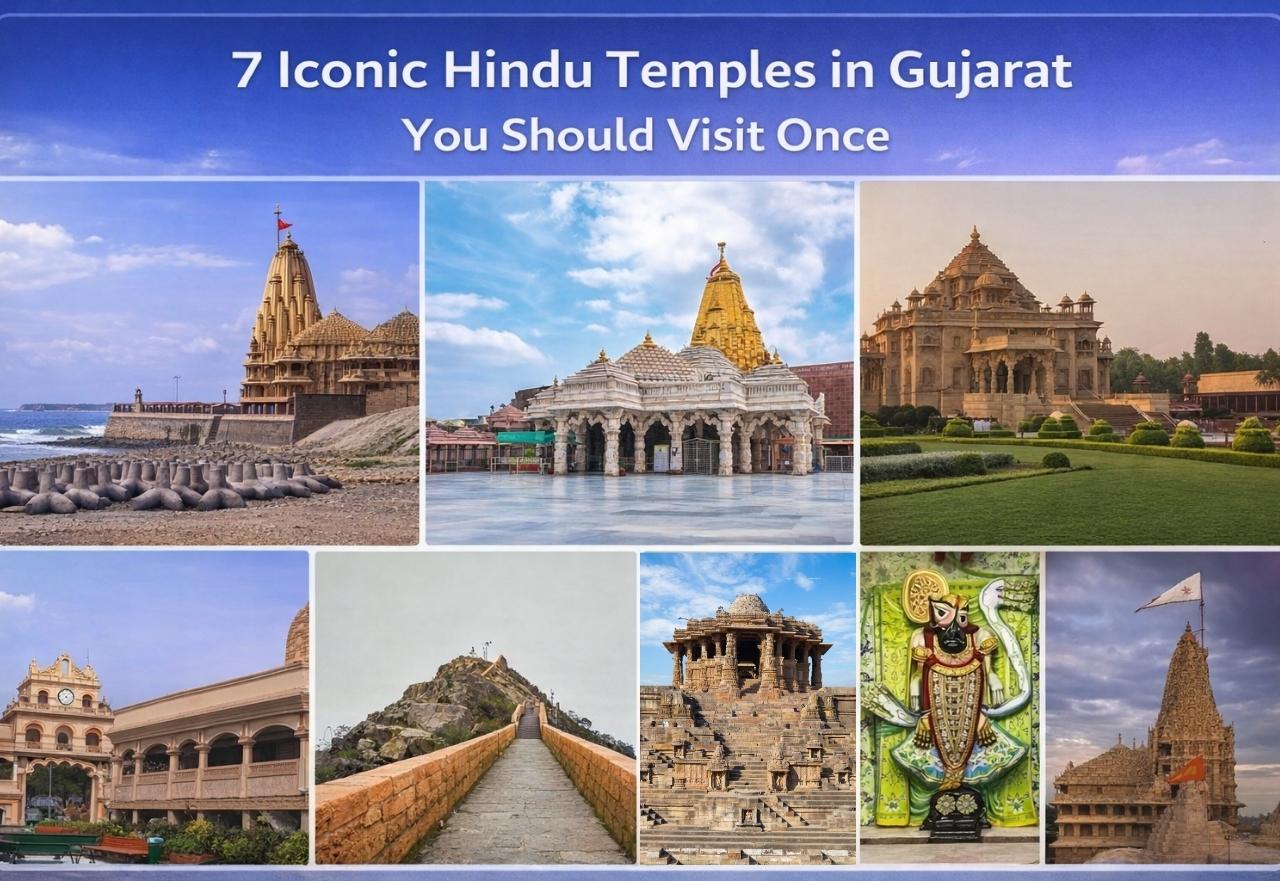
1. Somnath Temple – The Eternal Shrine of Lord Shiva
Location: Prabhas Patan, Saurashtra Coast
Few temples in India embody resilience like Somnath Temple. Revered as the first of the twelve Jyotirlingas of Lord Shiva, Somnath has been destroyed and rebuilt multiple times—yet its spiritual gravity hasn’t dimmed one bit.
Standing right on the Arabian Sea, the present structure showcases Chaulukya (Solanki) architecture, complete with soaring shikharas, intricately carved pillars, and over 1,400 gold-plated kalash crowning the temple. Come evening, when the aarti begins and waves crash rhythmically outside, something quietly profound happens—belief stops being abstract and starts feeling tangible.
Why it stands out:
- First Jyotirlinga of Shiva
- Sea-facing sanctum (rare and powerful)
- Sound-and-light show narrating its epic history
Best time to visit: October to January
2. Dwarkadhish Temple – Kingdom of Lord Krishna
Location: Dwarka, Devbhoomi Dwarka
Welcome to Dwarka—believed to be the ancient kingdom of Krishna himself. At its heart rises the magnificent Dwarkadhish Temple, one of the revered Char Dham pilgrimage sites.
The five-storied structure rests on 72 massive pillars, housing the idol of Dwarkadhish—the King of Dwarka. Devotees swear by the belief that prayers offered here, if sincere, don’t go unanswered. Between darshan queues, temple bells, and the salty coastal breeze, Dwarka feels less like a town and more like a living chapter from the Mahabharata.
Don’t miss:
- Morning Mangla Aarti
- Evening rituals by the Gomti River
- Ferry ride to Beyt Dwarka
Best time: November to February
Also read : Complete Ujjain–Omkareshwar Spiritual Tour (4Days)
3. Ambaji Temple – One of the 51 Shakti Peethas
Location: Banaskantha District
Among India’s most powerful Shakti sites, Ambaji Temple is unique—and not just spiritually. There’s no idol inside the sanctum. Instead, worship centers around a sacred Shree Yantra, symbolizing the formless feminine cosmic energy of Goddess Amba.
Pilgrims often climb Gabbar Hill—about 300 steps—to experience sweeping views and a calm that settles deep in the chest. During Navratri, Ambaji transforms into a sea of devotion, dance, and chanting that’s impossible to forget.
Spiritual highlights:
- Yantra-based worship
- Navratri celebrations
- Hilltop pilgrimage ascent
Best time to visit: Year-round (peak energy during Navratri)
4. Swaminarayan Akshardham – Faith Carved in Stone
Location: Gandhinagar
Modern yet timeless, Swaminarayan Akshardham is an architectural marvel built entirely from pink sandstone—no steel, no shortcuts. At its center stands a 7-foot gold-leafed idol of Lord Swaminarayan, radiating serenity.
Beyond the mandir, the complex features exhibitions on Indian values, landscaped gardens, and a Light & Sound Show that’s surprisingly moving. It’s spiritual education done right—visual, emotional, and memorable.
5. Modhera Sun Temple – Where Stone Meets the Sky
Location: Mehsana District
Dedicated to Surya Dev, the Modhera Sun Temple is a masterclass in astronomical alignment. Built in the Maru-Gurjara style, the temple was designed so the first rays of sunrise during equinoxes would illuminate the sanctum—talk about ancient precision!
Carvings here narrate epics like the Ramayana and Mahabharata, while the stepped Surya Kund reflects both sky and stone. Every January, the Uttarardh Mahotsav brings classical dance alive against this historic backdrop.
Best time to visit: October to March
6. Jagannath Temple Ahmedabad – The Pulse of Rath Yatra
Location: Ahmedabad
At over 450 years old, Jagannath Temple Ahmedabad is famous across the state for hosting Gujarat’s largest Rath Yatra. Once a year, massive chariots carrying Jagannath, Balabhadra, and Subhadra roll through the city—crowds swell, chants rise, and Ahmedabad becomes a river of devotion.
Outside festival season, the temple still hums with daily rituals and quiet faith.
Best time to visit: June–July (Rath Yatra season)
7. Girnar Hill – The Sacred Ascent of 10,000 Steps
Location: Near Junagadh
Last, but absolutely not least, is Girnar Hill—a pilgrimage that demands effort and rewards perseverance. Nearly 10,000 stone steps wind upward past Hindu and Jain temples, eventually reaching Gorakhnath Temple at 1,117 meters, Gujarat’s highest point.
It’s tough. It’s sweaty. And yes, it’s totally worth it—especially during the Bhavnath Mahadev Mela.
Best time: November to February
Frequently Asked Questions
Q1. How many days are ideal for this pilgrimage?
A minimum of 7–10 days allows a comfortable pace.
Q2. Is Gujarat suitable for first-time pilgrims?
Absolutely! Infrastructure, safety, and signage are solid.
Q3. Are these temples open year-round?
Yes, though festivals and winters offer the best experience.
Q4. Can families and senior citizens manage Girnar Hill?
It’s demanding—plan rest breaks or consider partial climbs.
Conclusion
If you’ve been looking for a journey where belief, history, and architecture blend seamlessly, 7 Must-Visit Hindu Temples in Gujarat: A Complete Pilgrimage & Heritage Guide isn’t just a catchy title—it’s an invitation. From sea-kissed Jyotirlingas to sun-aligned sanctums and stairways that test both legs and faith, Gujarat offers a pilgrimage that lingers long after the trip ends.
So don’t just travel—seek. Gujarat’s temples aren’t waiting to be ticked off a list; they’re waiting to be experienced.