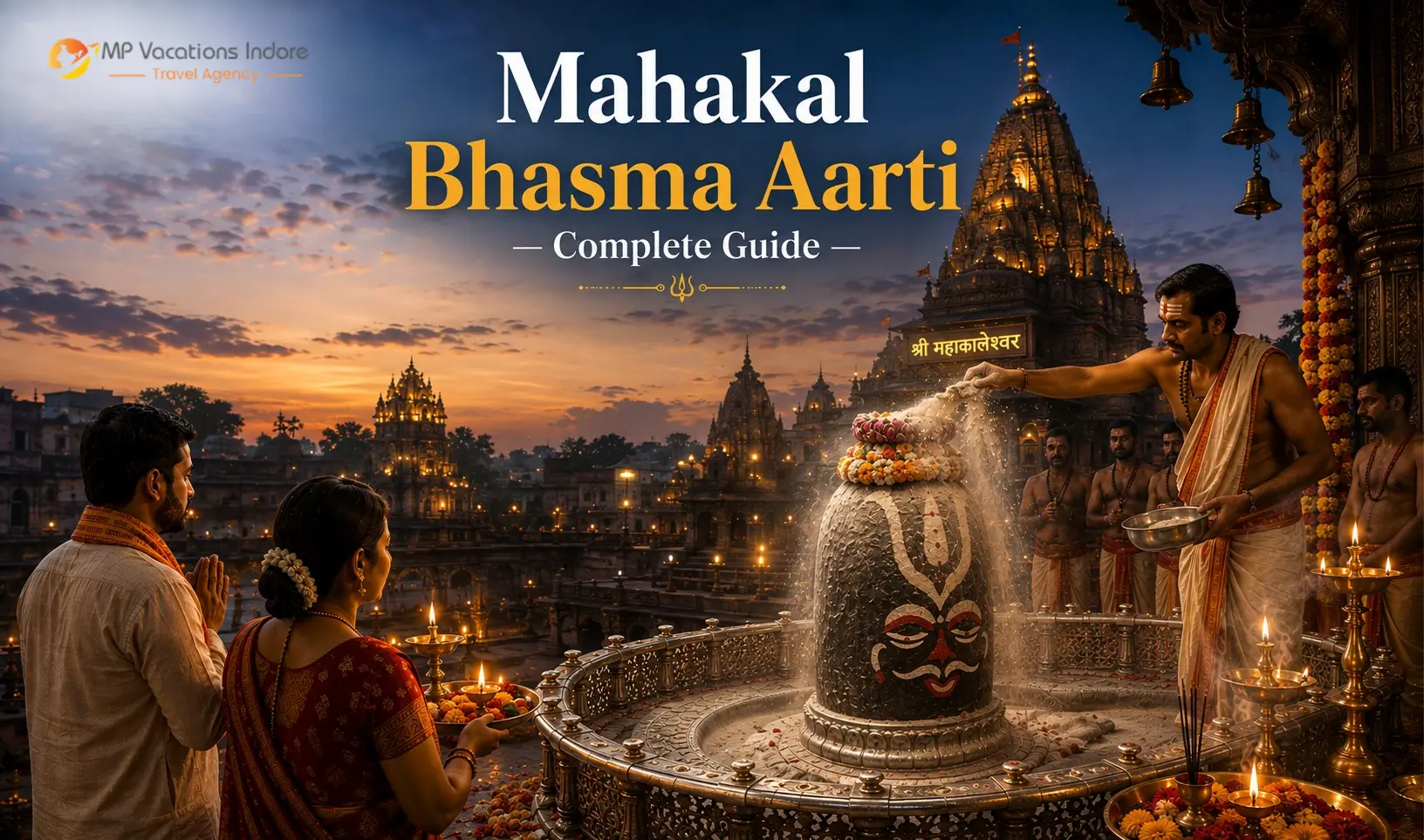
Before dawn, when Ujjain is still largely quiet, a distinctive ritual takes place at the Mahakaleshwar Jyotirlinga: sacred ash is ceremonially offered to the Shiva Lingam. This is the Bhasma Aarti — a ritual performed only at this temple, among all twelve Jyotirlingas, in this exact form.
This guide explains what Mahakal Bhasma Aarti is, what its history actually establishes versus what tradition believes, why ash is central to its worship, how it is performed today, and how to plan a visit from Indore, the nearest major city and the most common starting point for this journey.
Bhasma Aarti at Mahakaleshwar, Ujjain: Quick Facts
| Detail | Information |
|---|---|
| Location | Shri Mahakaleshwar Jyotirlinga Temple, Ujjain |
| Deity | Shiva, worshipped here as Mahakal |
| State | Madhya Pradesh, India |
| Ritual | Bhasma Aarti (sacred ash offering) |
| Timing | Generally 4:00–6:00 AM daily; verify current official timing before travel, as it can shift on festival days |
| Frequency | Performed every day; procedure adapts on Mahashivratri, Shravan Mondays and Holi |
| Bhasma (ash) used today | Current sources describe ash prepared through the temple’s own sacred fire tradition, not from cremation grounds — see the dedicated section below |
| Who performs it | Authorised sanyasis of Shri Panchayati Akhada Mahanirvani, assisted by temple priests |
| Booking | Advance registration with valid photo ID required for guaranteed seating; verify current process on the official portal |
| Dress code | Traditional dhoti (men) / saree (women) required for closer ritual-seating categories; verify by category |
| Main significance | Symbolises the impermanence of the material body and Shiva’s mastery over time and death |
What Is Bhasma Aarti?
Bhasma Aarti is the pre-dawn ritual at Mahakaleshwar Temple, Ujjain, in which the Shiva Lingam is bathed, decorated and then ceremonially offered sacred ash (bhasma). It is performed daily by authorised representatives of the Mahanirvani Akhada and is described across religious and tourism sources as unique among the twelve Jyotirlingas.
Mahakaleshwar Jyotirlinga is one of the twelve traditionally recognised Jyotirlingas — sites where Shiva is believed to have manifested as a column of light — and is located in Ujjain, Madhya Pradesh. Bhasma, in Sanskrit and Hindi, means sacred ash; it is also called vibhuti in wider Shaiva usage. Aarti is the act of worship performed with lit lamps, usually with bells and chanting.
Bhasma Aarti is distinct from an ordinary morning puja in three ways: the central offering is ash rather than the more typical milk, honey and flowers; it is conducted by an ascetic order rather than the resident temple priesthood alone; and it happens daily, not only on special occasions.
Book your Mahakaleshwar tour with MP Vacation Indore – Ujjain 2 Day Itinerary with Mahakaleshwar & Bhasma Aarti
Why Is Mahakaleshwar Called Mahakal?
“Kala” means time in Sanskrit, and by extension death, since time consumes everything. “Maha” means great. Mahakal is Shiva worshipped as the one who governs and transcends time — reflected architecturally in the temple’s Dakshinamukhi (south-facing) orientation, a feature widely described as unique among the twelve Jyotirlingas.
South, in Hindu cosmology, is traditionally the direction of Yama, the god of death. A deity facing south is popularly and tantrically understood as one who confronts or presides over that direction, rather than being subject to it — a devotional and symbolic reading, not a literal or scientific claim. Multiple religious sources connect this orientation to Ujjain’s broader tantric traditions, discussed later in this guide.
The History of Mahakaleshwar Temple: Site vs. Structure
Ujjain’s sacredness and Mahakal worship date back over two thousand years, supported by textual and numismatic evidence. The present physical temple, however, is substantially a 12th-century Paramara-era reconstruction rebuilt again in the 18th century under Maratha commander Ranoji Shinde — not an unbroken ancient structure.
It is important not to blur two separate claims: the antiquity of the sacred site, and the age of the physical building standing today.
Ujjain, called Avantika or Avanti in ancient sources, is one of Hinduism’s Saptapuri — its seven most sacred cities — and was historically a major centre of scriptural learning and astronomy. According to Incredible India, the Government of India’s official tourism portal, historical references indicate King Chanda Pradyota appointed Prince Kumarasena to oversee the temple in the 6th century BC, and punch-marked coins from Ujjain dated to the 4th–3rd century BC carry the figure of Shiva — early numismatic evidence of an established Shiva cult in the city, not proof of the current building’s age.
The same government source states the temple was reconstructed in the 12th century AD under Paramara kings Udayaditya and Naravarman, and several sources note the complex was damaged during 13th-century invasions, commonly associated with Sultan Shamsuddin Iltutmish. It was substantially rebuilt in the 18th century, with Incredible India specifically crediting Maratha commander Ranoji Shinde, serving under Peshwa Bajirao I, with major renovation work. The temple’s architecture today is generally described as a blend of Bhumija, Chalukya and Maratha styles, and continues to be developed — most visibly through the recent Mahakal Lok Corridor.
Explore MP Vacation Indore’s Mahakaleshwar tour packages – Ujjain Omkareshwar Tour Package from Pune (3 Days)
Historical Timeline
Ancient Avantika and early Shiva worship → Early historical/numismatic evidence — Chanda Pradyota, Kumarasena, Shiva-marked coins (6th–3rd century BC) → Puranic tradition of Mahakala takes literary shape (dating uncertain) → Paramara-era reconstruction under Udayaditya and Naravarman (12th century AD) → Destruction associated with 13th-century invasions → Maratha-era rebuilding under Ranoji Shinde (18th century AD) → Scindia-era administration and later development → Modern Temple Management Committee and the Mahakal Lok Corridor
Mahakaleshwar in the Puranas: The Story of Chandrasena, Shrikhar and Dushan
According to Puranic tradition — not documented history — King Chandrasena of Ujjain’s devoted worship, and the prayers of a boy named Shrikhar and a priest named Vridhi, led Shiva to appear in his fierce Mahakala form, destroy the invading demon Dushan, and agree to remain in Ujjain permanently as the Mahakaleshwar Jyotirlinga.
The Puranic literature — chiefly traditions connected to the Shiva Purana and, for Ujjain specifically, the Skanda Purana’s Avantikhanda — describes Mahakal as one of the twelve Jyotirlingas. The Varaha Purana is cited by Madhya Pradesh Tourism as the traditional source for the belief that Ujjain sits at the Nabhi (navel) of the earth, a cosmological rather than geographical claim.
The most widely repeated legend, as recounted by Madhya Pradesh Tourism and Incredible India, runs as follows. King Chandrasena, a devoted worshipper of Shiva, once turned away a boy named Shrikhar from joining his prayers. Sent to the city’s outskirts near the river Kshipra, Shrikhar learned that rival kings Ripudamana and Singhaditya, aided by a demon named Dushan (granted invisibility by Brahma), were plotting to attack Ujjain. Shrikhar prayed for the city’s protection; a priest named Vridhi joined him. The invasion went ahead regardless, and the city was plundered — until Shiva, answering his devotees’ pleas, appeared in his Mahakala form and destroyed Dushan and the invading forces. At Shrikhar and Vridhi’s request, Shiva agreed to remain in Ujjain as its presiding deity.
A separate account, drawn from the Shiva Purana’s Koti Rudra Samhita, instead centres on a Brahmin named Vedapriya and his four sons, into whose devotion Shiva is said to have merged as the self-manifested (Swayambhu) lingam.
Who Started Bhasma Aarti? (What History Actually Establishes)
There is no historical record identifying a single founder of Bhasma Aarti. No official temple source, government tourism body, or reputable historical account names a specific king, saint or Mahant who created the ritual. Its roots lie in longstanding Shaiva ascetic tradition and the institutional custodianship of Shri Panchayati Akhada Mahanirvani, which evolved rather than being founded on one identifiable date.
This is one of the most searched questions about the ritual, and also the one most often answered irresponsibly online. Based on the sources reviewed for this guide:
- The use of ash in Shiva worship generally is old and well documented within Shaivism, tied to Shiva’s mythological association with cremation grounds and renunciation — not a single invented custom.
- The specific daily institution of Bhasma Aarti, in its current form, is consistently described by religious, tourism and news sources as a longstanding, continuous temple tradition — but not one source reviewed supplies a specific inscriptional, textual or administrative date marking its beginning.
- The clearest institutional continuity is the ritual’s custodianship by the Mahanirvani Akhada, one of Hinduism’s major Shaiva ascetic orders, whose sanyasis are the only people authorised to perform it, according to current temple-linked news reporting.
The historically responsible answer, and the one this guide adopts, is that Bhasma Aarti was not founded by a single identifiable person. It is better understood as the product of long Shaiva tradition around Mahakal, cremation-ground symbolism, and Akhada custodianship — evolving over a period the historical record does not fix to an exact date.
Book your Mahakaleshwar tour with MP Vacation Indore – Ujjain – Omkareshwar Overnight Jyotirlinga Yatra (2Days)
How Old Is Bhasma Aarti?
Sources consistently describe Bhasma Aarti as an old and continuous Shaiva tradition, but none of the sources reviewed for this guide provide a specific founding year or century. Any claim of an exact starting date should be treated with caution unless it cites a primary temple record or academic source.
Why Is Bhasma Offered to Mahakal?
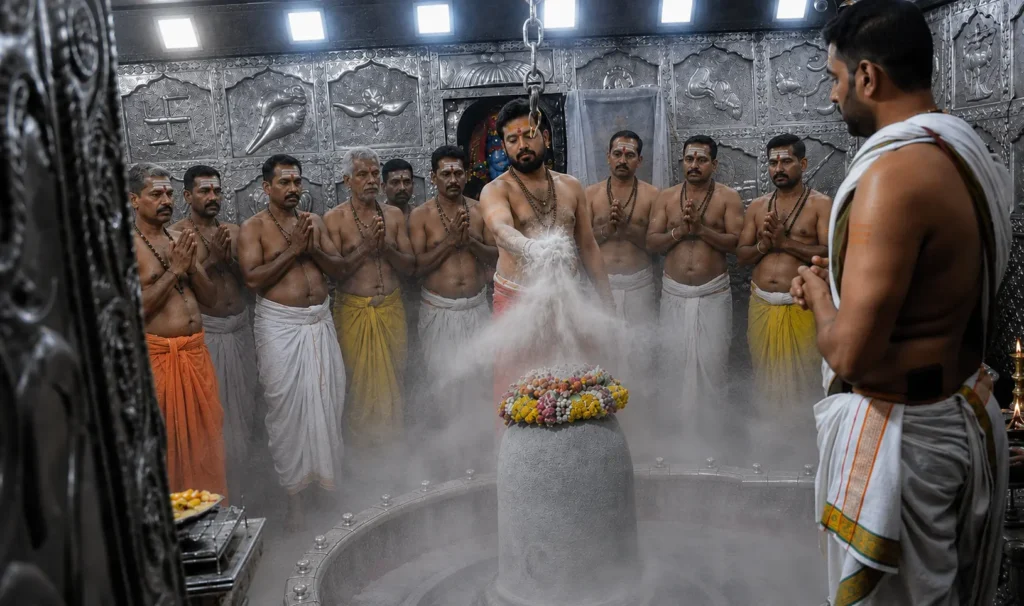
Ash represents the final physical state of all matter and, in Shaiva theology, symbolises the impermanence of the body, the renunciation of ego, and Shiva’s own identity as an ascetic associated with cremation grounds. Offering it to Shiva as Mahakal — lord of time — connects the ritual directly to his theological role as master of mortality.
Several overlapping ideas explain this, rather than one single reason.
Ash as the honest end-state of matter. Everything physical eventually becomes ash when burned. In Shaiva thought, this makes ash the most direct possible symbol of anitya (impermanence) — offering it to Shiva ritually acknowledges that the body is temporary while the divine is not.
Shiva as the ascetic of the cremation ground. Hindu mythology closely associates Shiva with cremation grounds (smashana), depicting him smeared in ash, meditating among the dead, unmoved by what conventional society treats as impure. This imagery is central to Shaivism’s framing of Shiva as a deity beyond ordinary categories of pure and impure.
Renunciation and the destruction of ego. In ascetic (sannyasi) practice broadly, ash on the body marks a person who has symbolically “died” to worldly identity — a concept called vairagya. Offering ash to the deity extends this symbolism to devotees, who commonly receive a mark of vibhuti on their own foreheads.
Death and liberation, not despair. This symbolism is not intended as morbid. In Shaiva theology, confronting impermanence honestly is presented as a path toward liberation (moksha). Devotees are described across multiple sources as finding the ritual reassuring rather than frightening — a devotional belief, presented here as such.
Was Cremation Ash Historically Used? Legend vs. Present Practice
According to tradition, ash from the first funeral pyre lit in the cremation ground the previous night was historically used. Current, independently reported practice, however, describes the ash used today as prepared through the temple’s own sacred fire and ritually burnt material — not human cremation ash. No credible current source states cremation ash is used at Mahakaleshwar today.
This is one of the most commonly confused points about the ritual, so the two accounts are set out separately.
The traditional/legendary account. Several devotional and travel sources state that, according to tradition, ash from the cremation ground’s first nightly pyre was historically used in the ritual. These sources themselves frame this as belief or legend (“it is said,” “according to tradition”) rather than as a documented administrative practice with dated records.
Current, independently reported practice. More recent sources, including 2025–2026 travel and news coverage, describe the ash used today as prepared through the temple’s continuously burning sacred fire (the Dhuni), and/or from burnt cow-dung cakes and specific sacred woods. A 2026 IANS report specifically names Gohari, Peepal, Palash, Shami and Bel as the woods used.
These most plausibly describe two different periods rather than a single contradiction: an older, legend-associated practice, and the present, temple-managed method. Readers should treat the cremation-ash story as historical/traditional narrative explaining the ritual’s symbolism, and the sacred-fire/cow-dung-cake account as the accurate description of current practice.
What Is the Bhasma Made From Today?
Current sources describe the ash used in Bhasma Aarti as prepared through the temple’s own ritual fire tradition — drawn from the continuously burning Dhuni within the temple, and/or freshly prepared from burnt cow-dung cakes and sacred woods including Gohari, Peepal, Palash, Shami and Bel — under the authority of the Mahanirvani Akhada.
Very specific procedural detail beyond this (exact quantities, exact preparation timing) is not independently documented in public sources reviewed for this guide, and this article limits itself to points corroborated across more than one source rather than repeating single-source blog claims as fact.
Book your Mahakaleshwar tour with MP Vacation Indore – Ujjain-Omkareshwar tour from Mumbai (3 days)
Role of Shri Panchayati Akhada Mahanirvani
Shri Panchayati Akhada Mahanirvani is a major Shaiva ascetic order (an Akhada) whose sanyasis are the only people currently authorised to perform Bhasma Aarti at Mahakaleshwar; regular temple priests assist with coordination but do not conduct the ash offering itself.
An Akhada is a centuries-old institution of organised Hindu ascetics, historically combining spiritual training with, in some traditions, physical discipline — the same word is also used for a wrestling ground, reflecting this dual heritage. Akhadas hold recognised religious authority within Shaivism and play a central role in events such as the Kumbh Mela.
Mahanirvani Akhada is one of the major Shaivite shastradhari orders (those that carry religious scripture and insignia). According to its own tradition, cited by Wikipedia, its heritage is said to stretch back millennia, though it was formally organised in 748 CE at Gangasagar, later established near Neel Dhara in Haridwar, with Adi Shankaracharya credited with strengthening its formal organisation.
At Mahakaleshwar specifically:
- The Bhasma Aarti is conducted by the Mahanirvani Akhada, not the temple’s general priesthood.
- Only Mahanirvani Akhada sanyasis are authorised to perform the ritual.
- No devotee, male or female, enters the Garbhagriha (inner sanctum) during the ritual — it is witnessed from designated seating, not from within the sanctum itself.
This makes the Akhada’s role structurally different from an ordinary temple management committee: it represents an older, independent line of religious authority operating within the temple’s daily ritual calendar.
Step-by-Step: How Mahakal Bhasma Aarti Is Performed
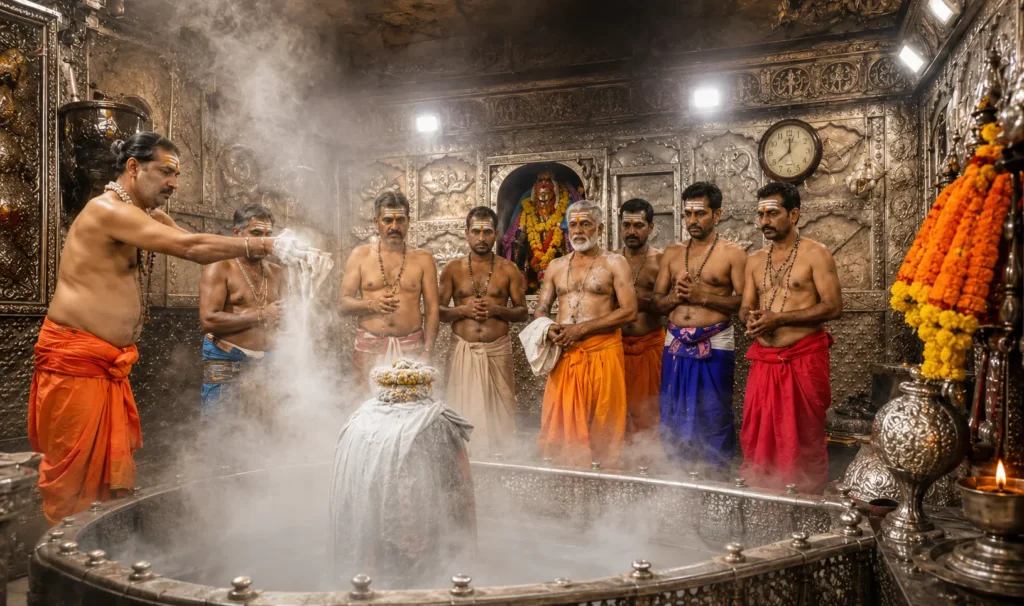
The ritual generally follows a fixed sequence: the temple opens before dawn, the Jyotirlinga is bathed with water and Panchamrit, decorated with sandalwood, flowers and Bilva leaves, then offered sacred ash by Mahanirvani Akhada representatives, followed by the Aarti with lamps, bells and conch, and finally darshan for devotees present.
Based on multiple corroborating descriptions (temple-affiliated sources, pilgrimage guides and festival-day news coverage):
- Temple opens in the pre-dawn hours, typically around 4:00 AM — though one Shravan Monday news report recorded doors opening around 2:30 AM to manage exceptional crowds.
- Jalabhishek and Panchamrit abhishek — the lingam is bathed first with water, then with Panchamrit (milk, curd, honey, ghee and sugar).
- Cleaning and decoration — sandalwood paste, flowers and Bilva leaves, sacred to Shiva, are applied.
- The ash offering — Mahanirvani Akhada representatives bring forward and apply the sacred ash, the ritual’s central act.
- Aarti — lamps are waved to the sound of bells, conch shells and chanting.
- Darshan — devotees view the fully adorned, ash-covered deity; several sources describe this transition from formless to manifest form as devotionally significant in itself.
On major festivals the sequence adapts. On Holi, 2026 news coverage describes Holika Dahan performed the previous evening, followed by grand decoration and gulal (coloured powder) shown alongside the ash offering.
On women and the ritual specifically: Current reporting (IANS, April 2026) states that, per long-standing tradition, women do not view the ash-offering moment in the same way men do and instead keep their heads covered with an odhni or veil during darshan — a documented current custom, not a blanket exclusion from the temple.
Why Is Mahakal Bhasma Aarti Performed Before Sunrise?
The pre-dawn hours (Brahma Muhurta) are considered the most spiritually favourable time in Hindu tradition for the day’s first worship. The specific 4:00–6:00 AM window observed today is the temple’s current scheduled practice, and can shift on festival days — it should be understood as a maintained scheduling tradition rather than an unchanging ancient clock-time.
Performing the day’s first, most significant aarti in this window is standard at many major Shiva and Vishnu temples — it is not unique to Mahakaleshwar. What is unique is what is offered at that hour: ash rather than the more typical morning items.
Book your Mahakaleshwar tour with MP Vacation Indore – Ujjain – Omkareshwar Overnight Jyotirlinga Yatra (2Days)
Why Is Bhasma Aarti Unique to Mahakaleshwar?
Multiple independent religious, tourism and pilgrimage sources describe this exact combination — a daily ash offering, performed by an Akhada, at a south-facing Jyotirlinga associated with mastery over death — as found nowhere else among the twelve Jyotirlingas.
This claim is reasonable based on the consistency with which independent sources repeat it. It is worth being precise, however, about scope: ash (vibhuti) offerings exist elsewhere in Shaivism more generally; what is being described as unique is this specific, daily, Akhada-administered temple ritual — not the broader use of sacred ash in Hindu worship.
Religious Symbolism of the Ritual’s Elements
| Element | Symbolic Meaning |
|---|---|
| Water (Jalabhishek) | Purification — the base offering in Shiva worship |
| Panchamrit | Nourishment and auspiciousness |
| Sandalwood | Coolness, calming Shiva’s fierce aspect |
| Bilva leaves | Considered especially dear to Shiva |
| Flowers | The manifest, decorated aspect of the deity |
| Bhasma (ash) | Impermanence and Shiva’s transcendence of the material world |
| Bells and conch | Auspicious sound marking the ritual’s sacredness |
| Lamps (Aarti) | Light dispelling darkness, literal and spiritual |
| South-facing orientation | Popularly and tantrically read as mastery over Yama’s direction |
Devotees and religious writers commonly describe the ritual as moving through purification and decoration (creation/preservation) toward the ash offering (destruction/impermanence) and finally the Aarti’s light (renewal) — echoing Shiva’s theological role across creation, preservation and destruction. This is a devotional interpretive framework, not a claim of scriptural literalism.
Book your Mahakaleshwar tour with MP Vacation Indore – Senior Citizen Jyotirlinga Tour – Omkareshwar & Ujjain (3Days)
Mahakal Bhasma Aarti and Shaiva Ascetic Traditions
The ritual’s connection to ascetic Shaivism is administrative as well as symbolic, since it is performed by an Akhada rather than a hereditary priestly lineage. This links Mahakaleshwar’s daily worship to renunciate Shaiva orders whose members have historically practised smearing the body in ash and, in some ascetic sub-traditions, deliberately engaging with cremation-ground imagery as spiritual discipline.
It would be inaccurate to state that the Mahakaleshwar Bhasma Aarti was directly created by Aghori or Kapalika ascetic traditions — historically documented but distinct tantric orders associated with more extreme cremation-ground practice in some medieval sources. No source reviewed for this guide makes that claim. What can be said is that the thematic material — ash, cremation-ground symbolism, confronting death directly — is shared cultural ground across Shaiva ascetic traditions generally, of which Mahanirvani Akhada, a mainstream Shastradhari order, is the one with documented institutional authority here.
MahakalBhasma Aarti and Ujjain’s Tantric Traditions
Ujjain carries a long-standing reputation as a centre of tantric practice within Hinduism. Several sources connect Mahakaleshwar’s south-facing orientation to a tantric shivnetra tradition said to be unique among the Jyotirlingas to this temple. Ujjain is also home to other sites central to Shakta and tantric worship, including the Kal Bhairav Temple and the Harsiddhi Temple, one of the Shakti Peethas — both discussed further below. This reputation is treated here as documented cultural and religious tradition; this guide does not describe specific esoteric ritual content beyond what is already openly discussed in tourism and religious sources.
Mahakal Bhasma Aarti During Mahashivratri and Shravan
During Shravan Mondays and Mahashivratri, the temple opens significantly earlier and manages far larger crowds than on an ordinary day; one Shravan Monday report recorded doors opening around 2:30 AM with over three lakh devotees expected. Booking slots and reporting-time expectations become tighter during these periods.
Devotees planning a visit during Shravan month, on Mondays specifically, or around Mahashivratri, should expect substantially larger crowds, earlier opening times, tighter security and faster booking-slot exhaustion. If a calmer, more spacious experience of the ritual is the priority, visiting outside these peak periods is worth considering — though many devotees deliberately choose Shravan or Mahashivratri specifically for their heightened religious significance, which is an entirely valid reason to visit then instead.
Current Rules for Devotees
Current sources consistently report that advance booking with valid photo ID is required for guaranteed seating, photography inside the sanctum is prohibited, a dress code applies to closer seating categories, and reporting well before the scheduled time is expected. Because some details (exact mobile-phone rules, exact fees) vary across sources, verify specifics on the official portal before travel.
- Advance booking is required for guaranteed seating; walk-in entry is not reliable, especially in peak season.
- Valid original government photo ID (commonly Aadhaar) is required, matching the name used at booking.
- A dress code applies in the closer ritual-seating categories (detailed below).
- Photography and videography inside the sanctum/ritual hall are consistently reported as prohibited. Rules on simply carrying a phone are reported inconsistently — confirm before travel.
- Reporting time is commonly cited as 30 minutes to an hour before the slot, with much earlier arrival advisable during peak periods.
- Silence and decorum are expected throughout.
- Children under a commonly cited age of five are often permitted free with an adult; older children typically need their own pass.
- Use only officially authorised booking channels. Multiple sources independently warn about touts and unofficial “guaranteed booking” services.
How Do You Book Mahakal Bhasma Aarti?
Bookings are handled directly by the temple through its official website, shrimahakaleshwar.com, under the Bhasma Aarti section. This is the only channel Madhya Pradesh Tourism itself links to, so it’s the one to trust.
You’ll come across other websites and apps claiming to offer “guaranteed” Bhasma Aarti passes — some even use similar-sounding domain names. Don’t pay through any of them. Before entering payment details anywhere, double-check that you’re actually on the temple’s own site and not a lookalike.
The general process reported across current guides:
- Visit the official website and locate the Bhasma Aarti / devotee-services booking section.
- Register or log in, and select an available date from the booking calendar.
- Enter devotee details exactly as they appear on a valid government photo ID, and upload it.
- Complete payment where applicable, and download or print the confirmation.
- Carry the original ID used for booking, plus the confirmation, to the temple on the day.
Reported entry fees vary across sources (a low general range is commonly cited for standard Bhasma Aarti entry, with separate higher figures cited for VIP or closer-seating categories). Because these figures are inconsistent, this guide does not state a specific fee as fact — verify the current amount on the official portal. Several sources note booking windows commonly open around 30 days in advance and fill within minutes for popular dates.
Where planning support helps: This is exactly the stage where independent travellers most often lose a preferred date — simply from not knowing the exact booking-window opening time or being unfamiliar with the portal. An Indore-based operator that regularly arranges this exact visit can help time the booking attempt and build the rest of the Ujjain trip around whichever slot is actually secured.
What Is the Dress Code for Mahakal Bhasma Aarti?
For the closer, paid ritual-seating categories, men are generally expected to wear a traditional unstitched dhoti (with the upper body often expected to remain bare, per ritual custom), and women a saree; Western clothing is not permitted in these categories. General darshan outside these categories is more flexible but still expects modest, traditional attire.
- Men: Traditional unstitched dhoti for closer seating categories; several sources note the upper body is traditionally expected to remain bare in that inner area. Shirts, trousers, jeans and stitched Western clothing are described as not permitted there.
- Women: Saree (commonly cotton or silk) is the expected traditional attire for closer categories; guidance for unmarried women is less uniform across sources. Jeans, leggings, sleeveless tops and skirts are described across multiple sources as not permitted in these categories.
- General darshan is reported to be more flexible, expecting modest, respectful Indian attire rather than the strict dhoti/saree requirement.
- Leather items are sometimes restricted; footwear is removed before entry, with storage typically available.
Because strictness is reported to vary by exact seating/ticket category, confirm the specific dress requirement for your booking with the temple or your tour operator before travelling.
Can Women Attend Mahakal Bhasma Aarti?
Yes — women participate in darshan, but per long-standing, currently documented temple tradition, they keep their heads covered and do not view the ash-offering moment in the same direct manner as men. This is a specific, well-documented custom, not a blanket exclusion from the ritual or the temple.
This distinction matters because it’s often gotten wrong online in one of two opposite ways — either the claim that women simply aren’t allowed to attend, or the assumption that there’s no real difference in how men and women experience the ritual. Neither holds up. Based on current reporting from April 2026, the reality sits between those two extremes, and that’s the version this guide has gone with.
Book your Mahakaleshwar tour with MP Vacation Indore – Luxury Mahakaleshwar–Omkareshwar Spiritual Retreat (4Days)
What to Expect During the Experience
Ujjain, in the hour or two before dawn, is unusually alive for what is otherwise the quietest part of the day. Devotees begin arriving before the gates open, moving through security checks in the dark.
Inside, the hall fills gradually. The atmosphere is generally described as anticipatory and hushed rather than festive, occasionally broken by chanting. When the ritual begins, the sequence of water, Panchamrit, sandalwood and flowers unfolds at a measured pace before the central moment: the ash offering, met with a rise in bells and conch.
Multiple sources describe devotees as visibly moved during this part of the ritual. This guide presents that as a widely and consistently reported devotional response, not a guarantee of any individual’s experience — how any one visitor reacts is naturally personal. By the time the Aarti concludes, the sky outside has usually begun to lighten, a detail several visitors note as part of what makes the ritual feel complete.
Mahakaleshwar and the Sacred Geography of Ujjain
Mahakaleshwar sits within a wider network of sacred sites in Ujjain:
- Kal Bhairav Temple — associated with the fierce, protector aspect of Shiva, known for its tradition of offering liquor to the deity.
- Harsiddhi Temple — one of the Shakti Peethas, sites connected to the goddess Sati/Parvati.
- Ram Ghat, on the Kshipra (Shipra) River — a major bathing ghat, central to the Simhastha Kumbh tradition (next due in Ujjain in 2028) and everyday ritual bathing.
- Mangalnath Temple — traditionally associated with the birth of the planet Mars (Mangal) in Hindu astrology.
- Sandipani Ashram — traditionally identified as the site where Krishna and Balarama received their education.
- Mahakal Lok Corridor — a large, recently developed pilgrim corridor around the temple, featuring statuary depicting Shiva mythology, best appreciated in daylight given its scale.
On the Kshipra River specifically: Ram Ghat and the Kshipra sit right at the heart of Ujjain’s spiritual life, tied closely to the city’s bathing rituals over the centuries. You’ll sometimes hear it said that the ash used in Bhasma Aarti actually comes from the riverbank, or from cremations that take place near it. It’s a nice story, but it doesn’t hold up — what actually goes into the ritual is ash prepared through the temple’s own sacred fire, made from specially prepared materials, not anything pulled from the river. So that’s the version worth believing.
Legend, Faith and History: What We Know About Mahakal Bhasma Aarti
| Subject | What tradition says | What historical evidence establishes |
|---|---|---|
| Origin of Mahakal | Shiva appeared as Mahakala to destroy the demon Dushan and protect King Chandrasena’s Ujjain, then chose to remain permanently (Puranic legend) | Ujjain’s Shiva worship is attested by numismatic evidence (Shiva-marked coins, 4th–3rd century BC) and administrative records (Kumarasena’s appointment, 6th century BC); the Chandrasena narrative itself is not independently verified as historical event |
| Origin of Bhasma Aarti | Some devotional accounts hold that Shiva himself instructed worship with ash | No source establishes a specific founding date or documented origin event for the ritual as currently practised |
| Funeral-pyre ash | Tradition holds that ash from the cremation ground’s first nightly pyre was historically used | No current official or news source confirms cremation ash is used today; current reporting describes ash from the temple’s own sacred fire and ritually burnt material |
| Role of Mahanirvani Akhada | Regarded by tradition as the rightful, exclusive performers of the ritual, tied to the Akhada’s own ancient ascetic lineage | Contemporary news reporting (2026) confirms the Akhada is the current, sole authorised performer of the ritual; the Akhada’s own formal organisation is dated by its tradition to 748 CE |
| Founder of Bhasma Aarti | No consistent single-founder tradition exists across sources | No historical record identifies an individual founder |
| Present-day Bhasma | Popularly assumed by some to still involve cremation-ground material | Current sources describe temple-prepared ash from sacred fire, cow-dung cakes and specific woods (Gohari, Peepal, Palash, Shami, Bel) |
| Temple structure’s age | Popularly assumed to be entirely ancient and unchanged | Government sources confirm 12th-century Paramara and 18th-century Maratha reconstruction; the site’s sacredness is ancient, the standing structure is not unchanged since antiquity |
Common Myths About Mahakal Bhasma Aarti
Myth: Human cremation ash is still used today. Not supported by current sources. The most consistent, most recent accounts describe temple-prepared ash from sacred fire and ritually burnt material, not cremation-ground ash.
Myth: The ritual was definitely started by one specific person. Not supported. No credible source names a historical founder.
Myth: Anyone can walk in at 4 AM without booking. Not accurate for guaranteed seating; advance registration with ID is consistently required, particularly for paid seating categories.
Myth: The current temple structure is unchanged since ancient times. Not accurate; the site is ancient, the standing structure reflects 12th- and 18th-century reconstruction.
Myth: Mobile phones and photography are always fine inside. Photography inside the sanctum/ritual hall is consistently prohibited; rules on simply carrying a phone vary by source and should be confirmed.
Myth: Women cannot visit Mahakaleshwar for Bhasma Aarti at all. Overstated. Women participate in darshan with heads covered and do not view the ash-offering the same way men do — a specific documented custom, not a blanket exclusion.
Why Devotees Consider Bhasma Aarti Spiritually Powerful
Devotees across the sources reviewed describe a consistent set of beliefs: relief from the fear of death, protection connected to Mahakal’s death-conquering symbolism, an emotional confrontation with impermanence described as clarifying rather than distressing, and spiritual renewal tied to witnessing the deity move from formless to fully manifest. These are devotional beliefs, held sincerely and widely, and are presented here as beliefs — not as scientifically established claims, consistent with how the sources themselves frame them (“devotees believe,” “it is said”).
How to Reach Ujjain from Indore
Ujjain is approximately 55 km from Indore, roughly 1 to 1.5 hours by road under normal traffic. Indore’s Devi Ahilyabai Holkar Airport is the nearest major airport, and frequent trains connect the two cities in under an hour on express services.
Indore is the natural base for most Bhasma Aarti visitors, since it is Madhya Pradesh’s largest city and its main airport hub.
- Distance: Approximately 55 km by road (route variations put this between roughly 54 and 65 km).
- Travel time by road: Typically 1 to 1.5 hours under normal conditions on well-maintained highway.
- By train: Multiple daily trains connect Indore and Ujjain, with the fastest journey under an hour.
- By air: Devi Ahilyabai Holkar Airport, Indore, is the nearest major airport; Ujjain is reached from there by road.
- For the Bhasma Aarti specifically: Because the ritual begins around 4 AM and gates typically require earlier arrival, a same-day trip from Indore means departing in the very early hours (often 1:30–2:00 AM). This works for a determined day trip, but many pilgrims — families, senior citizens, or anyone unfamiliar with Ujjain’s roads in the dark — find an overnight stay in Ujjain considerably more comfortable, since it removes the pre-dawn drive entirely.
How to Plan a Bhasma Aarti Mahakaleshwar Trip from Indore
A Bhasma Aarti visit involves more moving parts than an ordinary day out: an unforgiving booking window, a pre-dawn schedule, a dress code that varies by seating category, and a city many first-time visitors are navigating in the dark for the first time.
Local planning removes most of the friction: a reliable early-morning vehicle and driver who already knows the temple’s gates and parking situation; a hotel that is genuinely close to the temple rather than merely close on a map; time built in for the rest of Ujjain’s sacred sites rather than treating the Aarti as an isolated errand; and support if the exact booking slot wanted isn’t available on the preferred date.
This matters most for families travelling with children or elderly members, for whom the early hour and queuing time are the main practical hurdles, and for first-time or international visitors, for whom the unfamiliar booking portal and dress-code requirements are the more common sources of last-minute stress.
If you would prefer to have transportation, accommodation and the wider Ujjain itinerary planned in advance rather than coordinating each piece separately, MP Vacation Indore runs pilgrimage circuits built specifically around Ujjain and Mahakaleshwar, with routing that extends to Omkareshwar, Maheshwar and Mandu for travellers who want a fuller Madhya Pradesh circuit.
Suggested Ujjain Itinerary Options
| Option | Duration | Best For |
|---|---|---|
| Same-day Indore–Ujjain pilgrimage | 1 day | Travellers short on time, comfortable with a very early start |
| Indore + Ujjain overnight | 2 days | A relaxed pace without the pre-dawn drive |
| Ujjain + Omkareshwar circuit | 3 days | Unhurried darshan at both Madhya Pradesh Jyotirlingas |
| Mahakaleshwar + Omkareshwar (Jyotirlinga-focused) | 4 days | Pilgrims wanting a dedicated two-Jyotirlinga circuit — see MP Vacation Indore’s Madhya Pradesh Jyotirlinga Tour – 4 Days |
| Ujjain + Indore + Mandu heritage circuit | 6 days | Combining pilgrimage with Mughal-era heritage — see the 5 Nights / 6 Days Indore – Ujjain – Omkareshwar – Maheshwar – Mandu Tour |
| Flexible 2–3 day Jyotirlinga route | 2–3 days | Travellers wanting route and timing detail before booking — see the Indore–Ujjain–Omkareshwar Jyotirlinga tour guide |
Planning a Mahakal Bhasma Aarti Trip from Indore?
A self-planned trip works well for confident, experienced travellers. Where a planned tour genuinely helps is in details that are easy to underestimate until you’re standing at a locked temple gate at 3 AM: knowing exactly when a booking window opens, having a driver who already knows the alternate route when the direct one is congested, and having a fallback plan if a specific date’s slots are already gone.
None of this replaces the personal, devotional nature of the visit — it simply removes the logistics that have nothing to do with faith and everything to do with unfamiliar infrastructure at 3 AM in a city you may be visiting for the first time. For the current range of Indore-based departures, MP Vacation Indore’s tour packages from Indore page lists day trips through to longer circuits.
Book Your Mahakal Bhasma Aarti Online
Booking your Mahakal Bhasma Aarti online is simple enough on paper — head to the temple’s official website, pick a date, upload your ID, and you’re done. In practice, it rarely feels that easy. Slots for popular dates vanish within minutes of opening, the portal can be finicky at peak times, and if you’re not sure which category to pick or what happens if your preferred date is gone, it’s easy to end up stuck at 2 AM with no plan B. This is where having someone who does this regularly actually helps. MP Vacation Indore handles Bhasma Aarti bookings for travellers as part of its Ujjain and Mahakaleshwar packages, taking care of the timing, the paperwork, and the backup options — so you’re not troubleshooting a booking portal in the middle of the night. Pair that with an early-morning pickup from Indore and a hotel that’s actually close to the temple, and the whole trip stops feeling like a logistics puzzle and starts feeling like the pilgrimage it’s meant to be.
Frequently Asked Questions
What is Mahakal Bhasma Aarti? It is the pre-dawn ritual at Shri Mahakaleshwar Temple, Ujjain, in which the Jyotirlinga is bathed, decorated and offered sacred ash, performed daily under the authority of the Mahanirvani Akhada. It is described across sources as unique among the twelve Jyotirlingas.
Who started Bhasma Aarti at Mahakaleshwar? There is no historical record identifying a single founder. Its origins lie in longstanding Shaiva ascetic tradition and Mahanirvani Akhada custodianship, which evolved over time rather than being created by one person on a documented date.
How old is Bhasma Aarti? It is consistently described as an old, continuous temple tradition, but no source reviewed provides an exact founding date — treat any specific date claim with caution.
Is human cremation ash used in Mahakal Bhasma Aarti today? No. Current sources describe ash prepared through the temple’s own sacred fire tradition, from cow-dung cakes and specific sacred woods. The cremation-ash story belongs to older legend, not documented current practice.
What is the Bhasma used for Mahakal Bhasma Aarti made from? Ash from the temple’s ritual fire (the Dhuni) and/or burnt cow-dung cakes and woods such as Gohari, Peepal, Palash, Shami and Bel, according to current reporting, prepared under Mahanirvani Akhada authority.
Why is Bhasma offered to Mahakal? Ash symbolises the impermanence of the material body and Shiva’s transcendence of time and death, connecting directly to his theological identity as Mahakal, lord of time.
Why is Mahakaleshwar called Mahakal? “Maha” (great) plus “Kala” (time/death) — Shiva as the one beyond and governing time, reflected in the temple’s unique south-facing (Dakshinamukhi) orientation.
What time is Bhasma Aarti in Mahakaleshwar performed? Generally 4:00–6:00 AM daily, though timing shifts earlier on Shravan Mondays and other festivals. Always confirm the current schedule before travelling.
Is Mahakal Bhasma Aarti performed every day? Yes, daily, with the procedure adapted on major festivals such as Holi and Mahashivratri.
How can I book Mahakal Bhasma Aarti? Through the temple’s official website (shrimahakaleshwar.com, per Madhya Pradesh Tourism’s own link), with valid photo ID. Slots reportedly open around 30 days in advance and fill quickly.
What is the dress code for Bhasma Aarti Mahakaleshwar ? Traditional dhoti for men and saree for women in the closer ritual-seating categories; general darshan is more flexible but still expects modest, traditional attire. Confirm the exact requirement for your booking category.
Can women attend Mahakal Bhasma Aarti? Yes, women take part in darshan, but per documented tradition keep their heads covered and do not view the ash-offering the same way men do.
How early should I reach the temple? Commonly 30 minutes to an hour before your slot; during Shravan or Mahashivratri, arriving considerably earlier is advisable given queue volumes.
Can children attend Bhasma Aarti Mahakaleshwar ? Yes; children under a commonly cited age of five are often free with an adult, while older children typically need their own booked pass.
Can foreign tourists attend? Yes, subject to the same booking, ID and dress-code requirements as domestic visitors.
Can I take photographs during Mahakal Bhasma Aarti? No — photography and videography inside the sanctum/ritual hall are consistently reported as prohibited.
How far is Ujjain from Indore? Approximately 55 km, roughly 1 to 1.5 hours by road under normal conditions.
Can I attend Mahakal Bhasma Aarti on a day trip from Indore? Yes, though it requires departing Indore around 1:30–2:00 AM; many travellers prefer an overnight stay in Ujjain instead for comfort.
Is Mahakal Bhasma Aarti unique compared to other Jyotirlingas? Yes — it is consistently described as the only ritual of its kind: a daily ash offering, performed by an Akhada, at the only south-facing Jyotirlinga among the twelve.
Who performs the Mahakal Bhasma Aarti ritual? Authorised sanyasis of Shri Panchayati Akhada Mahanirvani perform the core ritual; temple priests assist with coordination but do not conduct the ash offering itself.
Final Thoughts
Mahakal Bhasma Aarti is easy to describe in dramatic terms, and much of what circulates online does exactly that, sometimes at the cost of accuracy. What careful research actually shows is arguably more interesting: a genuinely old, continuously maintained Shaiva tradition, administered by one of Hinduism’s historic ascetic orders, built around a piece of theology — impermanence, and mastery over the fear of death — that Hindu philosophy has taken seriously for a very long time.
Tradition and documented history are not always identical here, and this guide has tried to keep that distinction clear throughout — a legend explaining the ritual’s meaning is not weakened by being called a legend; it simply deserves to be described accurately. For travellers coming from Indore, the practical distance is short, but the visit benefits from getting the details right: the correct booking channel, the right dress for your seating category, and a realistic plan for the pre-dawn hours — whether arranged independently or with the help of an operator like MP Vacation Indore that runs this route regularly.