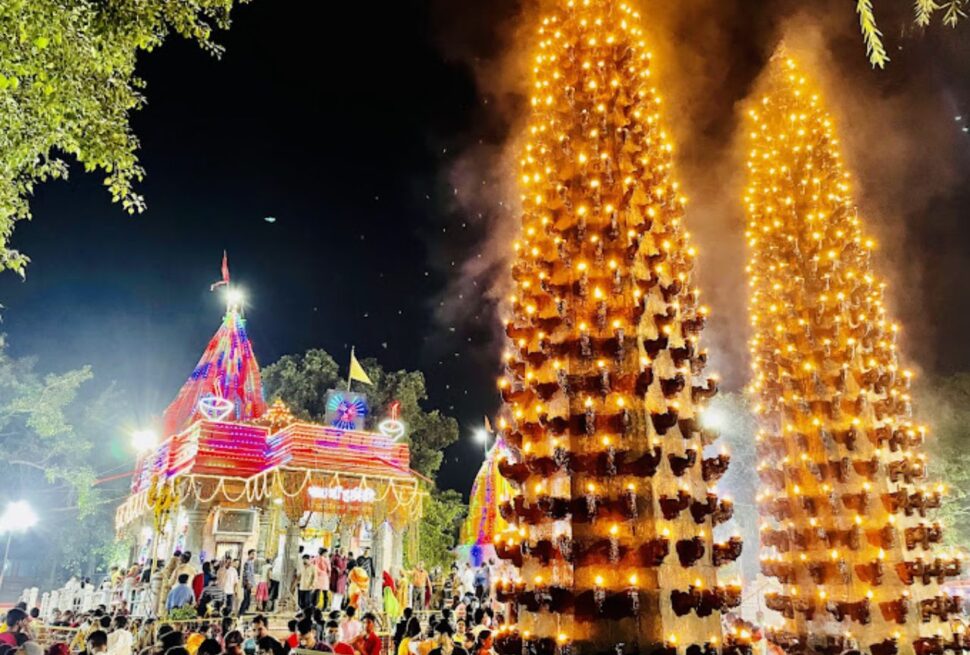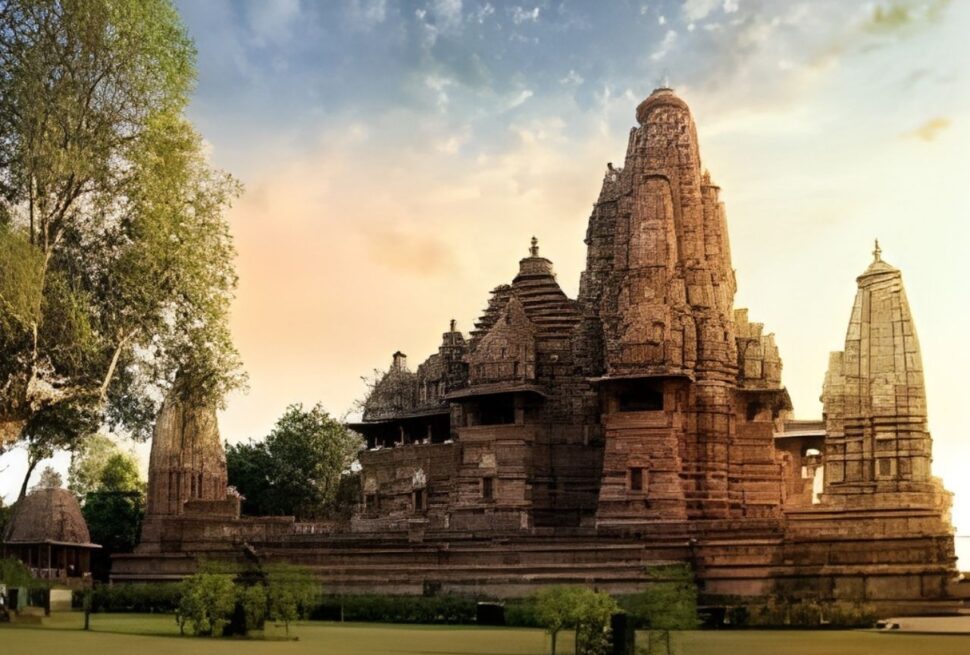
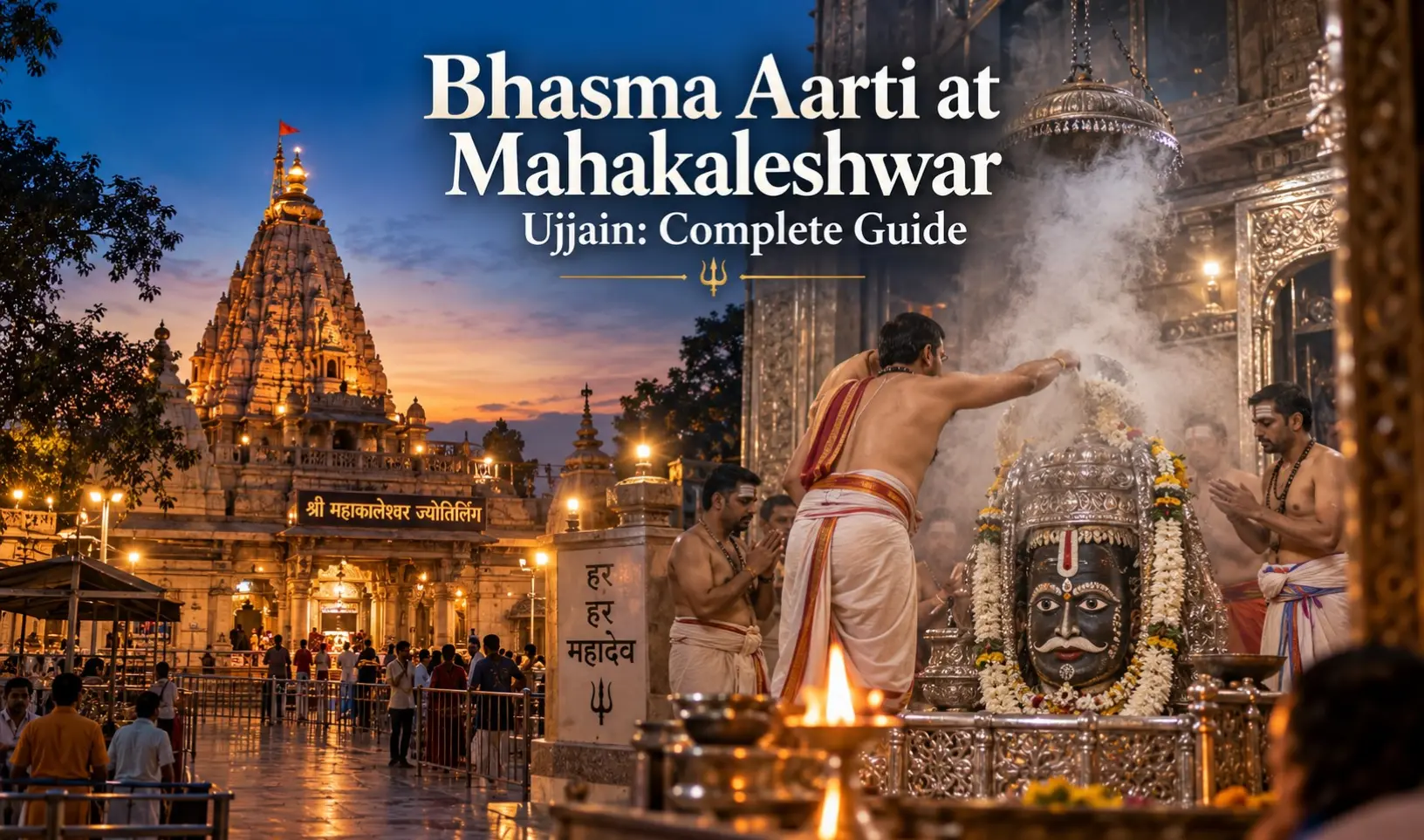
| Quick Answer — What Is Bhasma Aarti at Mahakaleshwar : Bhasma Aarti is the pre-dawn daily ritual at Shri Mahakaleshwar Jyotirlinga Temple, Ujjain, in which sacred ash (bhasma) is offered to the Shiva Lingam. It is performed every morning between 4:00 AM and 6:00 AM by authorised sanyasis of Shri Panchayati Akhada Mahanirvani — unique among all twelve Jyotirlingas. Mahakaleshwar is the only south-facing (Dakshinamukhi) Jyotirlinga, representing Shiva as the lord of time (Kala) and death. The ritual sequence: Jalabhishek → Panchamrit Abhishek → decoration with sandalwood and flowers → sacred Bhasma offering → lamp Aarti → devotee darshan. The ash is prepared from the temple’s sacred fire tradition — burnt cow-dung cakes and sacred woods. From Indore, Ujjain is 55 km (1–1.5 hrs). MP Vacation Indore coordinates Bhasma Aarti tours: +91-7898355153. |
Before the Ritual: What Happens in Ujjain at 3 AM
While Indore sleeps — while most of Madhya Pradesh sleeps — Ujjain wakes up. Not loudly. Not the way a city wakes up for a festival, with noise and colour. This waking is different. Before 3 AM, the lanes around Mahakaleshwar Temple begin to fill with pilgrims who arrived the previous evening and stayed near the temple specifically for this moment. Shopkeepers who sell marigold garlands and rudraksha beads open their shutters in the dark. The smell of agarbatti (incense) drifts from the narrow streets long before the sun is anywhere near the horizon.
At around 4:00 AM, the doors of Shri Mahakaleshwar Temple open for the Bhasma Aarti. Inside the underground sanctum — the Garbhagriha — a ritual is about to begin that has been performed in this city, at this site, in some form, for at least 1,600 years. Possibly much longer. The Kalidasa who described the sound of Bhasma Aarti drums floating through the night air of Ujjain in the fourth or fifth century CE was describing something already ancient in his time.
This is that ritual. This is its complete history, its mythology, its meaning, and the sequence of exactly what happens from the moment the temple doors open to the moment devoted pilgrims file out into the Ujjain dawn.
What Bhasma Aarti Is — The Definition That Actually Matters
Bhasma Aarti is not simply a morning prayer. It is a specific, compound ritual with distinct elements — each with individual significance — performed in a fixed sequence, by a specific organisation (the Mahanirvani Akhada), at a specific time (Brahma Muhurta — the pre-dawn hour considered most auspicious in Hindu tradition), at a specific place (the underground Garbhagriha of Mahakaleshwar Temple), and using a specific offering (sacred ash) that carries a theological weight unique in the twelve Jyotirlinga tradition.
The word Bhasma comes from Sanskrit and means sacred ash. It is also called vibhuti in wider Shaiva usage — the ash that Lord Shiva smears across his body in his ascetic form. Aarti is the act of ritual worship performed with lit lamps, accompanied by bells, conch, and devotional chanting. Together, Bhasma Aarti means: a ritual in which the primary offering to the deity is sacred ash, conducted with the ceremony of lamp worship.
| Bhasma | Sacred ash — from Sanskrit. Also called vibhuti. The physical substance that is both offering and symbol. |
| Aarti | Ritual worship with lit lamps, bells, and chanting. The ceremony in which Bhasma is offered. |
| Garbhagriha | The inner sanctum — the womb-chamber of the temple. The underground room where the Jyotirlinga resides and the ritual takes place. |
| Jyotirlinga | A manifestation of Shiva as a column of light. Twelve recognised in Hindu tradition — Mahakaleshwar is the only one in Madhya Pradesh and the only one facing south. |
| Brahma Muhurta | The pre-dawn period approximately 1.5 hours before sunrise. Considered the most auspicious time of day for prayer and ritual in Hindu tradition. |
| Dakshinamukhi | South-facing. Mahakaleshwar is the only south-facing Jyotirlinga among the twelve. South is the direction of Yama — the god of death. Shiva facing south means Shiva commands death. |
| Mahanirvani Akhada | Shri Panchayati Akhada Mahanirvani — the ascetic order authorised to perform the Bhasma Aarti. Not the resident temple priests. |
| Swayambhu | Self-manifested. The Mahakaleshwar Jyotirlinga is said to have manifested on its own — not installed by human hand. |
| “Long before Kalidasa wrote about it, long before the Puranas recorded it, the ash was being offered to Mahakal in the pre-dawn dark of Avantika. The ritual is older than its own documented history.” |
The History of Mahakaleshwar Temple — From Ancient Avantika to Today
The Ancient City — Avantika
Ujjain’s ancient name was Avantika, or Ujjaini. The Varaha Purana identifies Avantika as the nabhi — the navel or central point — of the earth. This was not merely a spiritual claim. Ancient Indian astronomical tradition placed the prime meridian of the earth through Ujjain — the reference point from which Indian astronomers calculated all coordinates, long before Greenwich was established as Europe’s reference meridian. The Ujjain meridian (75°46’E) was the zero longitude of Indian cartography for centuries. On the summer solstice at noon, a vertical pole in Ujjain casts no shadow — the sun is directly overhead.
This positioning — at what ancient science considered the earth’s centre — made Ujjain the most significant city in India for both astronomy and pilgrimage. The Skanda Purana identifies it as one of the Saptapuri — seven sacred cities where dying grants moksha (liberation from the cycle of rebirth). A city that was both the centre of the earth and a gateway to liberation was the natural home for Mahakal — the lord of time itself.
The Origin Legend — Shrikhar, Dushan, and the Manifestation of Mahakal
The most widely told origin story of Mahakaleshwar Temple involves a young Brahmin boy named Shrikhar, a faithful farmer’s son, and a demon named Dushan. According to the Avanti Khanda of the Skanda Purana, the city of Avantika was ruled by the devout King Chandrasena, a dedicated devotee of Lord Shiva. A demon king named Dushan had obtained a boon from Brahma granting him extraordinary power, and he began terrorising the people of Avantika, attacking and destroying their places of worship.
A young boy named Shrikhar, son of a farmer, had once seen King Chandrasena at prayer and been moved by the king’s devotion. Wanting to offer similar worship, Shrikhar gathered some stones at the city’s outskirts and began to pray fervently to Lord Shiva. When Dushan’s armies attacked, the devotees prayed desperately for divine protection. Lord Shiva responded — manifesting in his Mahakal form (the lord of time, the destroyer) — and annihilated Dushan and his forces. The devotees then asked Lord Shiva to remain permanently in Avantika as their protector. Shiva agreed, establishing his permanent residence as Mahakaleshwar.
The Puranas also link the site to Goddess Parvati’s penance — identifying Ujjain as the location where Parvati performed tapas (intense meditation) to win Lord Shiva as her husband. The Varaha Purana goes further, stating that Mahakaleshwar exists at the very nabhi of the earth, making Ujjain’s Jyotirlinga the primordial axis around which the divine world turns.
Plan Your Ujjain Journey With Us – Ujjain 2 Day Itinerary with Mahakaleshwar & Bhasma Aarti
Historical Records — From the 6th Century BCE to Kalidasa
The Mahakaleshwar Temple’s historical record — distinct from its mythological record — is extensive and old. Historical sources indicate that in the 6th century BCE, King Chandapradyot of Ujjain appointed his son Kumar Sena to oversee the temple’s administration. Coins from Ujjain dating to the 4th–3rd century BCE carry the figure of Lord Shiva — placing active Shiva worship in Ujjain at least 2,300 years ago.
The most celebrated ancient literary reference comes from Kalidasa — widely regarded as the greatest Sanskrit poet — who described Ujjain in his poem Meghaduta (The Cloud Messenger) with the precision of a resident. He calls the city the jewel of the earth and specifically describes the sound of the Bhasma Aarti drums floating through the night air as the ceremony begins. Kalidasa is dated to approximately the 4th–5th century CE, placing active Bhasma Aarti worship at Mahakaleshwar at least 1,600 years ago. The ritual he described was clearly, by his own account, already a well-established and famous feature of the city.
The temple appears in the Skanda Purana’s Avanti Khanda, the Shiva Purana, the Matsya Purana, the Varaha Purana, and the Kalika Purana — five of Hinduism’s most authoritative texts. By the 10th century, during the reign of the Paramara kings of Malwa, the temple had reached what contemporary literature described as its peak of architectural beauty and pilgrimage significance.
Destruction and 500 Years of Waiting — 1235 CE
In 1234–35 CE, Sultan Shams-ud-Din Iltutmish of the Delhi Sultanate invaded the Malwa region. His army reached Ujjain — one of India’s most sacred and significant cities — and demolished the Mahakaleshwar Temple, which at that point had been a functioning pilgrimage centre for at least 1,600 documented years. The Persian historian Minhaj-i-Siraj recorded the attack in Tabaqat-i-Nasiri. The Jyotirlinga was desecrated and thrown into a neighbouring pond, subsequently named Kotiteerth Kund.
The temple structure lay in ruins for nearly 500 years. The site remained a powerful spiritual point for Hindu devotees throughout this period — the Jyotirlinga was eventually recovered from Kotiteerth Kund, and private worship continued at the site — but the public temple and its formal ritual structure were effectively suspended for five centuries.
The Maratha Reconstruction — 1734 CE
The restoration of Mahakaleshwar Temple began in the early 18th century when the Maratha Empire established control over Malwa. Around 1728 CE, Peshwa Bajirao I appointed Ranoji Rao Scindia (also written Ranoji Shinde) as administrator of the Ujjain region. Ranoji Rao’s Diwan — administrative officer — was Ramchandra Baba Shenvi, a deeply devout man who decided to invest his personal wealth in rebuilding Mahakaleshwar Temple.
Plan Your Ujjain Journey With Us – Mahakaleshwar Temple Guide – Bhasma Aarti & Timings
The reconstruction was largely completed between 1732 and 1736 CE — approximately 500 years after Iltutmish’s destruction. The current structure of Mahakaleshwar Temple dates from this Maratha-era reconstruction: a five-storied structure in a blend of Maratha, Bhumija, and Chalukya architectural styles, with a high tiered shikhara, ornate balconies, and massive colonnaded halls. Following Ranoji Scindia, the Holkar and Scindia dynasties made further contributions to the temple’s maintenance.
After Indian independence in 1947, administration passed to the Mahakaleshwar Dev Sthan Trust and subsequently to the Ujjain collectorate office. The recently constructed Mahakal Lok Corridor — a 900-metre pilgrim corridor with 200+ statues depicting scenes from the Shiva Purana — represents the most significant development since the Maratha reconstruction.
| 6th century BCE | King Chandapradyot of Ujjain appoints Kumar Sena to oversee temple administration |
| 4th–3rd century BCE | Coins from Ujjain carry figure of Lord Shiva — Shiva worship confirmed at this date |
| 4th–5th century CE | Kalidasa describes Bhasma Aarti drums in Meghaduta — ritual confirmed active |
| 10th century CE | Paramara kings of Malwa — temple at architectural peak |
| 1234–35 CE | Sultan Iltutmish destroys temple · Jyotirlinga thrown into Kotiteerth Kund |
| 1234–1734 CE | 500 years — site remains sacred but formal temple in ruins |
| 1732–1736 CE | Ranoji Rao Scindia / Ramchandra Baba Shenvi rebuild temple in Maratha style |
| 1947 CE | Administration transferred to Mahakaleshwar Dev Sthan Trust post-independence |
| 2022 CE | Mahakal Lok Corridor inaugurated — 900 metre pilgrim corridor with 200+ Shiva Purana statues |
Why Mahakaleshwar Is Called Mahakal — The Theology of Time
The name Mahakaleshwar requires more than translation. Maha means great. Kala means time — and also death, because in Sanskrit the word for the deity of death (Yama) is also Kala, and in Hindu philosophy time and death are aspects of the same cosmic truth. Mahakal is therefore not merely ‘great time’ — it is Shiva in his identity as the one who governs and transcends time itself, who is lord over both the passage of time and the finality of death.
This theology is expressed architecturally in Mahakaleshwar’s most distinctive characteristic: it is the only south-facing (Dakshinamukhi) Jyotirlinga among the twelve. In Hindu cosmology, the south direction belongs to Yama — the lord of death. By facing south, Mahakal does not merely acknowledge death but commands it. The Jyotirlinga faces the direction of death and asserts dominion over it. The deity who governs time faces the direction of time’s ultimate expression — mortality — and exercises authority over both.
| “At 12 noon on June 21st, a vertical pole in Ujjain casts no shadow. The sun is directly overhead. Time, here, stands still. And its lord is Mahakal.” |
This is why the Bhasma Aarti — an offering of ash, representing the end state of all physical matter — is performed at this specific temple and not at the others. Ash is what remains after time has finished with a physical form. Offering ash to Mahakal — the lord of time — is the precise and logical act of acknowledging time’s sovereignty over all material things, while simultaneously worshipping the one who stands beyond it.
The Theology of Bhasma — Why Ash, Not Flowers
Most Hindu temple worship uses offerings of flowers, milk, honey, and incense — substances associated with purity, nourishment, and the senses. The Bhasma Aarti uses ash. This distinction is not incidental — it is the entire point.
Ash in Shaiva Tradition
In Shaiva tradition, Shiva is the ultimate ascetic — the being who renounces all material attachment, who dwells in cremation grounds, who smears his body with ash from funeral pyres. The ash is not a symbol of death in the morbid sense. It is a symbol of what remains when all illusion (maya) has been burned away. All material things — bodies, possessions, identities, ambitions — are temporary. Fire consumes them. Ash is what endures: the inert truth beneath the appearance of substance.
When a Shaiva ascetic smears ash on his body, he is enacting this understanding: I am not this body, not these possessions, not this identity. I am what remains when all of that burns. Ash is, in this framework, the most honest substance — it has already passed through transformation and can deceive no one about its nature.
Why Ash at Mahakaleshwar Specifically
The ash offering at Mahakaleshwar is theologically appropriate in a way it would not be at any other Jyotirlinga. Mahakal is the lord of time. Time transforms all things into ash. Offering ash to Mahakal is offering the god of time the product of time’s work — it is returning to the deity the precise substance that his domain produces. The ritual is not arbitrary. It is a coherent theological statement enacted through an ancient ceremony.
The Ash Used Today — Sacred Fire Tradition
A persistent legend holds that the ash used in the Bhasma Aarti was historically sourced from cremation grounds — reflecting Shiva’s identity as the ascetic of the cremation ground. Current documentation consistently describes the ash used today as prepared through the temple’s own sacred fire tradition: from the continuously burning Dhuni (sacred fire) and/or freshly prepared from burnt cow-dung cakes and sacred woods including Gohari, Peepal, Palash, Shami, and Bel — under the authority of the Mahanirvani Akhada. The symbolic resonance is maintained while the actual practice follows the temple trust’s established procedure.
| Ash as symbol | The final state of all matter — what remains when time has finished its work |
| Ash and Shiva | Shiva smears ash on his body — symbol of renunciation, transcendence of material identity |
| Ash at Mahakal | Offering the product of time (ash) to the lord of time (Mahakal) — theologically complete |
| Sacred woods used | Gohari, Peepal, Palash, Shami, Bel — each with specific ritual significance in Shaiva tradition |
| Sacred fire | Dhuni — the continuously burning sacred fire maintained at the temple under Mahanirvani Akhada authority |
| Applied to | The Shiva Lingam (Jyotirlinga) — the form of Shiva worshipped at Mahakaleshwar |
The Role of Mahanirvani Akhada — Who Performs the Ritual
One of the most distinctive features of Bhasma Aarti at Mahakaleshwar is that it is not performed by the temple’s resident priests alone. The sacred ash offering is conducted by authorised sanyasis (ascetics) of Shri Panchayati Akhada Mahanirvani — one of the major Shaiva ascetic orders in India, with roots in the Dashanami Sampradaya tradition attributed to Adi Shankaracharya.
The Akharas are ancient institutions — monastic orders that have preserved specific ritual traditions, ascetic practices, and doctrinal lineages across centuries. Their presence at Mahakaleshwar in the specific role of Bhasma Aarti conductors is not ceremonial — it is a live expression of the same institutional tradition that has maintained this ritual across a documented minimum of 1,600 years, through the temple’s periods of active function. The resident temple priests coordinate and assist, but the ash offering itself is the Akhada’s responsibility.
This is why the Bhasma Aarti is called unique among the twelve Jyotirlingas — it is not just the ash that makes it distinct, but the combination: daily, at Brahma Muhurta, at the only south-facing Jyotirlinga, performed by an Akhada, using ash from a sacred fire tradition, in the underground sanctum where the Swayambhu (self-manifested) Jyotirlinga resides. No other Jyotirlinga has this combination.
The Complete Ritual Sequence — What Actually Happens
The Bhasma Aarti follows a fixed sequence that has been documented across multiple temple sources, news reports of individual ceremonies, and pilgrimage guides. Here is the complete sequence from temple opening to post-aarti darshan:
Stage 1 — Temple Opening and Priest Purification (Pre-4 AM)
Before the doors open, the priests perform their own ritual purification — achamana (internal cleansing through sipping of water with mantras), pranayama (breath regulation), and specific tantric purification practices that prepare them for entry into the Garbhagriha. This is not visible to devotees — it happens inside the sanctum before the doors open.
On standard days, the temple doors open at approximately 4:00 AM. On Shravan Mondays, major festivals, and Mahashivratri, doors may open as early as 2:30 AM to manage the significantly larger devotee volume. The Bhasma Aarti follows a Tantric-Shaiva worship pattern (as opposed to the Vedic-Agamic pattern of some other Jyotirlingas) — the ritual includes both Vedic mantras and Tantric elements.
Stage 2 — Ganesh Vandana and Guru Vandana
The ritual opens with the invocation of Lord Ganesha — Ganesh Vandana — to remove obstacles from the ceremony. This is standard practice in Hindu rituals, which begin with Ganesha as the deity of beginnings and obstacle-removal. Guru Vandana follows — salutations to the spiritual lineage and the tantric masters who have preserved this tradition across generations, acknowledging the chain of transmission through which the ritual has survived.
Stage 3 — Jalabhishek
The first physical act of the ritual is Jalabhishek — the sacred water bath. The Jyotirlinga is bathed with holy water — Gangajal (water from the Ganga) is traditionally used. The sound of water on the Jyotirlinga, accompanied by Vedic chanting and temple bells, begins to fill the underground sanctum. Devotees present in the Garbhagriha for this stage have approximately five minutes, after which they are asked to vacate so the next stage can proceed with only the authorised priests and Akhada representatives.
Stage 4 — Panchamrit Abhishek
After Jalabhishek, the Panchamrit Abhishek is performed — the bathing of the Jyotirlinga with Panchamrit, the five-nectar mixture of milk, curd, honey, ghee, and sugar. Each of the five substances carries specific symbolic significance. Milk represents purity. Curd represents nourishment and transformation (raw milk becomes curd through a process of change). Honey represents sweetness and the effort of sustained practice. Ghee (clarified butter) represents the essence extracted from a substance through purification. Sugar represents joy and the fruit of spiritual practice. Together, the five substances represent the complete range of offerings a devotee can make.
The Panchamrit is poured over the Lingam while Vedic mantras are chanted — the liquid runs down the Jyotirlinga and is collected in the Kund (sacred well) below. This Panchamrit, sanctified by contact with the Jyotirlinga, becomes prasad — the blessed substance that carries divine grace. After the Bhasma Aarti concludes, no Panchamrit is distributed — the rules state clearly that after the Garbhagriha is closed post-Bhasmarti, no devotee shall give or receive Panchamrita.
Stage 5 — Shringar (Decoration)
After the Panchamrit bath, the Jyotirlinga is cleaned and decorated — Shringar, or divine adornment. On an ordinary day, the decoration includes sandalwood paste (chandan), fresh flowers, Bilva leaves (the leaf most sacred to Shiva), and fragrant garlands. On special occasions — Shravan Mondays, Mahashivratri, Simhastha — the decoration is elaborate: silver crescent-trishul crowns, silver Sheshnag mukut (serpent crown), silver mundmal (garland of skulls), rudraksha garlands, fragrant floral malas, bhang, and dry fruits. The Tripund tilak — three horizontal lines of sacred ash on the forehead of the Jyotirlinga — is applied, representing the three aspects of Shiva’s cosmic function.
The adornment of Lord Mahakal for the Bhasma Aarti has been described repeatedly in temple news reports as the revelation of the deity’s divine form (Swaroop darshan) — the moment when the fully adorned Jyotirlinga becomes visible to devotees in the flickering lamplight of the underground sanctum. This is considered by many pilgrims to be the most emotionally powerful moment of the entire ceremony.
Stage 6 — The Bhasma Offering
The central act of the ritual: the sacred ash (bhasma) is offered to the decorated Jyotirlinga by the authorised sanyasis of the Mahanirvani Aarti. The bhasma is prepared under the Akhada’s authority — from the sacred fire tradition — and is applied to the Lingam while specific tantric mantras are chanted. According to the temple tradition, after the offering of bhasma, Lord Mahakal grants darshan to devotees in his manifested, tangible form — making this the ritual’s spiritual culmination.
The application of ash to the fully adorned silver and flower-decorated Lingam creates a visual that carries the entire theological statement of the ritual: the deity of time, adorned in silver and marigold, receiving the offering of ash — the product of time — in a room lit only by oil lamps, beneath a city that was worshipping here 1,600 years ago and almost certainly longer.
Stage 7 — Camphor Aarti
Following the Bhasma offering, the lamp Aarti is performed — the ritual waving of lit lamps in a circular motion before the deity. At Mahakaleshwar, camphor lamps are used for the Aarti, filling the underground sanctum with the distinctive, clean-burning light and fragrance of camphor. The Aarti is accompanied by the rhythmic sounds of cymbals (manjiras), damru (the hourglass-shaped drum associated with Shiva), and conch shells. Nandi Maharaj — the sacred bull, Shiva’s vehicle and guardian — is also ritually bathed and worshipped during this stage.
The camphor Aarti concludes the formal ritual sequence. Camphor burns completely without leaving residue — like the human ego, it is said, which should be offered completely to the divine without remainder.
Stage 8 — Devotee Darshan
After the Bhasma Aarti ritual concludes, devotees with valid bookings are admitted for darshan — the sacred viewing of the deity. At the first bell of Lord Mahakal, devotees enter the Garbhagriha. The darshan time is limited — approximately five minutes per group — as the main morning darshan for general devotees begins immediately after. Devotees who have attended the complete Bhasma Aarti from Stage 1 have already witnessed the ritual in full; the post-aarti darshan gives them a final close viewing of the adorned Jyotirlinga before the general public enters.
| Pre-4 AM | Priest purification — achamana, pranayama, Tantric preparation inside sanctum |
| 4:00 AM (approx) | Temple doors open for Bhasma Aarti devotees · Devotees seated in Garbhagriha |
| Stage 1 | Ganesh Vandana + Guru Vandana — invocation and lineage acknowledgment |
| Stage 2 | Jalabhishek — sacred water bath of the Jyotirlinga (Gangajal) · 5 min · Devotees present |
| Stage 3 | Panchamrit Abhishek — five-nectar bath (milk, curd, honey, ghee, sugar) · Vedic chanting |
| Stage 4 | Shringar — decoration with sandalwood, flowers, Bilva, rudraksha, bhang, Tripund tilak |
| Stage 5 | Bhasma offering — sacred ash applied by Mahanirvani Akhada sanyasis · Tantric mantras |
| Stage 6 | Camphor Aarti — lamp ceremony with cymbals, damru, conch · Nandi worshipped |
| ~6:00 AM | Devotee darshan at first bell · Limited time per group · Main morning darshan begins |
The Temple Structure — Understanding What You Are Entering
The Mahakaleshwar Temple that devotees enter today is the Maratha-era structure completed in the 1730s, built on the foundation of the ancient sacred site. It is a five-storied complex in a blend of Maratha, Bhumija, and Chalukya architectural styles. The underground sanctum where the Bhasma Aarti takes place is unique in Indian temple architecture — most Jyotirlinga sanctums are at ground level. Here, the Garbhagriha is below ground.
| Ground Level (Bhooloka) | Mahakaleshwar Jyotirlinga — the primary shrine. All Bhasma Aarti rituals are performed here. Underground sanctum with direct access to the Jyotirlinga. |
| First Floor (Patalaloka) | Omkareshwar Shiva — the middle tier, representing the primordial sound of the universe. |
| Top Floor (Akashaloka) | Nagchandreshwar Maharaj shrine — accessible only once a year on Nagpanchami day. |
| Koti Tirtha Kund | Large sacred tank in the temple complex, built in sarvatobhadra style. The same kund into which the Jyotirlinga was thrown during Iltutmish’s 1235 CE destruction. |
| Mahakal Lok Corridor | Recently completed 900-metre pilgrim corridor with 200+ statues depicting Shiva Purana scenes. Inaugurated 2022. |
| Architectural Style | Maratha + Bhumija + Chalukya blend. High tiered shikhara, ornate balconies, colonnaded halls. |
The Spiritual Experience — What Devotees Consistently Report
Beyond the historical and theological explanation, a large body of firsthand accounts from pilgrims who have attended the Bhasma Aarti consistently describes a quality of experience that is difficult to attribute to any single element of the ritual but seems to emerge from their combination: the pre-dawn timing, the underground darkness, the sound of mantras and bells, the sight of the adorned Jyotirlinga in lamplight, and the knowledge that this same ceremony has been happening in this same place for more than a millennium.
The period just before the aarti begins — when the priests are preparing, the lamps are lit, and the early devotees sit in complete silence in the underground sanctum — is consistently described as one of the most profoundly peaceful experiences of a devotee’s life. The complete absence of photography equipment (no phones, no cameras) — enforced by temple staff — eliminates the usual modern impulse to document and creates something rare: a large gathering of people who are all, without exception, simply present.
The smell of sandalwood and camphor in a confined underground space, the sound of the damru and bells amplified by stone walls, the visibility of the Jyotirlinga by lamplight rather than electric light — these create a sensory environment that is both ancient and immediate. Pilgrims from across India and abroad — including many who are not regular temple-goers — describe the Bhasma Aarti as a reset, a perspective-restoring experience in a way that ordinary daily life rarely provides.
Bhasma Aarti and Simhastha 2028 — The Once-in-12-Years Conjunction
The Bhasma Aarti is performed every day, 365 days a year. But its significance is amplified exponentially during Simhastha — the Kumbh Mela held at Ujjain every 12 years, triggered when Jupiter enters Leo (Simha Rashi). Simhastha 2028 runs from 27 March to 27 May 2028, with three Amrit/Shahi Snan dates: 9 April, 23 April, and 8 May 2028.
During Simhastha, the Bhasma Aarti at Mahakaleshwar takes on additional gravity. Crores of pilgrims arrive in Ujjain for the Shahi Snan on the Kshipra River — and many of them specifically add a Bhasma Aarti visit to their Simhastha pilgrimage, creating the most spiritually charged conjunction that Ujjain experiences in a 12-year cycle. The Mahakaleshwar Jyotirlinga — the only such temple in Ujjain, the city that is also the Kumbh Mela venue — becomes the intersection of two of Hinduism’s most significant ritual traditions simultaneously.
| MP Vacation Indore is already coordinating Simhastha 2028 Bhasma Aarti packages from Indore for all three Shahi Snan dates. Book early — transport, hotel near the temple, and Ujjain circuit planning for Simhastha Bhasma Aarti visits. Call +91-7898355153. |
Planning Your Bhasma Aarti Visit from Indore
Indore is the most natural starting point for a Bhasma Aarti visit — 55 km from Ujjain, approximately 1 to 1.5 hours by road on the new highway. The proximity means Indore residents can technically do a same-day Bhasma Aarti visit — departing at approximately 2:00–2:30 AM and returning by early afternoon. For families with elderly members or children, the overnight stay in Ujjain the night before is considerably more comfortable.
MP Vacation Indore has been coordinating Ujjain Bhasma Aarti trips from Indore since 2013. The service covers what logistics actually require for this visit: a driver who knows the Indore–Ujjain highway at 2 AM, who knows the parking situation at Mahakaleshwar in the pre-dawn hours, and who can plan the full Ujjain circuit for the day after the aarti concludes — Mahakal Lok Corridor, Harsiddhi Shakti Peeth, Kal Bhairav, Sandipani Ashram, and Ram Ghat Sandhya Aarti.
| Indore to Ujjain | 55 km · 1–1.5 hours by road on new highway |
| Departure for Bhasma Aarti (same-day) | Approximately 2:00–2:30 AM from Indore |
| Overnight stay option | Stay in Ujjain the evening before — recommended for families and senior pilgrims |
| Post-aarti circuit | Mahakal Lok · Harsiddhi Shakti Peeth · Kal Bhairav · Sandipani Ashram · Ram Ghat Sandhya Aarti |
| MP Vacation service | Private AC vehicle · Driver experienced on 2 AM Indore–Ujjain run · Hotel near Mahakaleshwar if overnight |
| Booking Bhasma Aarti pass | Official portal: shrimahakaleshwar.mp.gov.in · 30 days advance · MP Vacation assists with planning, not the booking itself |
| Contact | WhatsApp or call +91-7898355153 |
Frequently Asked Questions — Bhasma Aarti at Mahakaleshwar
Q: What is the history of Bhasma Aarti at Mahakaleshwar?
A: Bhasma Aarti at Mahakaleshwar has a documented history of at least 1,600 years — the Sanskrit poet Kalidasa (4th–5th century CE) described the sound of Bhasma Aarti drums in his poem Meghaduta. The ritual is rooted in Shaiva ascetic tradition and the Mahakaleshwar Temple itself is mentioned in the Skanda Purana, Shiva Purana, Varaha Purana, and Matsya Purana. The Mahanirvani Akhada has been the performing authority through the temple’s documented active periods.
Q: Why is Bhasma (ash) offered at Mahakaleshwar and not at other Jyotirlingas?
A: Bhasma is offered at Mahakaleshwar because the temple’s theology is specifically about Shiva as Mahakal — the lord of time and death. Ash represents what remains after time finishes with any physical form — the ultimate product of time’s work. Offering ash to the lord of time is a precise theological act: returning the product of the deity’s domain back to the deity. Mahakaleshwar is also the only south-facing Jyotirlinga, facing the direction of Yama (god of death), reinforcing this theological identity.
Q: What is the significance of Mahakaleshwar being Dakshinamukhi (south-facing)?
A: Mahakaleshwar is the only south-facing Jyotirlinga among the twelve. In Hindu cosmology, the south direction belongs to Yama — the god of death and time. By facing south, Shiva as Mahakal asserts dominion over death itself — the lord of time faces time’s ultimate expression and commands it. According to the scriptures, the Mahakaleshwar Shivling facing south signifies that even death here depends on the command of Shiva.
Q: Who performs the Bhasma Aarti at Mahakaleshwar?
A: The Bhasma Aarti is performed by authorised sanyasis of Shri Panchayati Akhada Mahanirvani — one of the major Shaiva ascetic orders in India. The resident temple priests assist with coordination and the broader ritual, but the sacred ash offering is the Mahanirvani Akhada’s specific responsibility. No devotee enters the inner sanctum during the ash offering — it is witnessed from designated seating.
Q: Is the Bhasma Aarti at Mahakaleshwar unique among the 12 Jyotirlingas?
A: Yes — Bhasma Aarti in this specific form is unique to Mahakaleshwar among the twelve Jyotirlingas. The combination of elements is found nowhere else: a daily pre-dawn ash offering, performed by an authorised Akhada, at the only south-facing Jyotirlinga, in an underground sanctum, using ash from a sacred fire tradition. While vibhuti (ash) is used in Shaiva worship generally, this specific daily Akhada-administered temple ritual is not found at any other Jyotirlinga.
Q: What is the connection between Bhasma Aarti and Simhastha 2028?
A: Simhastha 2028 (27 March – 27 May 2028) is the Kumbh Mela held at Ujjain every 12 years. During Simhastha, the Bhasma Aarti at Mahakaleshwar carries amplified significance — it is the conjunction of the daily Jyotirlinga ritual with the 12-yearly Kumbh Mela at the same city. Many pilgrims combine their Simhastha Shahi Snan visit with a Bhasma Aarti. MP Vacation Indore is coordinating Simhastha 2028 Bhasma Aarti packages from Indore. Call +91-7898355153.
Q: How can I visit Bhasma Aarti at Mahakaleshwar from Indore?
A: Indore is 55 km from Ujjain — approximately 1 to 1.5 hours by road. Same-day Bhasma Aarti visit from Indore requires departing at approximately 2:00–2:30 AM. For families and senior pilgrims, an overnight stay in Ujjain is recommended. MP Vacation Indore provides private AC vehicle, hotel near Mahakaleshwar, and the full Ujjain circuit plan for all Bhasma Aarti visit packages from Indore. WhatsApp or call +91-7898355153. Note: Bhasma Aarti registration must be done personally at shrimahakaleshwar.mp.gov.in — not through any travel agent.
Q: What is Kalidasa’s reference to Bhasma Aarti?
A: The Sanskrit poet Kalidasa — regarded as ancient India’s greatest literary figure — described Ujjain and the Mahakaleshwar Temple in his celebrated poem Meghaduta (The Cloud Messenger), written in approximately the 4th–5th century CE. He specifically describes the sound of Bhasma Aarti drums floating through the night air of the city. This literary reference places active Bhasma Aarti worship at Mahakaleshwar at least 1,600 years ago — and since Kalidasa was describing it as a well-known feature of the city, the practice was clearly established long before his time.
| Visit Bhasma Aarti at Mahakaleshwar with MP Vacation Indore Ujjain is 55 km from Indore. MP Vacation Indore provides private AC vehicle from your Indore address, hotel near Mahakaleshwar if overnight stay is preferred, and the full Ujjain circuit plan for after the Bhasma Aarti — Mahakal Lok, Harsiddhi, Kal Bhairav, Sandipani Ashram, Ram Ghat Sandhya Aarti. We help you plan and coordinate the visit. The Bhasma Aarti pass registration must be done at shrimahakaleshwar.mp.gov.in — we guide you through the process. WhatsApp or call +91-7898355153 · Mon–Sat 8 AM–9 PM · Plot No. 170, Scheme No. 113, Near Brilliant Convention Centre, Indore 452010. |